
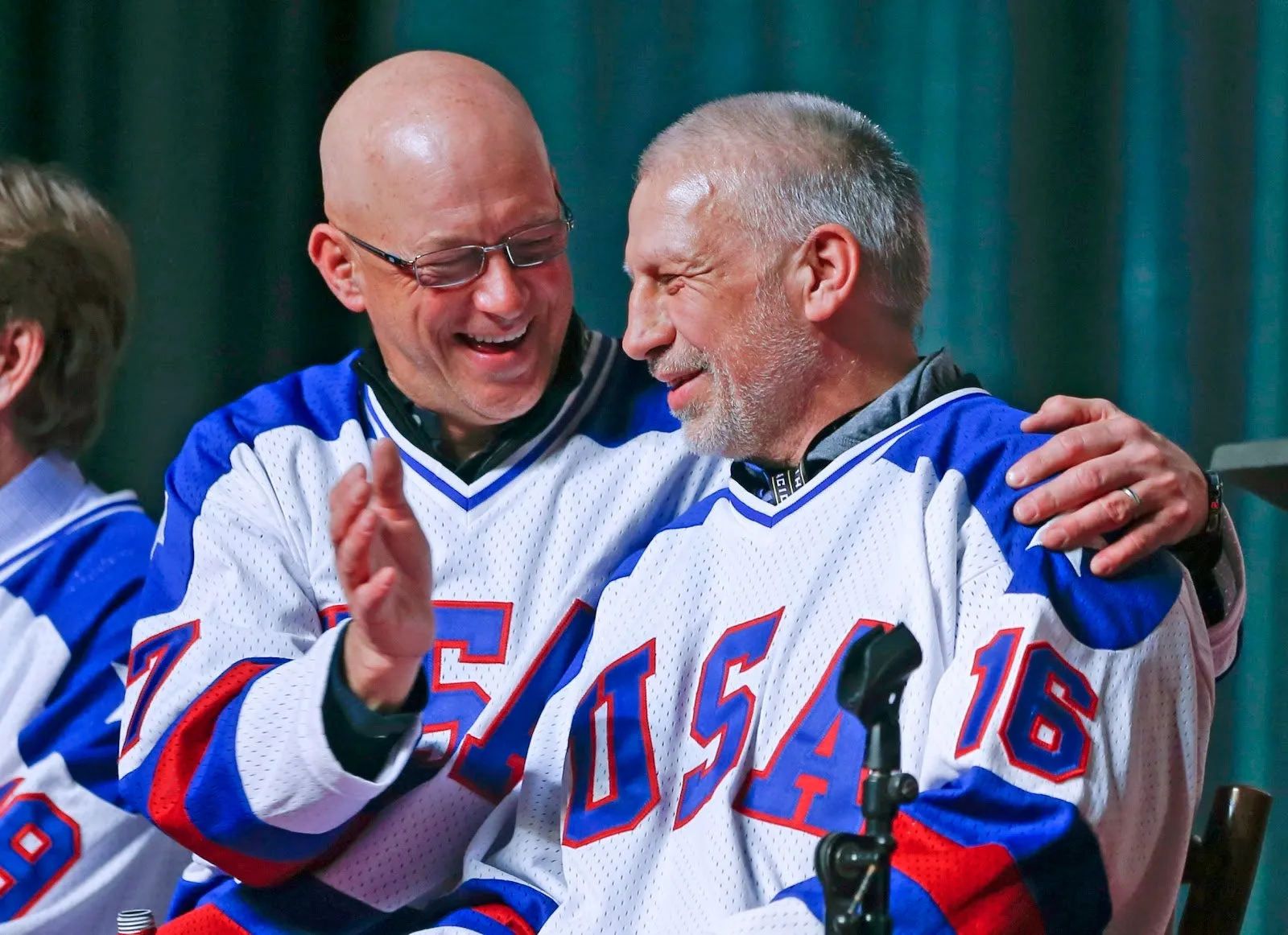
As the US Men’s Olympic Hockey Team was dominating opponents on their way to a surprise gold medal, you did not hear the name Mark Pavelich mentioned often during their two-week run. Which is a shame because he was a key member of Herb Brooks’ coached team that shocked the Soviets and then defeated Finland at the 1980 Lake Placid Winter Olympics.
Pavelich was a quiet, unassuming guy who was not out for the fanfare. He was a hockey “rink rat” who played every shift with heart and determination. But his demeanor is not the reason that his name is not up in lights like his teammates Mike Eruzione, Jim Craig, and Mark Johnson. Mark Pavelich’s last years were spent in a world crashing around him, which eventually ended in tragedy.
Mark Pavelich’s Early Life and Pre-Olympic Years
Mark Pavelich was born in the Iron Range town of Eveleth, Minnesota, to Croatian immigrant parents. He was a star performer on the ice for Eveleth High School and then took his talents to the University of Minnesota Duluth, where he played for three years with the Bulldogs.
His Eveleth linemate, Ron Tomassoni, said this about Pavelich’s high school playing days. “He was just a great skater. He just always saw the ice so well. Mark was extremely creative and extremely strong. He had that low center of gravity. It was difficult to get a piece of him because he was so quick and so fast.”
Pavelich accumulated 142 points in 110 games as a centerman for UMD. In his final season, he tallied 31 goals and 48 assists for 79 points, all school records at the time. He earned All-American and All-Western Collegiate Hockey Association first team honors in 1978-79. He skipped his final season at UMD to play for the US National Team. Pavlich had a solid season for the national team, scoring 15 and adding 30 assists in 53 games. Due to his performance, Mark was named to the 1980 US Men’s Olympic Hockey Team.
Miracle on Ice

The Soviet Union’s Men’s Hockey Team entered the Lake Placid Olympics as the heavy favorites to win the gold medal. They had soundly defeated a team of NHL All-stars the previous year in the Challenge Cup and had destroyed the US team 10-1 at Madison Square Garden right before the start of the Olympics. They were professional men playing college players. Czechoslovakia was considered the favorite for the silver medal. Sweden and the US would be left to fight it out for the bronze.
And the Americans almost blew their chances for a medal in their very first game. With under 30 seconds left, it appeared Sweden would defeat the US 2-1. But with 27 seconds left in the contest, US defenseman Bill Baker launched a slap shot from inside the blue line that would elude the Swedish goaltender. The match would end in a 2-2 tie. Next, Pavelich, now playing on the “Conehead Line” with fellow “Rangers” Buzz Schneider and John Harrington, would score a clutch goal in the US’s 7-3 upset win over Czechoslovakia.
The Americans rolled past Norway and Romania and came back to defeat West Germany, setting the stage for their rematch with the Soviets in a semifinal game at the Olympics. With just over 10 minutes remaining in the game, the two teams were locked in a 3-3 tie. Pavelich was a catalyst for the Americans’ game-winning goal. After taking a pass from his linemate Harrington, he lifted a perfect pass to team captain Eruzione, who fired the puck past Soviet goaltender Vladimir Myshkin for a 4-3 lead.
They would hang in the final 10 minutes to defeat the Soviets 4-3 in one of the biggest upsets in sports history. “Do you believe in Miracles?” Two days later, after trailing Finland for most of the game, the Americans took home the gold, scoring three goals in the third period to defeat the Finns 4-2. Pavelich had an outstanding tournament, scoring one goal and adding six assists.
NHL
After not being drafted after the Olympics, Pavelich spent a season with HC Lugano in Switzerland, and returned to the US National Team for the 1981 Ice Hockey World Championships. But as fortune would have it, Herb Brooks was hired as the head coach of the NHL’s New York Rangers, and he asked Mark to come on board.
And he flourished with the Rangers, scoring 133 goals and 185 assists in 341 games. In his second season in New York, Pavelich became the first American player to score five goals in a game against the Hartford Whalers. But his tenure with the Rangers ended badly when a dispute arose with his new coach, Ted Sator, and Pavelich was let go by the team. After bouncing around the NHL and the European League for the next three years, Mark hung up the skates for good in 1992.
Later Life
After Mark’s retirement, he married the former Kara Burmachuk, and they settled into a peaceful life in the woods of Lutsen, Minnesota. These were happy times for Pavelich and his new wife as they began building their dream home on Deeryard Lake.
When they weren’t working on the house, Mark fished while Kara worked on her paintings. Friends would stop by, as well as Pavelich’s daughter (Tarja) from his first marriage. The work on the house went slowly, but they were living the perfect life until the morning of September 6, 2012.
That morning, Mark found Kara lying on the ground beneath a balcony. She apparently had fallen off the deck that was missing a railing, hit her head, and died a short time later. The death seemed suspicious to some, but this only added to Mark’s grief and anguish at the loss of the love of his life. Pavelich went into a deep depression and withdrew from contact with almost everyone. Sadly, during this gray period, Pavelich put his Olympic gold medal up for auction, where it finally sold in May 2014 for $262,900.
The only solace he found during these years was his work on completing the house, escaping to a fishing cottage he had built in Idaho as a getaway spot, and his twice-weekly phone calls with his father-in-law. He rarely attended any of the Miracle on Ice team’s many reunions, and his teammates were understanding of this. However, as the years went on, Pavelich showed obvious signs of paranoia, convincing himself that those closest to him were trying to do him harm.
Untimely Death
It all came to a head on August 15, 2019, when Pavelich assaulted a neighbor with a pipe. The two had been fishing earlier in the day, and Mark believed the neighbor had put something into his beer. He was charged with four felony counts but was ruled incompetent to stand trial and was committed to the Minnesota Security Hospital in Saint Peter. The court documents indicated that Pavelich was “mentally ill and dangerous.”
When he was examined by doctors, it was ruled that he was suffering from a neurocognitive disorder caused by a traumatic brain condition related to the head injuries he sustained while playing hockey. In August 2020, Pavelich was approved for transfer to a lower-security treatment center. Mark seemed to be doing much better at the Eagles Nest Treatment Center in Sauk Centre, Minnesota. He would take long walks with his dog, Taz, and play his guitar, and his sister remarked that he seemed like his old self.
But sadly, Mark committed suicide at Eagle’s Nest on March 4, 2021. His cause of death was asphyxiation. Pavelich’s sister, Jean Gevik, believed he was suffering from chronic traumatic encephalopathy (CTE), which had led to his altered behavior after the death of Kara. Mark Pavelich was 63 years old at the time of his death.
Tributes
The “Do You Still Believe in Miracles” Gala was held in New York City in October, with proceeds going to The Ranch, a center at Eagle’s Nest, which was the brainchild of Pavelich before his death. His vision was to create a place where former hockey players suffering as Mark did could get the help they needed, in a natural environment. At the Gala, several of his teammates from the 1980 Olympics team paid tribute to Pavelich.
Former linemate John Harrington had these kind words to say about Mark: “He was certainly my best friend, and it will be something I will always treasure that I got to play with Mark and call him a friend.”
Neal Broten said this about his former teammate. “The team is still close. Mark was such a big part of our team: a super quiet guy, a peaceful guy. It’s sad to talk about, but we still keep him in our hearts and move on with life, I guess.”
And this from Rob McClanahan, “He was underrated as a player. He was by far a better teammate than he was a player, and he was a better friend than he was a teammate.”
