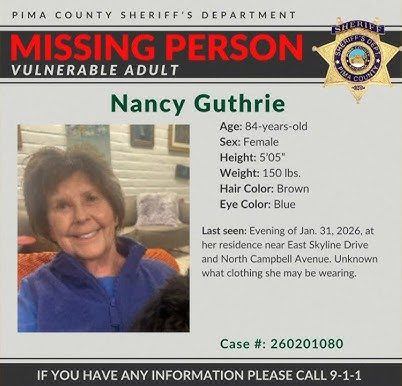
The disappearance of Nancy Guthrie is close to hitting the two-month mark, and authorities are no closer to bringing her home. Several officials, including former FBI agents, have shared concerns regarding the handling of the investigation, and news reporters have questioned the capability of Pima County Sheriff Chris Nanos, who is leading the search.
Evidence With No Leads
Guthrie was last seen on January 31, 2026, at her home in Tucson, Arizona. The most significant pieces of evidence in her disappearance, which gave so much hope to the family, have led nowhere. The man shown in the released doorbell camera footage tampering with the device before breaking into Guthrie’s home has not been identified.
The unique Ozark Trail Hiker Pack backpack he was carrying seemed to be a dead end, and the getaway car that was supposed to be a breakthrough, but no further updates have been provided.
Any of the DNA samples that have been found–the black glove and blood in the home–thus far have either been connected to the missing 84-year-old woman or have not gotten a hit and have led to many speculating the lack of effort put into the case.
Billboards of Nancy Guthrie were recently placed in Arizona and surrounding states, and retired FBI agent Jennifer Coffindaffer, who has been quite vocal on the investigation, believes this is another failed effort. While she is “glad they are using billboards to spread awareness,” she does not think a photo of Guthrie is substantial.
“This photo should be next to Nancy’s on the billboards that the FBI put up,” she wrote in reference to the doorbell image of the kidnapper. “The abductor would have hidden Nancy. Likely no one in Texas or California would have ever seen her post-abduction, but they could know Porch Guy. I guarantee his friends and family recognize him.”
Professionals Discuss Investigation
Investigative reporter Brian Entin says that DNA evidence will be crucial in locating Guthrie. Forensic expert April Stonehouse also noted that traces of DNA are often left behind, so there should be something for authorities to go on.
“I really believe, at the end of the day, DNA is what may crack this case,” Entin said on an episode of Brian Entin Investigates. “The DNA is important — obviously, with any case, but especially with this case — because it doesn’t seem like there’s been a lot of other solid leads. And remember, the big piece of DNA, that I think is going to end up being the most important, is the DNA that was found in Nancy’s home … is a stranger’s DNA, so it could be the suspect’s DNA.”
Entin has been covering the investigation since it began, and believes DNA will solve the sudden disappearance of Nancy Guthrie. He invited Stonehouse, who is a professor at Arizona State University in the Interdisciplinary Forensics department, onto the show on Friday to discuss the pieces of forensic evidence found, and they shared optimism about finding Guthrie.
“I would be hopeful that [investigators] found at least a few items of evidence because, by virtue of the fact [the suspect is] in a home he doesn’t belong in, he is going to leave some of his DNA behind,” Stonehouse said.
“Now, he’s obviously taking measures to try and avoid leaving his DNA behind. He’s wearing gloves. He’s wearing a mask. But we know scientifically that they will leave behind traces of their DNA. It’s just a matter of locating it and finding it.”
DNA Evidence is Crucial
According to Stonehouse, the DNA processing has “actually been moving at a very rapid pace,” compared to other cases. She used the blood found in Guthrie’s home as an example, and officials quickly identified it as belonging to the missing woman.
“They ran that blood immediately,” she said. “When that all came back to match the victim, then they found themselves in the position of having to go back and submit additional items of evidence for testing. And so when they worked the blood, they wouldn’t have known what the results were until they actually got the results back. … It’s part of this process of working items, seeing what the results are, and then if the results aren’t helpful, working more items of evidence to try and advance the investigation.”
Stonehouse shared her experience with DNA evidence and how it can be the make-or-break in a case. She told Entin that the DNA found in a case of an unidentified woman who was murdered in Pima County in 1981 made all the difference; the challenge was finding it.
“The DNA in that case single-handedly made the difference in figuring out her identity and who had perpetrated that crime,” she said. “And so yes, DNA, and to your point about if DNA is left behind, yes, it could be left behind in very, very small quantities. Sometimes half the battle is just finding where it’s located.”
