
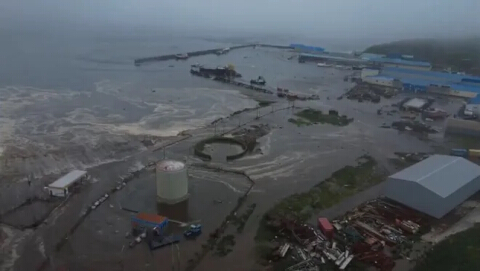
On July 29, the US Tsunami Warning System notified California, Hawaii, Oregon, Alaska, and the Aleutian Islands of a tsunami. Japan also received the same warnings for Hokkaido and Tohoku. The disastrous waves were caused by an 8.8-magnitude quake on Russia’s east coast. As fast as the warnings came, the Pacific monsters soon crashed into the US West Coast in the early morning of July 30th. Here are the latest updates so far.
Where in Russia did the Earthquake Strike?
According to the National Oceanic and Atmospheric Administration (NOAA), the devastating earthquake struck Kamchatka, Russia. Seismic waves were detected 315 miles southwest of Bering Island. At 11:24 PM UTC, the Pacific DART systems measured an 8.7 magnitude.
The earthquake’s sheer force quickly changed to 8.8 in a matter of milliseconds. The tracker reported the seismic waves were traveling up to 46 miles. Soon, inland Kamchatka residents fled when the floods hit the region’s ports. The peninsula immediately suffered from a 13-foot tsunami, followed by multiple aftershocks of 6.5 magnitude.
Emergency Shelters for Hokkaido and Tohoku Residents

The Japan Meteorological Agency (JMA) reported that a 2-foot tsunami struck the small town of Hamanaka. The wave crashed into the Hokkaido port five hours after the Kamchatka earthquake. Other areas within Tokyo Bay witnessed 8-inch waves afterwards. Japanese residents fear that they will suffer from another tragedy if they do not evacuate immediately.
In March 2011, a 9.1 magnitude earthquake terrorized civilians in the Tohoku region. The seismic activity from the Japanese Trench generated a 130-foot tsunami, killing over 18,000 people. The natural disaster also resulted in disabling the Fukushima Daiichi power plant after the wave cooled all three of its reactor cores.
Japanese Prime Minister Shigeru Ishiba ordered 1.9 million coastal residents to evacuate to higher ground. Authorities have prepared multiple emergency shelters to protect citizens from heatstroke as the country is also facing a 107.42°F heatwave. The Kuji port later faced a 4.3-foot tsunami after the beaches were cleared on July 30.
Hawaii Remains Vigiliant During Evacuations

The US Tsunami Warning System set up an ocean watch as more tsunamis were detected. Hawaii and California were predicted to be struck the hardest if the waves reach 5 feet high. At 8:00 PM PT, Maui County posted a video of Kahului Harbor’s water levels dropping by 15 feet. Taking no light precautions, the Hawaii Emergency Management Agency (HEMA) notified the public at 10:45 PM PT.
All evacuees in the state’s affected coastal regions were ordered to stay on high ground and away from the shores. Airports canceled passenger flights and went on standby for updates. Many streets became jam-packed as civilians hurried to escape the Pacific disaster. TV Hostess Oprah Winfrey assisted them by opening her private Maui Road for evacuation. The US Navy and Army also opened the Kolekole Pass on Oahu as an alternative path.
CNN reported on July 30 that a 4-foot tsunami crashed into the Oahu town of Haleiwa, at 1:00 AM PT. The island authorities immediately sent an emergency message on X, the social media platform. After hours of surveillance, Hawaii remains on high alert even after certain locations lifted the warning advisory.
The Pacific Rim Tsunami Watch
Russia now has the world’s sixth-deadliest earthquake in history. Its 8.8 magnitude has summoned a flurry of tsunamis around the Pacific Rim. The US West Coast and Japan are continuing their battle against these destructive waves. Mexico, Guam, Peru, French Polynesia, Chile, and Colombia are monitoring the coast while already executing precautions amid the emergency.
As for California, two updates from CNN reported that the state has been struck. A 2.5-foot tsunami first attacked San Francisco at 1:12 AM PT. Then, at 5:30 AM PT, a 4-foot wave hit Crescent City.
