
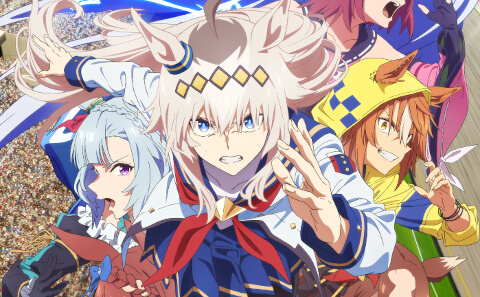
Two months before Umamusume: Pretty Derby’s mobile game global debut, Cygames released the anime’s anticipated spin-off series, Umamusume: Cinderella Gray. Unlike the previous title, the show centers around the legacy of “The Grey Monster,” Oguri Cap. Her journey as an Umamusume offers a perspective of determination in a competitive-driven world. And with the 2nd cour announced for this October, here’s what I learned from the racing legend’s reimagined story.
The Underdog from Kasamatsu Adaptation
Umamusume: Cinderella Gray was first developed for Young Jump magazine back in 2020. Cygames entrusted a four-member team at Shueisha to adapt Oguri Cap’s horse-racing legacy into a modern-day sports school life manga.
The stallion began from humble beginnings in Kasamatsu. The small Hanshima town hosted dirt track races, which helped “The Beast” adapt his knees to his running style in 1987. Young Umamusume looked forward to entering regional races. Oguri also first established a rivalry with Fujimasa March (March Tosho IRL).
Episodes 1-6 presented how they tested each other’s immense strength. According to the Japan Bloodstock Information System (JBIS), Oguri and March ran in 6 races together. Their final race ended in the Open Three-Year-Old Race in 1988. Their Umamusume versions showed a wonderful relationship forming, for neither enjoys losing to one another.
However, after making her 6th win at the Chukyo Hai, Class President Symboli Rudolf requested Oguri’s trainer, Jo Kitahara (Koichi Oguri IRL), to transfer her to Tracen Academy’s Tokyo branch. He debated whether to continue chasing the Tokai Derby or have Oguri chase something grander. He made a racing bet that affected his Umamusume’s performance, and worse, angered March. If she wins her Three-Year-Old Race, she will head to Tokyo. If not, Oguri can race her rival in the Tokai Derby.

Jou decides to accept his reality and cheers her on to finish the race strong. He promises to Kasamatsu that when Oguri returns, she will touch everyone’s dream of racing nationally. However, Jo head’s off to study for his national trainer license. He entrusted his mentor, Ginjiro “Roppei” Musaka, to take care of his trainee.
Oguri quickly adapts to turf racing after transferring to Tokyo. She defied racing rules and attracted an audience to trying to enter the Japan Derby. Rudolf requested that ‘The Beast’ enter the race without registration. However, the chairman of the Umamusume Racing Association (URA) rejected it, despite the supportive public petitions. The experience did give the derby board an idea for next year’s Japanese Derby to have elected participants.
Umamusume: Cinderella Gray’s lead story planner Junnosuke Ito and Pretty Derby scriptwriter Masafumi Suigura carefully improvised the stallion’s real-life events for an eye-catching underdog story. They did an incredible job utilizing Oguri Cap’s debut days and early national racing for an inspiring narrative.
Horse Color Prejudice Based on Real Superstition
I didn’t expect horse prejudice to exist when I began watching Umamusume: Cinderella Gray. The anime refers to Oguri Cap, and her rival, Tamamo Cross, as ashen horses. Throughout the 1st Cour, we see many of their opponents underestimating these light-haired horse girls.
For example, because of Tamamo’s short stature, she is considered frail. She runs as an end closer to avoid colliding with the pack. Then, there’s Oguri’s weak knees, which are based on her stallion counterpart’s birth defect. She tells her teammate, Belno Light (Twin Bee IRL), that her mother gave long massages to improve her walking. So, where did this rumor of ‘light-colored horses are weak’ come from? Two superstitions hold the answer.

Superstition 1: Grays are Bad Luck
The first one is from horse breeder Fredrico Tesio. He traced the first appearance of gray horses to an 1787 Alcock Arabian mare named Bab. She mated with a Brownlow Turk and gave birth to 10 gray offspring. Tesio theorized that the rare fur coat is a skin pigmentation disease occurring in thoroughbreds (Jockey Club horses) as they age.
Grays became popular in the United States in the 1950s with Native Dancer. For two centuries, their fur coat was believed to grant peak performance on muddy racetracks. They were often seen as lucky on cloudy and rainy days. ‘The Grey Ghost of Sagamore’ proved gamblers and jockeys wrong that grays aren’t bad at elite horse racing after winning the Triple Crown, which consisted of three G1 races.
A similar effect happened 30 years later when Oguri and Tamamo competed in the Autumn Tenno Sho in 1988. Umamusume: Cinderella Gray recreated the start of their friendly rivalry in Episode 13. However, “The Grey-Haired Monster” still had his black coat, while ‘White Lightning’ was growing speckled gray.
Superstition 2: White-Hooved Horses are Worthless
The second superstition is based on the color of the horse’s hooves. According to a 2002 American Farriers Journal article, many horseshoe makers believed that white-hooved horses are weak. There’s even a cruel, anonymous poem that describes what a breeder should do with them:
“One white hoof, buy him.
Two white hooves, try him.
Three white hooves, deny him.
Four white hooves and a white nose
Take his hide and feed him to the crows.”
However, this myth is far from the truth. The real problem lies within the structure of the capsule. It plays a vital role in the horse’s walk-cycle if they aren’t treated to be round and given a proper horseshoe. This was true for Oguri Cap as his paternal mother, White Narubi, couldn’t produce breast milk. He was neglected until Inabi Ranch took him into their care. His hooves needed to be clipped to walk properly.
In Umamusume: Cinderella Gray, Belno Light acts as a farrier thanks to her family’s business knowledge in uma shoemaking. Oguri is very thankful to have proper track equipment.
JUMP Visuals Matches Competitive Atmosphere
Young Jump Magazine one-shot artist Taiyo Kazumi left a first impression that translated well from manga to animation. Umamusume: Cinderella Gray presented Oguri Cap’s journey using dark impact panels, sharper character lines, and most importantly, monstrous faces to show Uma’s threatening presence.
Compared to Umamusume: Pretty Derby, there’s less humor and more grit due to the Showa racehorse generation’s competitive nature. Moments of relaxation and relief are presented with softer lines. When I first saw Oguri’s beastly aura, I reacted like her opponents who sensed dread. It only appears when ‘The Gray-Haired Monster’ uses her spurts.
The viewers see the same presence with Tamamo Cross. I appreciate that Kazumi differentiates the Umas’ spurt aura. Lightning surrounds her body, representing her speed and guts. They also offer a nice contrast to Oguri’s looming shadows that showcase her. The spin-off also preserved the aggressive faces from the original series. And with more risks to leg injury, viewers witness the challenges between regional and national tracks.
What’s in Store for Umamusume: Cinderella Gray 2nd Cour?
Oguri Cap is more motivated to become Japan’s best derby horse after losing to Tamamo Cross at the Autumn Tenno Sho. The 2nd cour will explore more of their rivalry and growth as upcoming national racers. Cygames hinted on Jun. 29th that their new opponents will come from around the world. They later shared the Umamusume names on Aug. 22nd:
- Moonlight Lunacy (United Kingdom)
- Michelle My Baby (USA)
- Ellerslie Pride (New Zealand)
- Toni Bianca (Italy)
- Obey Your Master (USA)
However, one Uma is absent from the roster. The June announcement trailer hinted that a Japanese horse would be facing Oguri. The only hints viewers are left with are that the girl wears a bow on her right ear, has long hair, and is nicknamed “Beauty of the Century.” Umamusume: Cinderella Gray will return next month on October 5th.
