
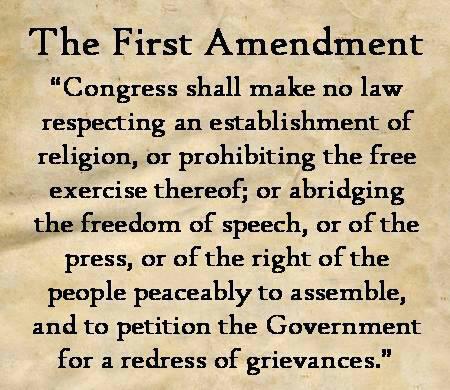
I was looking through the St. Paul Pioneer Press’ Minnesota Newspaper Museum at the Minnesota State Fair last week and noticed they were giving away posters with the First Amendment printed on them. I perused the text, remembering again its simplicity and yet the power in its words. I snatched two of them, one for a business partner, and walked away. As I pondered my acquisition, my mind drifted to the present, where so many of our inalienable rights are under attack.
And nothing is under greater assault than the rights contained in the First Amendment of our Constitution, particularly our right to Freedom of the Press. Living in our current national authoritarian state under a dictator who seeks to repress all manner of dissent makes me aware of just how fragile our freedom is. In the same week, two additional incidents made me more appreciative of these rights and how the battle rages to preserve them.
Freedom of the Press
Let me share with you the beauty and incisiveness of the First Amendment. It reads
“Congress shall make no law respecting an establishment of religion, or prohibiting the free exercise thereof; or abridging the freedom of speech, or of the press; or the right of the people peaceably to assemble, and to petition the Government for a redress of grievances.”
This amendment of 45 words oozes with freedom and the right of expression. Therein lies the foundation for the civil discourse that our nation has enjoyed for almost 240 years. There have been dark times in this country where these rights were ignored for supposed security and national defense purposes. Fortunately, cooler heads would prevail and remind us of these words and steer us back to our existence in a fair and just society.
The fact that these rights are under such a violent assault should be of no surprise to anyone. Trump and MAGA Nation had promised before his inauguration that the rights of some in the population were going to be sharply curtailed. However, the speed at which the Trump administration’s actions and the ineffective response to them should alarm those worldwide who cherish democracy and freedom.
Farewell to a Legend
Last month, the Atlanta Journal-Constitution (AJC) announced that it will halt its print edition at year’s end and become a strictly digital newspaper. This, in and of itself, does not surprise anyone. Newspapers across the country are choosing this option regularly. Printing a daily newspaper is no longer cost-effective, and digital formats appeal to a much younger demographic.
However, three factors make this situation unique. First, the AJC has produced a print version since shortly after the Civil War in 1868. Second, this isn’t a case of some big conglomerate taking over a news outlet to rid it of a “woke” press corps. On the contrary, the AJC has been owned by the Cox family since they bought the then-Atlanta Journal in 1939. This move has made Atlanta the largest U.S. metro area without a daily print edition. The only real comparison is the decision by The Star-Ledger of Newark to stop its print edition in February of this year.
When a paper goes digital, it does not necessarily mean it will grow and prosper. They have to dramatically increase the total of their online subscriptions, in the AJC’s case by 400.000. Also, AJC’s web traffic has witnessed a sharp downturn in the last year. There are three main reasons for this. One, Facebook is phasing down news content on its newsfeed; Google’s algorithms are not as robust as they used to be. And the rise of generative AI has altered how people search for news.
Does this decision by the Cox family reduce our access to free press? Probably not directly, but it does change the demographics of who is reading the news. Studies have shown that print media is easier to read, and the use of colors in print has a comforting effect on readers. Roughly 37% of the world’s population does not have internet access, so going all digital may exclude certain countries or age groups from accessing information. In these indirect ways, the loss of print media could, in some cases, reduce access to free press.
A Different Era
Watching Netflix’s excellent series “Turning Point,’ I was reminded of a different era where journalistic integrity was celebrated, and publishers and editors would stand behind reporters’ factual stories in the face of pressure to limit press freedom. This particular five-part segment was devoted to the Vietnam War.
It examined the dramatic consequences of the Vietnam War and its effect on all those who were involved in the conflict. One portion of a segment was dedicated to war correspondents, and a feature highlighting a report by CBS’s Morley Safer was particularly stark and revealing.
Long before he served as a correspondent for “60 Minutes,” Safer was a crack war correspondent. And in this capacity, he was embedded with some Marines on a search-and-destroy mission in South Vietnam. When on August 3, 1965, they arrived at the village of Cam Ne in Quang Nam Province. They had been receiving fire from the Viet Cong forces in the area for about three weeks. They entered the village and found some booby traps and land mines, but no Viet Cong soldiers.
Despite this, as Safer reported, the Marines started to set many of the villagers’ huts on fire, along with their possessions and rice stores. In the end, they arrested four senior men from the village. Safer and his South Vietnamese cameraman Ha Tue Can captured the Marines committing these atrocities, and Safer sent the story and the images back to the CBS offices in New York.
CBS News President Fred Friendly verified the authenticity of the information from Safer, and on August 5, 1965, the segment ran on the CBS Evening News. The reaction was immediate, and U.S. President Lyndon Johnson called CBS President Frank Stanton, complaining that the report insulted the American flag.
Johnson accused Safer of working with the Communists or bribing a soldier to start the fires—all this to persuade CBS to remove the reporter from his post in Vietnam. Neither accusation was true, and Friendly stuck to his principles and refused to recall Safer.
The Fight Continues
In summary, we have attempted to demonstrate the power and importance of the constitutional provision of freedom of the press. We have also tried to give examples of the threat to this freedom both now and in the past. We also attempted to show how the news is conveyed to its readers could result in press disenfranchisement.
Now is the time to stand up for this right and rebel against the forces trying to eliminate it. There is a conscious effort to silence critics and vest the flow of information in the hands of the rich and powerful. Join the fight. Your future may depend on it.
