
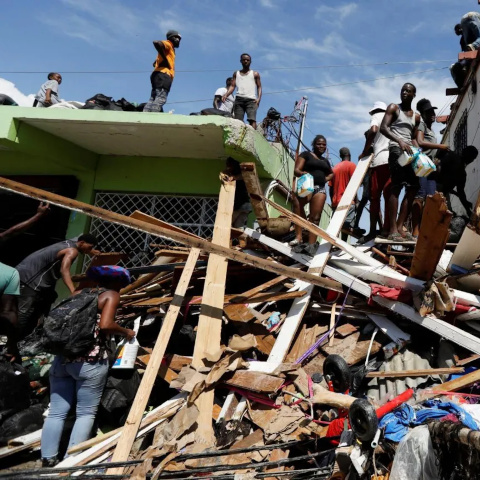
Since making landfall in Jamaica on October 28, Hurricane Melissa has left devastation in Caribbean nations. The “storm of the century” tore through multiple coastal communities, leaving thousands without a home. The United Nations has made preparations to provide humanitarian aid for the affected islanders.
Jamaica’s neighbor, Cuba, was struck by Melissa amidst the US Navy’s war against drug cartel boats. The soldiers occupying Guantanamo Bay chose to evacuate 1,000 non-essential members hours before the terrorizing winds arrived. With a fleet of 10,000 US naval ships in the Caribbean Sea, a new obstacle arises for the Trump administration. There have been no reports that the US ordered evacuation assistance for the island nations.
US Navy was in Path of Hurricane Melissa
The National Hurricane Center of Florida issued hurricane warnings to Jamaica when Tropical Storm Melissa became a Category 5 hurricane on Oct. 25. Its powerful winds were detected on the country’s shores despite moving at a snail’s pace. The Atlantic storm’s massive range also targeted Haiti, Cuba, the Bahamas, the Dominican Republic, and the Turks and Caicos Islands.
Simultaneously, US Defense Secretary Pete Hegseth ordered the Gerald R. Ford Carrier Strike Group to join the 10,000-man fleet in the Caribbean Sea. The initiative was deemed necessary to enhance enforcement against suspected drug cartel boats. Latin American leaders, including Venezuelan President Nicolás Maduro and Cuban leader Miguel Díaz-Canel, saw the continuous deployments as an act of coercion.
The Gerard R. Ford departed from Croatia on Oct. 26 while Hurricane Melissa gradually strengthened. Special US Air Force unit, the Hurricane Hunters, measured 185 mph winds on Oct. 27. The fierce storm landed in Jamaica at 1:05 PM GMT, tearing through the nation’s west side with heavy rainfall and violent gusts on Oct. 28. Melissa dialed down to Category 3 when it landed in Cuba on Oct. 29, then Category 1 in the Bahamas on Oct. 30.
Hegseth’s Cartel Boat Strikes Continued During Hurricane
One of the largest US naval fleets in history was making questionable safety movements before and during Hurricane Melissa’s frenzy. These soldiers have been tasked to eliminate ships that have traveled between Venezuela and United States since late August. PBS News reported that 37 alleged narcoterrorists were killed under Hegseth’s command on Oct. 23rd. The overseas death toll within the Caribbean and the Eastern Pacific grew to 61 on Oct. 28.
Two days before Hurricane Melissa landed in Jamaica, four boats were shot down by the US Navy. The US Defense Secretary offered vague answers on how the Trump administration identifies a ship’s operations before striking: “The boats were known by our intelligence apparatus, transitioning along known narcotic-trafficking routes.” Sources have traced these alleged cartel vessels off the coast of Venezuela.

Hegseth later posted about the Oct. 28 strike when the US Navy decimated an unclassified boat. The ship carried four operators inside. Total deaths from these attacks was 14, with one survivor accounted for. The fleet commander even tried to justify his order by saying, “Narcoterrorists killed more Americans in Al-Qaeda.” Despite having 10,000 troops scattered in the area, the attack was prioritized over resident evacuations.
The US Navy Evacuated Non-Essential Military Personnel
The Guantanamo Bay US naval station took the NHC’s weather advisory seriously and readied their air carriers on Oct. 25th. The base is home to 3,000 residents, mainly consisting of military families and authorized personnel. The US Naval Institute reported that more than 1,000 non-essential members have evacuated to Pensacola, Florida, on Oct. 27th.
Cuba was left to defend themselves as Hurricane Melissa traveled closer to their location. Resident coordinator Francisco Pichon reported 739,000 people evacuated from the coastline and nearby inland. The Jamaican government ordered a mandatory evacuation, starting with only 1,500 people taking shelter. The number grew to 15,000 during the storm’s landing. The American Red Cross announced that 6,000 of those residents remain in shelter after losing their homes. Haiti suffers a similar fate with 15,000 citizens living in the 120 shelters provided.
The US Responds with Understaffed USAID Personnel
On the evening of Oct. 28, the US State Department confirmed the nation will assist with Jamaica’s recovery. However, the Trump administration is being tested on its capabilities during the nation’s shutdown. A State Department official told The Independent that humanitarian aid will be provided to the affected countries.
Retired Navy officer Bryan Clarke believes the soldiers overseas can help Jamaica while countering narcoterrorists. He is also concerned about the recent actions of President Trump, including the end of SNAP benefits. “If the Trump administration chooses to keep naval forces focused on Venezuela rather than disaster response, it would certainly show how they want to exercise their defense priorities,” he told The Independent.
The administration is also responsible for eliminating 90% of the US Agency of International Development (USAID). The surviving 100 employees transition to the Bureau of Population Refugees and Migration (BPRM), the State Department’s humanitarian aid sector.
Oct. 29, Secretary Marco Rubio told the press that the USAID will assist the UN with Hurricane Melissa’s targets on: “The US is in close contact with Jamaica, the Dominican Republic, and the Bahamas as they confront the devastating impacts of [the hurricane]. We have rescue and response teams heading to the affected areas along with critical lifesaving supplies.”
USAID’s Sarah Charles is anxious about the State Department’s pace due to the administration cuts and communication issues: “So many of [the agency’s] systems came out of, frankly, the negative experiences of the 2021 Haiti earthquake, where people in and out of the government were so moved by the devastation that a lot of help flooded in. But in an uncoordinated way that created more chaos and challenges in the responses.”
The Road to Recovery Shows Conflicting Relations
Jamaica and their neighbors have accepted that the road to rebuilding their communities will not be easy. Accuweather estimated that $50 billion USD will be need to help the Caribbean nation recover from Hurricane Melissa. The storm flooded homes and devoured resources like electricity. The death toll continues to rise. It now stands at 50.

The US Navy is awaiting orders to assist the affected countries, while continuing to defend the Trump administration’s narcoterrorist war. The most recent development has Venezuelan President Maduro on edge. To the US government, he’s an alleged drug czar manipulating his country. The bounty for his arrest is $50 million USD. A US federal agent failed in his mission to have his entrusted pilot execute him in a 16-month operation.
Cuba received a victory with the UN General Assembly during the storm. On Oct. 29, the nation received 193 votes to lift the 1962 US embargo. The UN will adopt a new law, the Necessity of Ending Economic, Commercial, and Financial Embargo. Winning by 165 votes, the rule will protect Cuba from further government restrictions from the US that damaged their economy.
