
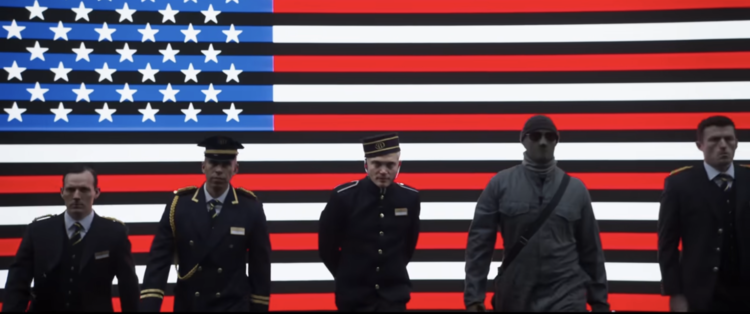
The Running Man has officially run into theaters, marking the latest in a very long line of Stephen King adaptations to hit some sort of screen this year. It’s the last movie on the docket that’s been made from one of King’s books, this time from Baby Driver director Edgar Wright and starring Glen Powell, Colman Domingo, Josh Brolin, and Michael Cera. It’s a movie predicated on running, and metaphorically speaking, it does. It just doesn’t ever reach a dead sprint.
The Running Man Review

Glen Powell is on the verge of really breaking out. He’s had big roles before, even leading roles, but an action blockbuster like this has the chance to push someone into true superstardom. It’s a shame he never quite lives up the billing. That’s not to say The Running Man’s star is bad. Far from it, actually. It’s just that in a world with rich, interesting characters, Powell’s Ben Richards is at his best when playing off of others.
When Powell is alone, which is not as often as you’d think based on the whole premise of the movie, he does fine, but the action lulls and so does the interest level. When the other characters, brought to life by a plethora of really stellar supporting actors, the film really blossoms. Powell carries the movie just fine on his own, as he’s really blossomed into a leading man, but all the best scenes are with him playing off of others.
This is never more evident than in the far too few scenes with Michael Cera. As someone who read the book, I know that Cera’s Elton Parrakis isn’t around for very long, but I was still left wanting more. He’s a phenomenal character here, brought to life with a slightly awkward but powerful performance by Cera. He’s not in enough movies these days, and when he is, he’s far underutilized like he is here. Lee Pace’s Ethan McCone is a good foil for Powell, but he’s not in much of the movie, either.
Josh Brolin’s Dan Killian and Colman Domingo’s Bobby Thompson, comparatively, are on screen and interacting with Powell much more often, and they’re both good. Domingo really shines, doing his best Caesar Flickerman impression. It would be impossible to say that that character from The Hunger Games didn’t, seemingly, inspire Domingo’s turn here, but it’s worth noting that The Running Man was written long before The Hunger Games.
Still, the comparisons are rich. It’s very much a similar story, but with Wright’s take on King’s novel opting to sort of merge the original Hunger Games with Catching Fire by changing the ending of the original novel, penned under the Richard Bachmann pseudonym. That would be the second King adaptation to drastically change the novel’s ending despite following along pretty closely up to that point.
Adapts, but Doesn’t Copy
When it comes to adapting, movies can take one of two routes. They can either be as close as possible to the original story and respect it that way, or they can expand on the themes of the book by adding or subtracting things. Either one can work.
In The Long Walk, the ending is changed completely, but it works to serve as another emotional gut punch after a movie full of them, and it really hammers home the original message of both the novel and movie. It’s a brilliant change I believe only enhances the story. Here, the ending is changed to offer a more hopeful outlook of what happens with Richards and with our country at the end of the tale. The novel ends on a bleak and depressing note, but it fits the story better.
However, when King wrote and published the story in 1982, he probably did not expect it to age as accurately as it did. The totalitarian state that Richards exists in bears a striking similarity to our world. There’s AI, overbearing governments, reality TV that distracts people, and a class divide that’s growing all the time. Sound familiar?
So with that in mind, it is a totally understandable change to offer a positive outlook and suggest that change is possible. It suggests that we can fight back, and that we can make a difference. The novel doesn’t even begin to wonder what happens after The Running Man ends, but the movie spends some time showing how it revolutionized the people and change began to occur.
It is very fitting, so as I write this, I’m beginning to ponder whether or not it was a bad change after all. Plenty of movies lately have tackled revolution and tried to show how it can take place and what happens as a result of it. Whether it’s really meant to inspire a people or not is unknown, but it is totally fair to think that 2025 audiences might not appreciate seeing their world satirized with a bleak and unyieldingly painful ending. We need hop, and the movie sets out to firmly provide that where the book did not.
It’s got some great action, too. It moves at breakneck speed, which makes sense and is both a positive and negative. It’s hard to really connect with Richards as much because there are so few moments with him where we’re given a chance to. But the action keeps flowing, so it’s as much an Achilles heel as a benefit.
This is from Edgar Wright, whose style highlights most of his movies. Unfortunately, that style is almost entirely absent here. It bleeds through on occasion with some excellent needle drops and really fun, bouncy scenes, but he’s mostly hidden throughout. Whether that’s a studio thing or just reverence for the source material is anyone’s guess, but it’s a shame, because the movie would be much better if it was oozing with Wright style.
The movie really does get going about halfway through, but the ending drags on a little bit. It also starts a little slow, and there’s some character development we don’t really see. Richards is angry at the world, and we know why. It’s just that the anger kind of ramps up without evidence for that. Richards is supposedly getting angrier and angrier at the situation, but it’s not always clear exactly why.
Sometimes, he’s reduced to someone who’s just angry anytime anyone mentions his sick daughter in any way at all. Someone, although it is someone who looks down on Richards, simply mentions that Richards had a daughter, and he threatens him and destroys the glass in front of him. It certainly showcases how Richards feels, but it feels too aggressive for the situation and for where he was at just prior.
Conclusion
The Running Man successfully adapts Stephen King’s impressive, timely novel. It just doesn’t quite reach the heights that an Edgar Wright film probably should, nor does it quite give Glen Powell the starring vehicle he could have. Still, with competency behind and in front of the camera, it’s hardly a bad time at the movies.
Score: 3.75/5
