
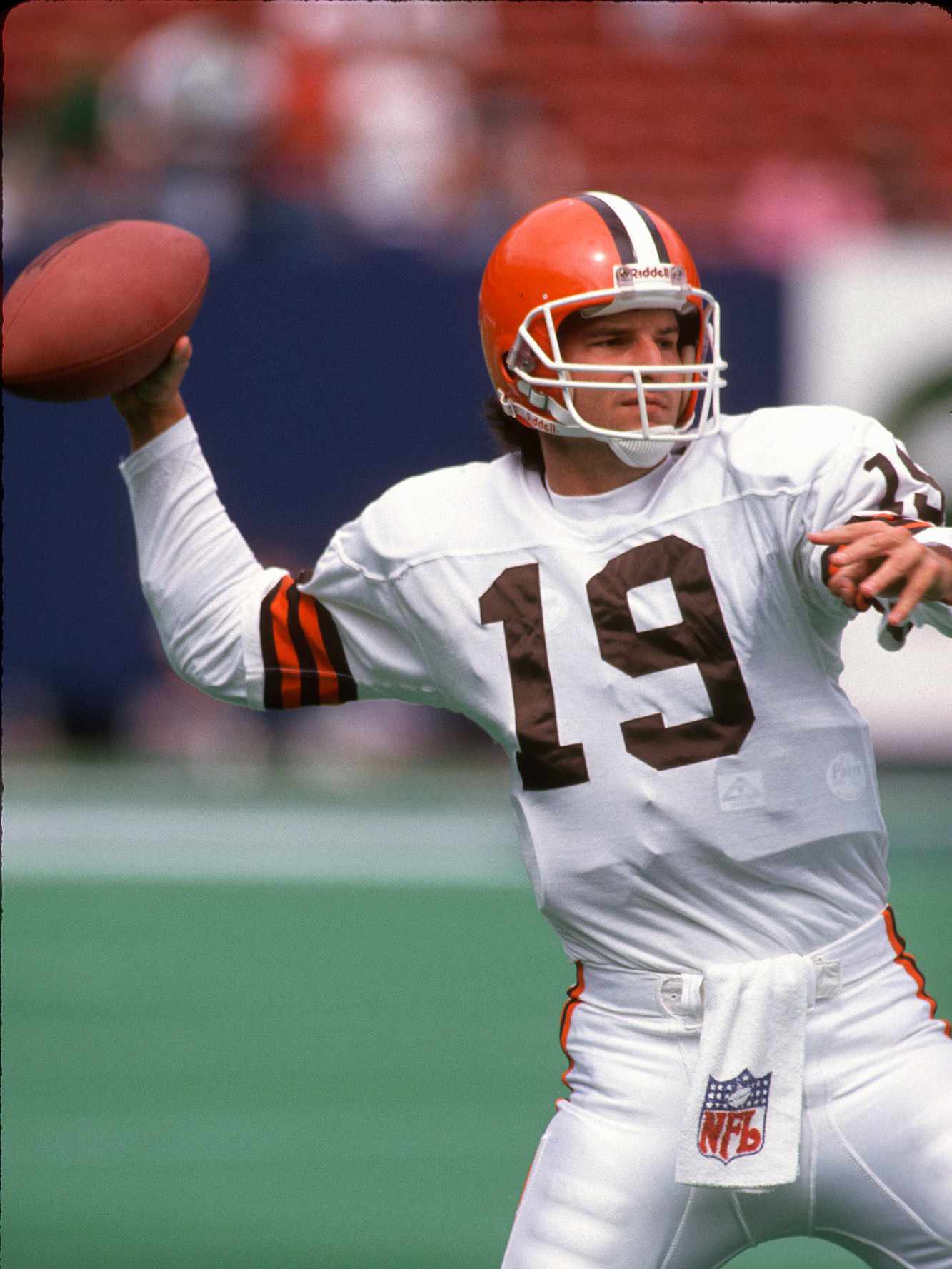
The Cleveland Browns have a legacy of losing, but following a ferocious battle with cirrhosis of the liver, former Browns quarterback Bernie Kosar is winning at life… After a year-long wait, he was the recipient of a liver transplant on November 17th.
Football Journey
Bernie Kosar’s football journey started at Boardman High School in Youngstown, Ohio. He was an All-American and Player of the Year in 1981. Much like another Ohio native, Kosar decided to bring his talents to South Beach when he committed to play for the University of Miami, where he led the Hurricanes to a National Championship in 1983. He would forgo his final two years of eligibility and declare for the NFL Draft.
There was just one small problem… NFL rules stated that only college seniors and graduates were eligible for the Draft; however, Kosar had completed the course requirements to graduate early. After battling eligibility issues and a bidding war in a controversial 1985 NFL Draft, Kosar was drafted by his “hometown” Browns in the NFL Supplemental Draft.
NFL/ Cleveland Curse
Kosar came into his rookie season as the Browns’ backup quarterback to Gary Danielson, but was thrust into the starting job when Danielson was injured in Week 5. Cleveland executed a run-first offense on the shoulders of a pair of 1,000+ yard running backs, Earnest Byner and Kevin Mack. Bernie and the Browns snuck into a playoff spot with an 8-8 record, but were eliminated by the Miami Dolphins.
In his second year, Kosar had a firm grasp on the keys to the Browns’ offense. He drove the team to an AFC-leading 12-4 record, while passing for 3,854 yards and 17 touchdowns. He led Cleveland to a 23-20 double-overtime win over the New York Jets in the divisional playoffs.
He threw for 489 yards, which was the NFL playoff record until some guy named Brady broke it in Super Bowl LII. The very next week, the Denver Broncos stampeded the Browns’ Super Bowl aspirations in the AFC championship game. John Elway marshalled his team on a 98-yard fourth-quarter drive, which led to a game-winning field goal in overtime.
Statistically, 1987 was Kosar’s best season. He passed for over 3,000 yards and 22 touchdowns in a strike-shortened season. The Browns sought revenge against Elway and the Broncos in the AFC championship. Kosar would throw three touchdowns on 356 yards, but his efforts would fall short, as a last-minute fumble by Byner would cost Cleveland the game.
Beginning of the End
Injuries would sideline Kosar for most of the 1988 season. Upon his return in 1989, he would go on to pass for 3,533 yards and lead the Browns to their third AFC championship game in four seasons and a date with their old dance partner, the Denver Broncos. The Browns once again wound up on the losing end in the Mile High City, falling 37-21.
The next few years were marred by injuries and the departures of talent around him. Kosar started the 1990 season by setting an NFL record for consecutive pass attempts (286 passes) without an interception. He ended the season with a career-high 15 interceptions and a 3-13 record. The following season, he redeemed himself by throwing for 3,487 yards and 18 touchdowns with nine interceptions.
In 1991, Cleveland hired future eight-time Super Bowl-winning coach (two as an assistant, six as a head coach) Bill Belichick as their head coach. After going 2-5, Kosar broke his ankle and missed nine games in 1992. Before the 1993 season, Belichick brought in another former Miami Hurricane, Vinny Testaverde, to take the helm of Cleveland’s offense.
For the first time since his rookie year, Kosar had competition under center. He got a second chance to captain the ship when Testaverde was injured, but following a 29-14 loss against his old nemesis, Denver, he was released by the Browns.
Back in the Saddle… Sort of.
Dallas Cowboys quarterback Troy Aikman was injured the same weekend that Kosar became unemployed, so Dallas jumped on the opportunity to sign Kosar as a backup to rookie quarterback Jason Garrett. As the starter against the Phoenix (Arizona) Cardinals, Garrett struggled to move the ball, so Kosar got the call to relieve the rookie.
He would start the next game before Aikman returned from his injury. He saw the field against the San Francisco 49ers in the NFC championship game, when Aikman suffered a concussion. Kosar threw for 83 yards and a touchdown. He knelt on the final play of Super Bowl XXVIII to win his only Super Bowl of his career as the Cowboys defeated the Buffalo Bills 30-13.
Following his Super Bowl victory, Kosar finished his career with the Miami Dolphins as Dan Marino’s backup. It is a little-known fact that he was the brains behind the “fake spike” play that Miami used in a comeback victory over the New York Jets.
The play took place with 38 seconds left in the fourth quarter, with the Dolphins trailing 24-21. Kosar instructed Marino through his headset to fake a ball spike to stop the clock. Marino shouted the call, “Clock, clock, clock…!” and faked the intentional time stoppage. Jets defensive back, Aaron Glenn, bit on the fake and Marino tossed an easy touchdown to wide receiver Mark Ingram to win the game 28-24.
Legacy
Kosar retired from football in 1996. He left behind an impressive playing career, logging 23,301 passing yards, 124 touchdowns, and 81 interceptions. His biggest accomplishment may have been winning the hearts of a lowly Cleveland fanbase. He was voted the most beloved Browns player of all time in 2019. He gave a perennially disenfranchised franchise a reason to show up every Sunday, rain, wind, or snow, to root for a team cursed to break their hearts year after year. That’s the Dawg Pound, and he is the Dawg warden.
Following his on-field career, Kosar had numerous business ventures. He was part of ownership groups that purchased the NHL’s Florida Panthers and Arena Football’s Las Vegas (later Cleveland) Gladiators. His various investments and properties would lead him to bankruptcy. He would later be hired as a consultant for the Browns in 2009. He briefly hosted a podcast, “The Bernie Kosar Show,” before being fired for gambling.
Health Issues
Throughout his playing career, Kosar suffered numerous concussions. He still feels lingering effects from them. He has experienced slurred speech, insomnia, and ringing in his ears and head as a result. He has undergone experimental treatments to reduce his symptoms and campaigns for others with early symptoms of chronic traumatic encephalopathy (CTE) to do the same. He has early signs of Parkinson’s disease, likely as a result of his head and brain injuries.
In 2024, he announced that he had been diagnosed with cirrhosis of the liver and would require a transplant. He has publicly acknowledged his battles with alcohol addiction. He attributes his head injuries, divorce, and poor financial decisions as leading factors to his drinking.
Victory Formation
He had been on the waiting list for a new liver for over a year, until a donor’s family answered his prayers. Sadly, a 21-year-old Ohio native and Browns fan, Bryce Dunlap, had recently suffered a life-threatening medical emergency, which he did not survive. When hearing of Kosar’s condition, Dunlap’s family wanted to save the Browns legend and donated Bryce’s liver to Kosar. With friends and family standing by wearing Browns jerseys, while his mother firmly grasping his hand, Dunlap was wearing a Browns t-shirt as he took his final breath.
On November 17, 2025, Kosar underwent surgery. His transplant was a success. With a long road to recovery ahead of him, Kosar remains in high spirits. Just three days after the procedure, he was walking around the hospital with a smile beaming from ear to ear. He has the support of the Dawg Pound and fans across the globe, cheering him on as he is winning at life. But nobody cheers louder for him than the family that gave him the second chance.
