
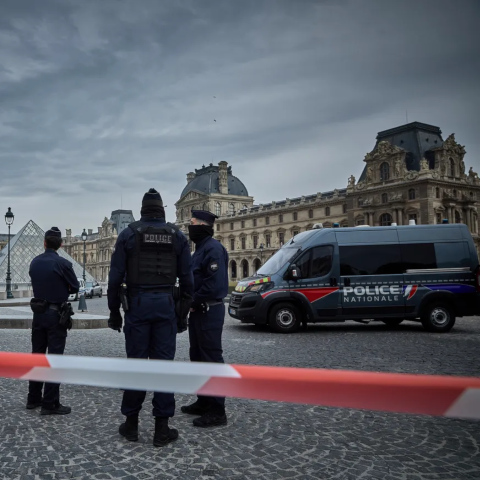
On Nov. 1, a 37-year-old man and a 38-year-old woman were charged preliminarily with involvement in the Louvre Heist. While Paris investigators believed they had apprehended all four thieves, four more people were detained on Nov. 25th. The Oct. 19 jewelry theft has expanded into a large-scale investigation. Discoveries within the museum’s faulty security system could link the additional four people to the bizarre daylight robbery.
Eight or More Thieves Could Have Robbed the Louvre
Previously, on Oct. 24, two French immigrants attempted to escape to Africa. Investigators used DNA left at the Louvre to identify and trace the two men within Paris’s city limits. French Prosecutor Laure Beccuau warned them that they would face preliminary charges for stealing the crown jewels from the Gallerie d’Apollon (Gallery of Apollo). Between their Oct. 29 confession deadline and Oct. 30, the authorities made their second arrest.
Five suspects were taken in for interrogation. One of them was believed to be part of the four-person group of thieves on Oct. 19. Within hours, one woman and one man were identified as the remaining two suspects. Forensics found their DNA inside the ladder lift truck parked in front of the Louvre’s entrance. The other three persons were released from custody.
According to USA Today, there are a couple with children. The 37-year-old man has been convicted 11 times for offenses ranging from traffic violations to aggravated theft. He’s also connected to a separate group robbery from 2015. As for the 38-year-old woman, stealing from the Louvre is her first-ever known crime.
The Nov. 25 arrest has sparked more questions about the actual number of people involved with the heist. Four new suspects have surfaced during the ongoing search for the €88 million jewels. Two men, 38 and 39, and two women, 31 and 40, will undergo a 96-hour interrogation as the previous four suspects did.
Possible Inside Job to Infiltrate the Mona Lisa Museum
During the investigation, the museum was criticized for slow renovations, including no security system upgrade. Recent discoveries show that the Louvre was still operating in Windows 2000 on the day of the crime. Microsoft stopped updating that version back in 2010.
The French National Agency for the Security of Information Systems (ANSSI) had a security audit scan the museum’s surveillance logins in 2014. ‘LOURVE’ was discovered to be the password. The same logins were found in the defense and cybersecurity company Thales. What’s alarming is that these access credentials were meant to be kept confidential.
Due to the daylight robbery lasting 7 minutes, there’s a chance that one or more criminals studied the Louvre’s layout. All four burglars were seen disguised as construction workers. The two infiltrators cut through a window that led them to the Gallerie d’Appollon exhibit. They somehow knew there was a blind spot near it to avoid surveillance.
Louvre security guard Sophie was one of the guards who spotted the burglars causing a commotion. She tells France 24, “There were three of us on that level. We thought it was an angry visitor, but we realized that it was a robbery. We evacuated everyone from the gallery and blocked all of the doors so the intruders couldn’t get into the rooms.”
She and her co-workers couldn’t prevent the theft as they were threatened with power tools. Visitors panicked and fled the museum when the alarms sounded. With the addition of four suspects, new insider roles could yield evidence of manipulation of the Louvre’s security measures.
Protecting the Gallerie d’Apollon Jewels

Interpol has no further updates on the recovery of the nation’s crown jewels. As they continue searching, the Louvre has tightened its protection of the Gallerie d’Appollon’s remaining jewels. According to The Independent, entrusted staff members have transferred some of the collection to the Bank of France. Empress Eugenie’s encrusted crown remains the only recovered piece.
