
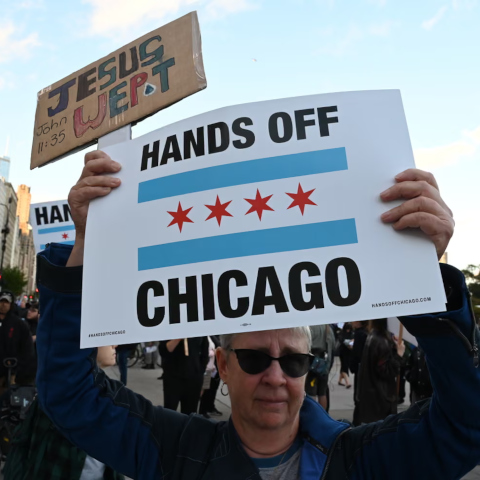
President Donald Trump’s immigration policy escalates tension in the United States by deploying the National Guard in major cities. Until Dec. 23rd, the Supreme Court blocks the president’s order to enter Chicago, Illinois. This is the third time the nation has successfully rejected the use of military force without a lawful basis. The 6-3 ruling signals a necessary step to restore the limitations on the US Executive Branch.
Illinois and Oregon Challenge National Guard Orders
President Trump targeted and deployed the National Guard in Los Angeles, Washington, and Memphis. He informed US citizens that it was to apprehend violent protestors. The reality was to establish his prowess in major Democratic cities and assist ICE in illegal immigrant crackdowns. Trump later met legal troubles in Illinois and Oregon as local judges challenged his authority and reasoning.
In October, Federal Judge April Perry demanded evidence from the administration to support their claim of dangerous protests in Chicago. The president hoped that a federal law would allow the National Guard to enter. Because there was no ongoing rebellion or invasion, Perry prohibited their entry into the state on Oct. 9. The Trump Administration sought to have the 7th Circuit lift the order, but the appeals court upheld Perry’s decision.
Oregon experienced a similar case when President Trump attempted to deploy the National Guard in Portland. His appointed judge, Karin Immergut, ruled that the recent protest had been peaceful and that there was no need for military involvement. She issued two rejection orders on Oct. 4 and Oct. 5, then permanently barred his administration from sending troops to the state’s ICE facility on Nov. 7. Trump’s colleagues sought to have the 9th Circuit approve the deployment, only to face another loss.
Supreme Court Justices Identify Misuse of Military

Chicago and the rest of Illinois knew that President Trump wouldn’t stop, even if the US Court of Appeals agreed with Perry’s prohibition order. US Solicitor General D. John Sauer requested the Supreme Court to pause the federal judge’s order. He argued that the federal courts do not hold the power to create countermeasures against the Commander-in-Chief. Then Sauer claimed that Perry’s and Immergut’s National Guard blocks were harming the nation’s Executive Branch from protecting US citizens.
According to SCOTUSblog, the Justices took two months to examine the claims and evidence. Sauer’s claims lacked a strong foundation for the trial to proceed, stating that Trump’s review is highly differential. Then he added, “If there is a plausible basis for [Illinois]-not the type of second-guessing, judgment-substituting, effective retrial of the factual basis that the lower courts engaged in.”
Chicago and Illinois’ counterarguments reminded the Supreme Court that the Judiciary Branch, including both national and state judges, carries responsibilities, including preventing the US President from abusing their power. Since the D.C. National Guard deployment, Trump has declared them as “crime emergencies.” His administration has granted similar permissions when raising tariffs on China. Illinois questioned their legality as they heightened immigration crackdowns.
On Dec. 23, the majority of the Justices voted that President Trump had violated the federal law of Illinois, even after the US Court of Appeals upheld Perry’s order. They explained, “At this preliminary stage, the government has failed to identify a source of authority that would allow the military to execute laws in Illinois.”
Trump Wants the Insurrection Act to Overturn the Case

While the ruling is not final, the decision empowers state justices to investigate the Executive Branch further. The 3 Justices who dissented on Chicago’s standing on the matter are Clarence Thomas, Samuel Alito, and Neil Gorsuch. However, Justice Brett Kavanaugh suspects Trump of using the Insurrection Act to appeal the Illinois restraining order.
The Insurrection Act of 1807 only applies when a rebellion or other domestic instances of violence occur. Those circumstances allow the President to summon the military or federal National Guard into a state territory. In the updated 1827 terms, the Supreme Court ruled that the authority to determine certain rebellions requires executive order or federal law enforcement. Judges can refer to the Posse Comitatus Act of 1878, which prohibits any branch of the US military from taking action in situations that can be handled by police.
The Trump Administration will continue its immigration crackdowns into 2026. The recent National Guard deployment is in New Orleans, Louisiana. Governor Jeff Landry praises the President and Defense Secretary Pete Hegseth for lowering crime rates despite critics saying the rates dropped before the military’s arrival. Oregon is expected to be next in line for a Supreme Court case to preserve Immergut’s barring order.
