
As I sit here, staring out the window of my New England apartment, the snow covers the world I know, and it gets me thinking… Why don’t we have snowball fights anymore? Something so simple that everyone who has ever experienced snow has done; from the first tiny fistful in mittened hands of a toddler to grown adults tightly wadding glistening spheres of snow, tossing it with all our might.
Something about snow brings me back to my childhood. Spending all day outside, sledding and snowball fighting. Like winter knights in North Face armor, the cold didn’t bother us in our coats, knit hats, and mittens. We were invincible. Impervious to the cold and snow projectiles. As we grew up, our invincibility wore off, and we got jobs. If only we had known that we could throw snowballs at people for a living…
Yukigassen
Our friends in Japan have brought our favorite winter pastime to the professional level, a sport called yukigassen, which translates to “snow battle” in English, and it is gaining popularity across the globe. The sport was developed to bring more fun to wintertime… which makes sense, because in my opinion, as a whole, winter kinda sucks.
History
Snowball fighting has been around for centuries. Rumor has it that dinosaurs were killed during the first snowball fight, when an embarrassed T-Rex retaliated against an overzealous triceratops that ambushed the short-armed carnivore, causing such a ruckus that a bloody melee ensued… but this theory has not been confirmed nor debunked.
In 1989, town officials in Sobetsu, Japan, came up with the idea to increase tourism during the slow winter months. The idea paid off; 70 teams showed up for the first yukigassen tournament, which took place at the base of the Showa-shinzan volcano.
The sport’s popularity grew in the 90s when the first women’s yukigassen tourney was held in 1991. Two years later, the Japanese Yukigassen Federation (JYF) was formed. In 1992, the first yukigassen tournament was held outside of Japan, as Austria and Finland embraced the sport. The sport’s following continued to expand as Norway adopted the sport in 1996.
Yukigassen spread across the pond; the United States joined in the fun in 2001. As the sport’s popularity snowballed, more countries, such as Sweden and Canada, entered the snow battle. By 2011, there were over 2,000 yukigassen teams in Japan alone. The sport’s growth led to the formation of the International Alliance of Sports Yukigassen (IAY) in 2013. The JYF has been lobbying for the sport’s inclusion in the Winter Olympics.
Snow Battle
The game of yukigassen combines elements of three popular children’s recess activities: Capture the Flag, dodgeball, and, of course, snowball fights. The concept is very simple. Capture your opponents’ flag without being pelted by snowballs or eliminate your frozen foes with snowballs.
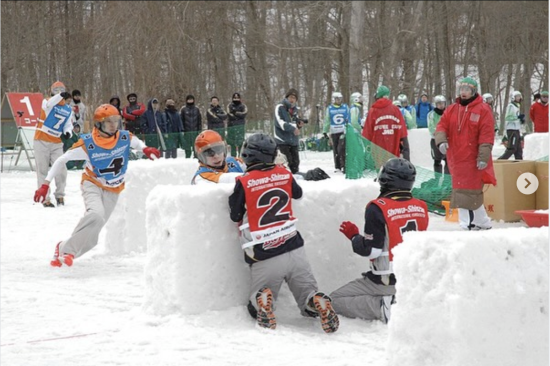
Yukigassen pits two teams of seven against each other with snowballs. In addition to warm winter attire, competitors are suited with helmets, face masks, and padding. Teams have three defensive shelters to shield themselves from a flurry of snowballs flying full-force across a 36-meter (long) by 10-meter (wide) “snow pitch” field.
Competitors use 90 pre-made, machine-made snowballs to maintain consistency, allowing them to be thrown at high speeds. In my opinion, the game would be more interesting if competitors were required to make their own projectiles on the fly, instead.
One snowball fight that always comes to mind is the scene from the classic Christmas movie ELF, where Buddy hand-packs an armful of snowballs to combat bullies. Unlike childhood snowball fights, yukigassen requires some strategy and planning to be successful. Much like sports like baseball, paintball, and dodgeball, players must utilize teamwork and tactical positioning, both on offense and defense.
The games are fast-paced and dangerous, with three three-minute periods of the highest-level athletes, often professional baseball players, chucking frozen snowballs at opponents’ faces; sometimes at speeds greater than 90 MPH. The first team to win two periods is the victor. Players have limped off the pitch with bruises, missing teeth, broken ribs, and broken noses. Winners and losers leave battered and broken, but the winners leave with their honor and dignity.
Come Out and Play
As our inner child has grown into cautious adulthood. Scars of childhood bravery and stupidity have left us afraid to have fun. While yukigassen is like a more extreme and unforgiving older sibling, snowball fights can still be fun and innocent. So next time it snows, tell that voice of reason inside your head to shut up and get outside, ball up a tight snowball, and be a kid again—Yukigassen and chill.
