
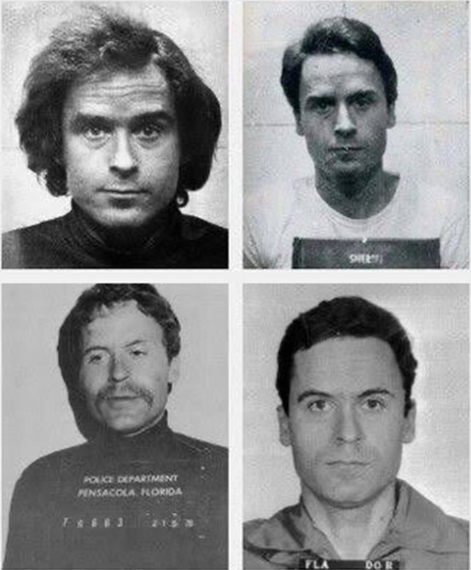
Ted Bundy’s cousin, Edna Martin, recently shared her experience of knowing a serial killer. She trusted Bundy and felt as if he was her protector, until she learned the true, sinister being he was. At the time, Martin was attending the University of Washington, and the cousin she thought she knew was living a double-murderous life. Bundy was stalking, raping, and killing women just like her, only blocks away.
“We knew that there was a predator out there, and we were his prey,” Martin said in the Oxygen special Love, Ted Bundy. “The ironic thing is, I felt safer because Ted lived so close. Ted would come over, we would talk about this and how much we were scared, and he was very sympathetic.”
Knowing a Serial Killer
Martin shared the moment she discovered her cousin’s sinister secret. After Bundy’s arrest in 1975 for the kidnapping of Carol DaRonch, Martin was working on a ship in Alaska and got a call from her brother. That phone call changed everything for her and rewired how she trusted people.
“Everything kind of shut down after that. I just needed some air. The whole ship is thrumming and vibrating, and I break through onto the deck outside, and I am running, and I am just screaming,” she recalled. “I just needed to get it out of my system that, no, this can’t be true, that someone you’ve grown up with, someone you trusted, someone who you felt safe with, could possibly have done this.”
Life Growing Up
Ted Bundy was born to Eleanor Louise Cowell out of wedlock. Given his mother’s situation, Cowell’s uncle–Martin’s Father–encouraged her to move them to Seattle and settle down as he did with his family. “They ended up living in my parents’ house. And it really worked,” Martin said. “It gave her a fresh start.”
Cowell married a man named Johnny Bundy after the move, and the two had four children together, but Bundy and Martin’s families remained close. “Ted was my cousin, but I loved him like a brother,” Martin admitted. “I adored him.” Little did she know that years later, Bundy would begin his reign of terror in the Pacific Northwest.

Bundy graduated from the University of Washington with a degree in psychology,y and in 1972, Martin followed in his footsteps by attending the same college. The two lived just a few blocks apart. He would stop by Martin’s home to cook for her and her roommate, or to entertain them with stories about working in the psych ward at Harborview Medical Center or volunteering with a crisis hotline.
Martin, like many others, described Bundy as charming and attentive. He had a way with people, especially women. “He used to drop by frequently with a bag of groceries and a bottle of wine,” Martin recalled. “We were thrilled to have him there.”
Women Begin Disappearing
In 1974, two years into Martin’s college experience, young women began disappearing. In February of that year, Lynda Ann Healy, a fellow student and a close friend of Martin’s best friend, went missing. After that, it continued. Donna Manson, then Susan Rancourt, Brenda Ball, Roberta Kathleen Parks, Georgann Hawkins, and so on. “These girls looked like my friends and I,” Martin said. “That was really unnerving thinking, ‘Man, whoever this is, they’re hunting people just like us.’”
Martin became fearful, as did many other young women. Her brother John stopped by her apartment to install a deadbolt, and Bundy assisted. “Ted and I are sitting there watching John install this barrel bolt to protect us from the very monster that’s sitting in my house right at that very moment,” she said in the documentary. “The irony of that still gets to me to this day.”
In August 1974, Bundy moved to Utah to attend law school, and uncoincidentally, the disappearances halted in Seattle, which Martin admitted she never pieced together.
Ted Bundy Arrested
Following Bundy’s arrest in August 1975 after he was pulled over by a Utah Highway Patrolman who found him lurking around a neighborhood, and found with burglary tools, handcuffs, and pantyhose with holes cut into them, he was identified in a lineup by 18-year-old Carol DaRonch, whom he tried to abduct in November 1974 from a Utah mall.
Martin described the moment she learned of her cousin’s arrest, claiming it to be “one of the worst days of my life.” She was convinced there was a misunderstanding, as her sweet cousin, whom she grew up with, would never. Bundy made bail and was awaiting trial for kidnapping, and Martin decided to meet up with him in December 1975.
Martin noted during the documentary that Bundy denied the murders, but he relished being famous within the media. She came out of a bookstore to find him standing on a street corner with his arms stretched out, eyes closed, spinning, and declaring, “I am Ted Bundy.” She said that moment changed how she viewed him forever.
“I’m freaked out, and I turn my head, and I look at him, and he’s just smiling at me,” she recalled of the moment she realized Bundy’s guilt. “Oh, God, he knows I know.” Martin feared for her life in the car driving him back to his house from the bookstore, imagining all the ways she could escape, but it never came to that. Bundy walked calmly into his house without any concern.
Death Row
Bundy was on death row for 10 years, and during that time, Martin had little contact with him. She reached out to him through letters in 1986, pleading with him to confess to the murders. “I’m not interested in hearing excuses, but would certainly be impressed if you would open those floodgates that have been so tightly shut these past years,” she wrote in one letter. “What do you say? Ted, it’s a chance for salvation.”
Bundy, being the arrogant and narcissistic person he was, refused until he was sitting in the execution chamber. “Ted’s final words when he was on his way to the execution chamber were, ‘Give my love to my family and my friends,’ And that was it,” Martin said. “When I heard that it was just…a very difficult moment. You know, just, just, I was very sad about how this person who had so much potential, completely went off the rails.”
