
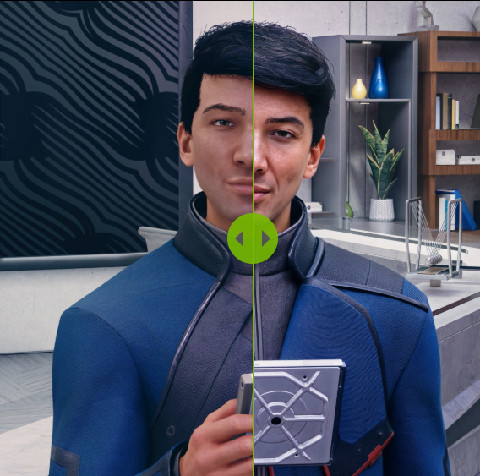
Nvidia hosted its annual GPU Technology Conference and presented the next stage of its AI upscaler, DLSS 5. Instead of applause, the tech and gaming community caused a massive uproar. Shockingly, game developers are speaking out about this new filter, whether they support it or not. CEO Jensen Huang responded to the backlash, hoping those who doubt the technology will come around once it is released.
What Makes DLSS 5 Different from Previous Versions?
Deep-Learning Super Sampling (DLSS) is Nvidia’s in-house transformer architecture that was originally meant for rendering lower resolutions to appear as a higher resolution. The process consists of frame generation, ray reconstruction, and anti-aliasing to enhance gaming performance and video quality. The AI upscaler became an appeal for developers who strive for realistic graphics and motivated their rival, AMD, to create their version of DLSS, FidelityFX Super Resolution (FSR).
Yet, Nvidia’s decision to become an AI-first memory provider has shown that its service to gamers has diminished. When the green GPU manufacturer released DLSS 5’s video demonstration, a sea of backlash immediately struck their core. Here’s what was shown in the following video:
Unlike its predecessor, DLSS 4.5, DLSS 5 relies on color and motion vectors in its frame generation and rendering process. The transformer then replaces the assets with an AI model of the scene with photo-realistic lighting. Nvidia explained that it does preserve a game’s original 3D source content, but the majority have disagreed and said, “It somehow became uncanny valley.” And the presentation doesn’t lie.
DLSS 5 Hates Motion
The presented games, including RE9: Requiem, were scanned and reproduced in a way that no longer fits the game’s core style. Hogwarts Legacy’s second clip is a prime example of when an AI fails to generate properly. The protagonist is a child attending the wizard academy. DLSS 5 mistook them for a middle-aged man and replaced Avalanche’s model with its own.
From what I can tell, Nvidia lacked testing for abnormalities. The most noticeable features are skin outline sharpening, adjusted and added facial features, and brightness overpowering contrast. PC hardware enthusiasts examined the footage multiple times for any missed imperfections in the AI recreation. Graphics card tester Vex identified that Grace Ashford’s eyes on DLSS 5’s end were jittering.
Nvidia granted permission to selected partners before GTC and, unfortunately, embarrassed themselves. Tech news site Digital Foundry is the one receiving the most criticism. Journalists Rich Leadbetter and Oliver Mackenzie released their deep dive directly alongside an article on Mar. 16.

While they acknowledged the GPU manufacturer’s vision, Leadbetter and Mackenzie failed to recognize the AI malfunctions. It became evident during their Oblivion Remastered gameplay. The upscaler did a great job of improving the environment, yet it lacks recreating model animation and loadouts.
DLSS 4.5 and its ancestor architectures succeeded because those learning models can identify pixels to improve resolution. This helps add visual effects to games and enhances lower-end graphics in the gaming experience.
Its disruptive successor, on the other hand, can’t replicate that same rendering method because its new subjects are vertices and UV maps. DLSS 5’s generative properties are best for still or shifting 3D assets. Its architecture is unable to keep up with consistent and complex movements. As seen in the Oblivion Remastered segment, characters will have certain assets of their model either deformed, altered, or missing during interactions with the player.
The Digital Foundry directly received negative feedback for giving Nvidia a passing grade for their so-called effort. Leadbetter later sent an apology on Mar. 18 on X. He told the site’s followers, “We should have taken more time with the material, and I think it would have been prudent to wait to see the reaction from the audience and the developers to the keynote.”
Which Game Developers are Rejecting the ‘AI Slop’ Filter?
In recent reports, four game studios have confirmed they are mortified by both Nvidia’s and Digital Foundry’s demonstrations. First up is Nintendo, which previously expressed dislike of generative AI for game development at the 2025 Tokyo Game Show.
They have stuck to their guns and stayed on the course of DLSS 3.1 for the Nintendo Switch 2, as confirmed by Lynxbyte Games on Aug. 11, 2025. On the same day as DLSS 5’s reveal, Nintendo announced the next console update, called Handheld Boost Mode, will allow original Switch games to be playable at 1080p while portable.
Two of the featured developers, Ubisoft and Capcom, are at odds with the executives who are approving Nvidia’s next-gen AI upscaler. Both studios have informed Insider Gaming that they have been “left in the dark” about the cooperation. One Ubisoft developer said, “We found out at the same time as the public.” The likely candidates to approve Assassin’s Creed Shadows for the filter are co-founder Yves Guillemot and the lead developers behind their playable AI, Teammates.
Capcom is going through a similar situation with their executive producer Jun Takeuchi. The studio has informed Insider Gaming that it has historically been “anti-AI.” This response contradicts their experimentation with Google Gemini, which is confirmed by Monster Hunter Wilds’ Kazuke Abe. He and Capcom previously stated that it was used during the idealization process on Jan. 23, 2025.
The last developer came in the form of supporting a Death Stranding 2 fan. They praised Kojima Productions’ dedication to finding balance in perfecting game design without the need for an AI filter. X user NikTek commented about the PS5 exclusive on the following post:
Indy100 reported that Hideo Kojima later reposted the tweet out of respect on the day of the PC port launch.
Jensen Huang is Completely Disconnected from Gamers
Halfway through the week, Nvidia’s Huang has had enough of the backlash over DLSS 5. He responded officially during the Q&A session at GTC, “Well, first of all, they are completely wrong.” Then, he explained, “The reason that is [because the architecture] fuses controllability of the geometry, textures, and everything about the games with generative AI.“
Huang does try to persuade journalists, saying that it helps developers fine-tune their game without losing artistic control. The ‘AI slop’ setting is indeed optional, but there are developers who want to get their hands on it, such as Bethesda’s Todd Howard. Though the Nvidia CEO should tread carefully, his company suffered a $600 billion loss on its AI venture last month, driven by demand for hyperscale data centers.
