
Recently, the AI industry has reached a new low. From Nvidia’s DeepSeek jealousy to Microsoft announcing their departure from OpenAI, investors are recognizing that artificial intelligence is not generating the expected profit. And economists have traced their findings back to the business’s worst nightmare. The reason the AI bubble is crumbling is that companies are hyperscaling their products, and that is viewed as untrustworthy.
What is Hyperscaling?
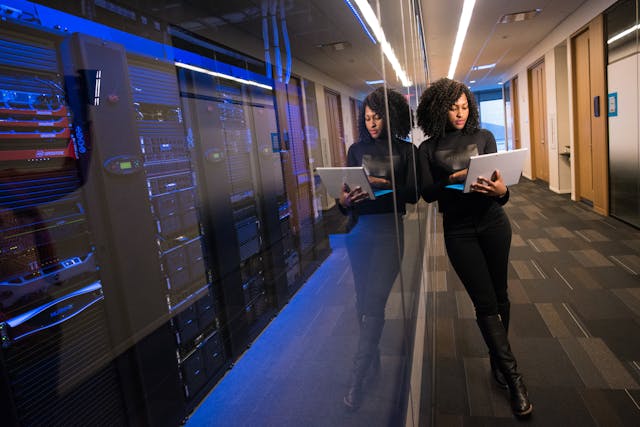
Hyperscaling is when an IT company expands its computing infrastructure to meet massive demand and deliver faster responses. In the AI industry, this strategy will allow artificial intelligence software to operate at rapid speeds because it requires high memory speeds to scan for information and generate an answer based on the top results. But what happens when the companies that cater to the technology abuse the strategy?
A Snowball Effect Disturbs the AI Bubble
Since 2024, the tech industry watched as business leaders and a few countries, including the United States and India, invested billions of dollars in generative AI. The world gradually saw it used for disinformation, plagiarism, and AI-generated content. Despite having tech experts researching and training people in the technology, a majority of business leaders want to innovate it to fully automate jobs rather than assisted 80% of the time.
EA CEO Andrew Wilson preached this philosophy to the video game and entertainment industry. He believed that adopting generative AI would provide faster workflows with less human effort. On Sept. 29, 2025, he accepted a joint purchase from Saudi Arabia, Jared Kushner’s Affinity Partners, and Silver Lake for $55 billion. Wilson needed $12 million to cover electricity costs for AI data centers, which can consume up to 300 megawatts. His actions led to the layoff of around 400 employees from Titanfall’s sequel.
Other tech industry leaders, such as Nvidia’s Jensen Huang, sought to invest their PC memory components in hyperscaling infrastructures due to the success of China’s cheaper AI software, DeepSeek. US President Donald Trump seeks to have the U.S. reach that same potential after the artificial intelligence wiped approximately $1 trillion from the global stock market on Jan. 27, 2025.

OpenAI CEO and ChatGPT founder Sam Altman was recruited as the Trump administration’s primary AI advisor. From there, he prioritized partnerships while initiating hyperscaling to meet nationwide demands. This caused a majority of the tech industry to integrate AI technology into consumer computers, everyday electronic appliances, and the job market.
Unfortunately, a rude awakening came when people became aware of AI’s flaws. Economists and data analysts learned that Altman’s $1 trillion spending did not match OpenAI’s annual billion-dollar earnings, resulting in ChatGPT relying on ad revenue. Microsoft’s Copilot and Recall, forced into Windows 11, have pushed its consumers away due to their invasion of privacy. And Nvidia faced an estimated $600 billion loss as DeepSeek reigns supreme during China’s technology independence.
Two of the most disturbing acts in the AI industry are Grok generating illegal pornography and Trump’s Obama ape video. Grok owner Elon Musk was exposed in the Epstein Files on Jan. 30. This led to France investigating X after thousands of generated images containing minors were found.
Meanwhile, the re-elected president faced scrutiny after he posted an AI video depicting former President Barack Obama and his wife, Michelle, as gorillas on Truth Social. After it was removed, White House Press Secretary Karoline Leavitt tried to persuade the US press that “it’s a parody of The Lion King.”
This was after the third batch of the Epstein Files was released, which redacted the president’s name 38,000 times. He attempted to distract the American people to preserve his leadership. Instead, he further pushed his disapproval rating downward and motivated the nation to fight for full transparency.
How Much Damage has Hyperscaling Caused?
Altman and the AI leaders who pushed for hyperscaling are now facing the reality of a short-lived venture. According to CNBC, Big Tech spent a total of $126.04 billion to add more AI data centers. Their Nov. 6 report showed that 60% of their funds came from a second Investment Group bond during 2025 Q3, while 30% percent came from loans. That rapidly increased to around to $650 billion on Feb. 6, 2026.
And as you can tell from Nvidia’s latest loss, the industry is suffering from their bullish spending. CES 2026 became a sign of businesses bloating due to smart devices and computers with AI integration. There were only a few companies, and engineers pursued a more assisted approach than a fully automated one, such as Caterpillar’s autonomous vehicles that will be monitored by remote workers. Others are prioritizing a local AI assistant over linking to a Wi-Fi connection to ensure the user’s privacy.

After an entire year of pro-AI, Big Tech is starting to fall apart. Microsoft CEO Satya Nadella was reportedly severing ties with Altman after he and the company were struck with reality. On Jan. 29, the Xbox manufacturer lost $357 billion from their investments. Oracle, which is in charge of the now US-owned TikTok, owes $100 billion after months of entering a $300 billion deal with OpenAI for a five-year cloud computing contract.
As for the Ram Crisis, sales are bound to fall short if the top 3 suppliers, Samsung, SK Hynix, and Micron, can’t keep up with hyperscaling demands. Not to mention that more GPUs and RAM scalpers and scammers are on the rise. This is due to the PC components containing gold and to people trying to upgrade their current computers. Thankfully, RAM producers like Corsair are changing their full cardboard packaging to see-through so customers can see the product before purchasing.
What is needed for these businesses to survive is to try to pull back and see how they could recover from their financial losses before digging themselves into a deeper hole. Adding more AI data centers will worsen the supply chain. If they don’t pull back, Big Tech will single-handedly risk the US economy sinking into a new recession.
