
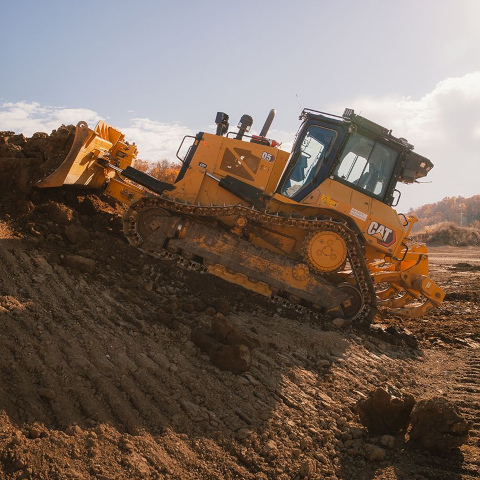
Construction and robotics company Caterpillar recently unveiled their new construction vehicle line featuring an AI assistant and an autonomous computing system. CEO Joe Creed and his experts inform potential investors that they aim to integrate artificial intelligence to secure physical jobs, improve work efficiency, and ensure safety for future architectural projects. After finishing their CES 2026 presentation, their ambitions hold the potential to set standards for using AI responsibly on the job site.
Caterpillar Cooperates with Nvidia
Vice President of Nvidia’s Robotics and Edge AI department, Deepu Talla, got tasked to lead and assist Caterpillar with their upcoming vehicle automation system. He further explained that Nvidia and the physical labor workforce want to start shaping it by utilizing physical AI rather than relying on more software advancements. The technology combines robotic engineering and edge AI.
Nvidia will provide Caterpillar with their Jetson Thor series APUs that are integrated with their Blackwell GPUs (Nvidia 5000 series). It claims to provide strong AI performance at 2070 teraflops and lightning-fast inputs at 23 GB/s. They are also energy efficient, using between 40-130 watts.
Talla mentioned that as more industries adopt evolving technologies, there’s a need to support workers. “We’re building factories for everything, right?” he told CES visitors.“Physical goods, power generation, and AI every day. At the same time, every industry suffers from a huge global labor shortage, skill gaps, and safety requirements. Physical AI and Caterpillar will help close this gap.” Nvidia is using three CAT work systems that will aid their mission.
- In-cab AI: An operator assistant that will enhance employee coaching, safety alert notifications, and improve productivity by providing real-time insight.
- Job Site Autonomy: Construction and mining machines are equipped with AI to calculate data and give recommendations based on the available job site data in milliseconds while helping with workers’ tasks.
- Working with Machine Intelligence: CAT fleets cooperate with the machines through computer vision and edge computing by processing sensor data. The information will update over time with its adaptive machine intelligence.
How Does CAT AI Function?
Chief Digital Officer Ogi Redzic told investors that their construction machines will have the CAT AI Assistant installed. As the work pipelines are growing faster, Caterpillar intends to use the technology to coach first-time operators without disrupting ongoing construction work. Redzic’s colleague and product specialist Mark Perkes gave a real-time demonstration during the stream at CAT’s CES West Hall booth.
Perkes sat in the CAT 306 mini excavator with CAT AI located on the right side window. Its first-generation build appears to be designed as a tablet attachment that acts as a kiosk guide. It takes vocal commands starting with “Hey Cat,” and it will respond to you based on your questions. In a construction operation vehicle, it will scan the machine’s system and teach the necessary steps for proper control use. It can even provide images for visual learners.
Caterpillar granted safety protocol commands for on-site hazards, so when a worker identifies them, CAT AI can generate a virtual danger zone. Using their simulated construction site. Perkes told the digital assistant, “Hey CAT, set an E-ceiling to 13ft overhead.” The assistant will set the limit and will automatically detect if the user reaches the limit. The product specialist perfectly shows the mini excavator’s arm immediately slowing down and completely stopping it.
CAT AI can also connect on smartphones to provide real-time insight within the job site’s perimeter. And best of all, this new integrated technology promises to offer remote jobs to collect reports on the machine’s system health. Redzic informed the audience that Caterpillar wants their physical AI to act as a proactive partner, including maintaining construction equipment.
Automated Construction Vehicles to Deploy in Q1 2026
Chief Technology Officer Jamie Mineart previewed their AI-powered vehicles that can swap to automated tasks. With positions such as mining facing higher demand, Caterpillar is taking advantage of AI tech to improve safer construction solutions. Construction fleets can now monitor and execute various tasks without risking worker accidents.
Mineart mentioned that they tested the integrated equipment with the US’s largest gravel provider, Luck Stone, for a full year at the Bull Run Quarry in Virginia. The results were outstanding as their fleet of driverless trucks hauled 2 million tons of crushed material consistently. Their edge technology allows them to scan and detect obstacles to avoid road collisions.
Third-generation Luck Stone CEO, Charlie Luck, loved that the largest construction manufacturer chose a harsh environment to put their innovations to its limits. He commented on Pit & Quarry, “This autonomous journey with Caterpillar has become one of the most powerful and transformative projects in our 100-year history.”
According to Mineart, the company has been experimenting with automated construction since the 1980s with Carnegie Mellon’s Robotics Institute. AI has now allowed the engineers to achieve that goal. “What once felt like a dream at our Bull Run site is now a reality,” Luck added, “Thanks to the trust, collaboration, and shared commitment between our teams.”
Caterpillar is planning to launch their first AI-powered construction machines in Q1 2026. The ones that will be sent into the market are loaders, haul trucks, excavators, compactors, and dozers. They will be equipped with two of their in-house systems, CAT VisionLink for surface vehicle operations, and CAT MineStar for mining vehicle operations.
