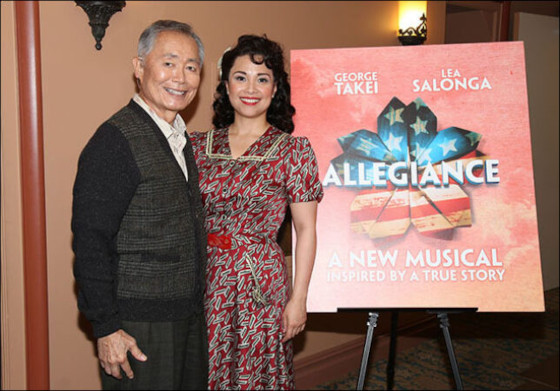
YouTube theater history channel Wait in the Wings (WitW) published their latest documentary on the 2010s musical, Allegiance. Host Brendon Henderson interviewed with the production crew and stage cast ten years after the Broadway show closed its doors.
What was supposed to be the first dominant Asian American Pacific Islander musical and break boundaries in historical fiction shows was cut short by Lin-Manuel Miranda’s Hamilton. Like its unexpected competitor, Allegiance blossomed from the perspective of America’s war history.
What began with Star Trek actor George Takei’s experiences in the Japanese American Incarceration evolved into a series of political influences on creative art direction. The updated 10-year retrospective from WitW depicts that the musical deserves another life on the Broadway stage.
George Takei’s Experiences Brought Allegiance to Life
Stage composer Jay Kuo and producer Lorenzo Thione met George Takei and his husband Brad during an Off-Broadway show. The four later watched Miranda’s musical, Into the Heights, between 2007 and 2008. Its story focused on the lives of New York Latin Americans working towards their American Dream. When the song “Inutil (Useless)” came on, Kuo and Thione noticed that only the Star Trek actor was crying.
He explained that the song reminded him of his late father, Takenuma “Norman” Takei. The Spanish word translates to “useless” because Dominican father Kevin Rosario (played by Carlos Gomez) can’t afford college tuition for his daughter, Nina. Despite his hard work, he felt it was worthless.
Takei mentioned to Kuo and Thione that his father underwent a similar thought process when his family was ordered to relocate to a Japanese incarceration camp during World War II. In 1942, the 32nd US President, Franklin D. Roosevelt, signed off on Executive Order 9066.
The US government authorized the US military on the home front to gather Japanese Americans from their homes and escort them to these confined settlements. The nation feared that any of the adults could be spies for the Empire of Japan after their fleet bombed Pearl Harbor.
The conversation became an inspiration for their soon-to-be musical of their own. After researching the history, the composer/producer duo established the project’s name, Allegiance. The title was perfect for the people pledged under oath to the US flag in the camps.
The AAPI Musical Portrayed Japanese American Hardships
Allegiance went through numerous revisions during its development. While its cast and story are fictional, the musical displays the polarizing relationship between Japanese Americans and the United States during the Great Depression.
Kuo and Thione selected Heart Mountain, Wyoming, for the show’s setting. Kuo commented, “[The camp’s name] sounds epic, romantic. It sounds like something out of a musical, right?” This World War II settlement housed over 14,000 people in 65 buildings. Henderson and the WitW crew had the honor of visiting one of the homes, experiencing the cramped living quarters up close.
Aside from the camp’s name, Heart Mountain is home to the Japanese American resistance, the Heart Mountain Fair Play Committee. The group was organized by the camp’s Nisei (Second-Generation Japanese Americans), who were tired of the unfair mistreatment in 1943. Two pivotal changes would scar them forever.
The first is the US Army’s recruitment process. Military officers rejected all Japanese Americans from enlisting in the war against the Axis Powers. The assault on Pearl Harbor induced so much fear and anger that the US government pushed for media propaganda against them. Henderson made a callback to the Seussical documentary, reminding his viewers about Dr. Seuss’s depictions.
The US military immediately changed its attitude in 1944 after losing numerous soldiers overseas. The Nisei who were drafted made up the 442nd Regimental Combat Team. Knowing they would rather see their families live than endure more pain, they expressed their drive through one motto, “Go for broke.”

The second reason is just as cruel under the guise of a loyalty questionnaire. The Application for Leave Clearance was intended to determine whether a Japanese American is a spy or a US citizen. What made this document controversial are questions 27 and 28 set up by the War Relocation Authority.
Q27 asks, “Are you willing to serve in the Armed Forces of the United States on combat duty, whenever ordered?” In the Japanese American women’s version of the questionnaire, they can choose to volunteer for the Army Nurse Corps or the Women’s Army Auxiliary Corps.
Q28 then asked both genders, “Will you swear unqualified allegiance to the United States of America and faithfully defend the United States from any or all attacks by foreign or domestic forces, and forswear any form of allegiance or obedience to the Japanese emperor, or any other foreign government, power, or organization?” If anyone shows signs of resistance or refusal, they will be taken to the Tule Lake Segregation Center.
Takei told Henderson he watched the resistance rise from the “no-no” boys, remembering, “They jogged every morning with the rising sun with rays painted in red on their white headband. And they jogged around camp with the cadence ‘Wasshoi! Wasshoi! Wasshoi! Wasshoi!’ At the end, they would all gather together and say ‘Banzai! Banzai! Banzai!’ That exacerbated more tension for the camp.”
Why Couldn’t Allegiance Soar Higher?

According to the production crew and the cast, Allegiance struggled to keep its ground due to the survivors and historians battling its creative liberties to portray its message. Two of their obstacles were the Japanese American Citizens League (JACL) and anthologist Frank Abe.
The JACL during World War II was led by Mike Masaoka, who cooperated with the US government on detaining Japanese Americans in incarceration. He plays a crucial role for the leading character, Sammy Kimura, who idolized Masaoka as he preached to his kin to embrace American patriotism.
He inspired him to join the draft, only to return home to learn about his girlfriend, Nurse Hannah, who got shot by mistake during his sister Keiko’s segregation. They did not appreciate his characterization being nonfictional, along with the Heart Mountain Fair Play Committee leader, Frank Emi.
On Jun. 18, 2014, the Masaoka family addressed a letter to the Allegiance crew. “Our families were put in difficult, impossible conditions, and people made various decisions for differing motives and reasons. All of them, including Mike, were victims struggling to find actions that reflected their values and hopes for the future. [We have asked the producers to revise the play] and take a broader spirit of understanding the community dynamics in those times.”
Abe, being a Sansei (Third-Generation Japanese American), says that he is the only person to have personally interviewed Masaoka to hear his experience. He had similar complaints about Allegiance’s depiction of the Heart Mountain settlement. He goes on a long tangent from the facilities to the behavior of the military personnel.
Whenever Kou and Thione wanted more information for the show’s revisions, many quickly hung up the phone because the JACL had warned them ahead of time.
Broadway Should Revive the Show Today

WitW did a fantastic job on highlighting the production’s dedication to breaking the mold with their historical fiction play. Unfortunately, Miranda would take that spotlight away from them with his hip-hop musical, Hamilton.
However, this AAPI musical should return to the Broadway stage. The United States has been undergoing to remove pivotal points of American history since Donald Trump’s return to the White House in 2025. Many include the LGBT+ community, African American enslavement, and any records his administration deems ‘useless’.
Executive Order Restoring Truth and Sanity to American History is a national initiative to remove the history relating to minorities. Over the past year, Densho Encyclopedia has resisted censoring the incarcerated lives of Japanese Americans. They responded, “[The Smithsonian’s censorship] is a part of a disturbing, and quickly escalating, attempt to erase and exclude marginalized histories from our national consciousness. […] We cannot honor the ‘richness of American History’ by refusing to acknowledge the entirety of that history.”
US citizens have even witnessed how much the president has damaged the nation’s reputation by repeatedly abusing the Constitution, obstructing the Justice Department, and now, admitting he’s not interested in recovering the country’s financial debt. He has repeated history by engaging in fanaticism, which was warned about in the 1943 US film, Don’t Be A Sucker.
At the end of 1944, Mitsuya Endo successfully ended the operations of the Japanese American Internment. The Supreme Court favored her because she petitioned for habeas corpus on behalf of an incarcerated state employee.
Among the four cases challenging the US government, Endo’s case proved that Japanese ancestry does not determine an individual’s loyalty to a country, only their actions to provide for it. The affected families were given bus tickets and $25 USD (~$460-$470 USD in 2026) to return home. However, the US dropped atomic bombs on Hiroshima and Nagasaki in 1945.
Allegiance has the perfect musical numbers that describe the irony of the Americans winning World War II and freeing Europe. “Itusuita” and “442 Victory Swing” presented the despair during the celebration of stopping Hitler’s endeavors to conquer Europe. Stage director Stafford Arima did not hold back on the creative direction either, using the backdrop screens for the explosion, transitioning to an American flag.
The eeriness of “Itusuita” represents the homeward Japanese Americans who witnessed a part of their parents’ country being annihilated. Those who were drafted or joined the 442nd Regimental Combat Team celebrated victory with their Caucasian comrades. The happy ragtime melody dilutes the tension awkwardly, which speaks volumes to what US citizens are experiencing today.
If you like to learn more from the Wait in the Wings documentary on Allegiance, you can check it out on their official YouTube channel.
