
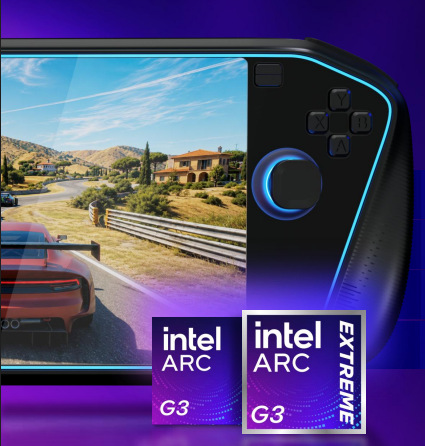
Earlier in January, at CES 2026, Intel announced that it will contribute its gaming processors for handheld gaming. Fast forward to June, the Arc G3 is revealed and is ready for hands-on demonstration at Taiwan’s tech exposition, Computex (also known as Computex Taipei).
Within the past weekend, the mobile processor has immediately astounded its audience with its advanced adaptive features. Reporters and tech reviewers have even claimed that it’s going to break AMD’s reliability in the industry. After multiple benchmarks were run on the supported devices, Intel held its promise to deliver high-quality performance for future handheld PCs.
Intel Hyped A Confirmed Leak for Arc G3’s Performance
For over 4 months, tech enthusiasts were impressed by Intel’s Panther Lake series. The 3rd series of their Core Ultra CPUs utilizes low power consumption for a substantial gaming experience while maintaining user efficiency. Yet, not many developers have adapted Intel’s XeSS upscaling and frame generation. Not even the controversial Unreal Engine 5 could stop microstuttering in games that do support it.
Panther Lake competed against AMD’s latest accelerated processing unit, the Strix Halo. Multiple benchmarks pitted the Core Ultra X9 388H against the Ryzen AI Max+ 395. Multiple benchmarks showed that the Strix Halo is slightly stronger than its Intel counterpart, but some have warned that Panther Lake’s processor could surpass it in the future.
A leak soon spread that the Arc G3 would be the next name for the gaming chip on April 28. Video Cardz reported that Intel confirmed the name, and there will be two versions in production: the G3 with a 10 Xe3-core iGPU and the G3 Extreme with a 12 Xe3-core iGPU.
At the time, curious gamers built simulations one month before Computex. ETA Prime used the OneXPlayer Super V, a laptop running on Core Ultra X7 and integrated with Arc B390 graphics. By running at wattages of 12, 15, and 25, and disabling two P-cores, the Arc G3 Extreme was expected to handle medium and low settings in games with frame generation on.
The Arc G3’s True Gaming Specifications
Intel brought their official partner handhelds to Computex: Acer’s Predator Atlas 8, MSI Claw 8 EX AI+, and the OneXPlayer 3. All three producers have confirmed that their gaming consoles will have the Arc 3 Extreme installed.
OneXPlayer claims that the 18A processor improves 50%-77% of system performance while prioritizing power efficiency and thermal management. WCCF Tech gathered that the Claw 8 EX AI+ provides the most RAM, offering up to 32 GB of LPDDR5x dual-channel memory. And Acer confirms that the partnered handheld PCs support PCIe 4.0 NVME storage.
The largest concern in the room was Arc G3’s reliance on frame generation and XeSS upscaling, as both are using adaptive AI to stabilize gaming performance. Some consumers feared that Intel would follow Nvidia’s method of utilizing generative AI visuals, as shown in the DLSS 5 trailer. That is not the case for this all-in-one computer chip.

PC World journalist Adam Patrick Murray published his short review on the Predator Atlas 8 running Forza Horizon 6 at Acer’s demo booth. The footage shows that with Native settings and no upscaling, Intel’s Extreme processor can operate modern games at up to 60 FPS.
Tech reviewer Paul Antill removed XeSS frame generation when testing Battlefield 6 at 1080p resolution on High settings on the Claw 8 EX AI+. The competitive gaming demo provided similar results with 65 FPS. Both are impressed by the Arc G3 Extreme’s capabilities for their supported handheld PCs.
Even more impressive is that they are compatible with other controllers, such as the Xbox Series X|S. They can run smoothly on larger screens for a wonderful high-end home gaming setup. According to the official specifications, the Extreme version can run up to 8K resolution at 60 Hz, while 4K resolution at 120 Hz on handheld PCs.
Clarifying Intel’s Frame Gen Support
Gamers Nexus host Stephen Burke interviewed Intel’s lead spokesperson, Tom Petersen, before Computex began admission. Before joining the CPU manufacturer, Petersen previously worked with Nvidia for 13 years as a tech engineer and marketing director. He also holds a Bachelor’s and Master’s degree in Science in Computing Engineering and Architecture, and an AI certificate from Stanford University Professional Development.
Throughout the May 31 interview, Petersen was very thorough, explaining Intel’s mission with the Arc G3 processor series for handheld gaming. When the ‘Frame Gen is the Way’ panel arrived, Burke was surprised by Petersen’s response to the stats.
He told him and the Gamers Nexus’ crew, “I think [frame gen] is very important for [handheld PCs] because of its energy saving. Obviously, you will need to test it for yourself, play it on and off. When you turn it on, gaming performance is 2x smoother. Don’t think of the [higher numbers as FPS]. Think of them as a smoothing factor.“
Burke agreed with the Intel spokesperson since gamers often mistake frame generation for in-game speed performance. Petersen further explained that the manufacturer’s competitors are competing for extrapolation, a calculation of predicting or estimating values based on the observed data.
“If you do it good, it can be used to help with game latency,” he added. “There are two trains of thought that I have on this. One is that extrapolation would be great if you do it well. It is a very hard problem because you lose half of your information, but AI can be pretty useful for that. But there are other ways to reduce latency that I think would be more effective.”

Petersen even acknowledged Burke’s observation when he noticed that frame generation lowers Cyberpunk 2077’s real FPS while the rest is filled in with XeSS. Comparing it to Super Resolution, the frames are accurate and maintain the game’s true performance on the Arc B390.
Intel is also aware of how much energy AI consumes. Petersen educated Burke’s viewers that frame generation drains massive amounts of power because the AI is trying to rasterize in real time. “[The AI] has to do a complete geometry simulation, and it has to draw each pixel from scratch, figuring out the color.” Until more benchmarks are published, the Arc G3 appears to have a bright future ahead for portable gaming.
