
The press conferences at Computex 2026 are exactly what people experienced at CES 2026. Big Tech is aiming to install artificial intelligence everywhere, mostly for the worst. Now, Nvidia and Microsoft are on the verge of developing agentic AI for office and home computers.
The supporting industry leaders are labeled as AI disruptors, trying to force creatives and white-collar workers to adapt to the technology. Consumers are aware of the prices that make personal computers less affordable, along with businesses and schools struggling to provide the best equipment to do their jobs. As people rebel against the AI bubble, we are seeing a resurgence in retro tech to avoid AI algorithms.
Applying Agentic AI as A Bloatware Service
Since OpenAI’s debut, many tech industry leaders have competed to strive for a piece of its glory. 2025 soon became the year that AI investors panicked as they noticed most consumers were actively avoiding their products and services. Microsoft CEO Satya Nadella is the perfect example of advertising Copilot as an AI assistant on Windows 11 and Microsoft Office 365.
Instead of being helpful, Copilot’s developers designed its software to take over multiple user interfaces. That includes scanning your art on Microsoft Paint, vibe-coding in Notepad, and editing in the Photos app. Many users either switched to Linux or Mac or used custom GitHub coding to uninstall it permanently rather than temporarily. Users considered the tactic to be bloatware.
Despite Nadella ending his partnership with OpenAI, Microsoft is partnering with Nvidia for agentic AI development. Their newest superchip, RTX Spark, will be integrated into ARM-based PCs. However, CEO Jensen Huang and Nadella have conflicting visions.
According to PCMag, Nadella’s attitude toward AI changed at the Computex 2026 presentation. Microsoft’s next step is to focus on creating a more stable version of Windows on ARM PCs for engineers and developers. They see Nvidia’s RTX Spark as the best option because its enhanced performance can support their workloads rather than relying on x86 and x64.
Huang partially shares that vision, but continues to market the superchip’s capabilities for handling creative software rather than a reliable workload processor. He advertised Nvidia’s Nemotron 3 Ultra, an agentic AI service that claims to generate solutions for all industries, including coding, video creation, and even music. The Nvidia presentation does not justify the bloatware approach.
What’s more worrying is the number of AI providers the company partnered with, especially OpenClaw, which has been struggling to repair itself in the past few months. NVIDIA has partnered with over 30 companies and platforms for RTX Spark.
AI Has Contributed to Digital Fatigue
Big Tech’s agentic AI agenda does not resolve the issues that the generative counterpart has produced. The technology is manipulated by users for media slop and electronics sales rather than innovation. The business practice of stuffing it into everything has been widely considered predatory.
If you watched Super Bowl LX, one commercial had successfully destroyed itself by integrating AI into surveillance. Amazon’s camera service Ring presented the ad “Be A Hero in Your Neighborhood”. It demonstrated the Search Party feature to locate a lost pet.
Their now-former partner, Flock Safety, hoped neighborhood watchers would use it to lower crime rates. The security developers failed to recognize that agentic AI surveillance puts user data at risk. More apps and services have adapted the tactic as governments, including the United States, demand Orwellian safety protocols. Even opting out does not prevent companies from collecting your private information.
The AI disruptors have embarrassed themselves for the Class of 2026 college graduations. The speeches that are meant to encourage young adults in their careers have left them disappointed. The most disrespectful comes from former Google CEO Eric Schmidt, discussing artificial intelligence rather than celebrating the graduates’ achievements.

When they booed during his speech, Schmidt responded, “You are inheriting a mess that you did not create. […] The question is whether you will help shape artificial intelligence.“ Media law and ethics assistant professor Israel Balderas further explained that this frustration goes beyond university students.
Since 2022, AI integration has shifted future generations into digital fatigue. The technology has been rapidly incorporated into every industry it could touch. Anyone unfamiliar with it is immediately shunned in the hiring process. Gen Z is struggling to stay afloat, for many are unsure if their existence matters in the workforce.
Washington Monthly reported that 46% of business executives said AI integration increased their chances of entry-level jobs. Meanwhile, 13% responded with the opposite effect. The Strada Institute director, Andrew Hanson, commented, “What used to be entry-level jobs, [the grunt work and learning on-site], is going away. Entry-level roles are becoming more like mid-level roles.”
Balderas informed his followers on Instagram, “Here’s the danger [of teaching AI integration in schools]. If higher education becomes solely about work efficiency, automation, and output, then universities stop being places where human beings are formed. They are transformed into tools for factories for credential production. And that’s the real threat.”
And unfortunately, the CEOs supporting AI automation are proving they do not care for your well-being. In April 2026, a Kimberly-Clark warehouse was targeted by 29-year-old Chamel Abdulkarim. Poor worker wages and wage theft caused him to resort to committing arson. He publicly posted his actions and rang the alarm, shouting, “All you had to do was pay enough to live.”
The Retro Tech Resurgence Is Keeping Spirits Alive
The digital fatigue drove people raised in the 1990s and 2000s to take a step back. Whether it’s to take a break from ad bombardments for AI or social media abusing it for malicious purposes, they crave retro technology.
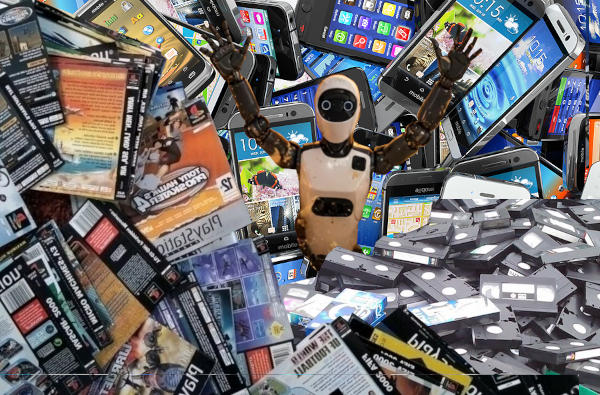
Agentic AI is seen as the next step in the attempt to override online safety, information theft, support biased opinions, and be the future worker. Big Tech’s agenda has inspired Gen Z and late millennials to search for non-invasive media and electronics. What was once thought to be E-waste is making a comeback.
The world witnessed the trend explode in March 2025, starting with people actively deleting social media apps and spending time away from their smartphone screens. Former RCA Records recording artist London Glorfield (aka London Jackson) founded Kickback, a retro tech brand and producer, to fight against the soulless modern-day machines.

They specialize in cameras, audio speakers, cassette players, physical CDs, and even vinyl record players. His Y2K business is still thriving after a year it established. “Tech is a sea of sameness right now,” Glorfield commented in his May 2026 interview with Business Insider. “This cultural shift away from wanting to be on your phone all the time has been hugely beneficial to us.”
Homemade analog revival projects have made a splash over social media as more people contribute to revisiting and exploring the potential of older tech. MP3 players, DVD players, and game consoles are the top 3 you will see. Due to the digital media market battling for ownership, they crave offline experiences that don’t require a streaming subscription or a premium upgrade.
I, too, have devoted myself to fighting against agentic AI by hunting for older computer parts that can handle current work standards. I soon yearned for a DVD player that could play both DVD/CDs and Blu-ray discs to watch any shows and movies without relying on a streaming service that has certain content region-locked. Since 2025, I have not regretted learning and researching tech to rebel against the AI bubble.
