
No one becomes a writer because they want to be famous. Only famous writers are famous. We especially wouldn’t choose to do it during a literacy crisis. We do it for the love of the craft. Writing if even no one were to ever read a single word we wrote. That last part, unfortunately, is becoming even more true around the globe.
My mother would beg to differ, I’m sure, but I’m not special. I’m not the only person with a liberal arts degree who was specifically told to major in something else (more STEM-focused). Nor am I the only writer that’s been asked, “What are you going to do with that?” when talking about my writing projects, because “writing isn’t a real job.” Like many of my peers, I’ve settled into and have even found solace in doing what I love, no matter the (often very high) risk.
What a Literacy Crisis Looks Like in the US
28% of adults in the US are at the lowest level of literacy and would be considered what we call functionally illiterate. It’s not that they can’t read at all; it means that these individuals face significant challenges when trying to comprehend or use written information in practical contexts.
This not only makes it more difficult for these people to function in professional spaces but also limits their participation in democratic processes and community affairs. It makes them less likely to vote or be more easily swayed by those who might not have their best interests.
The literacy crisis impacts the lack of critical thinking we’re seeing as well. Literacy is directly linked to cognitive flexibility, logical reasoning, and problem-solving skills. And if you’re a good writer, it’s a necessary skill for people to not only be able to read your work, but to seek it out.
The United States is also facing a significant literacy crisis among children, with many students struggling to read at grade level. Recent assessments have shown that a large percentage of fourth- and eighth-grade students lack proficiency in reading, a problem that worsened during the COVID-19 pandemic. Unequal access to high-quality education, limited early childhood literacy support, socioeconomic disparities, and plain ol’ American racism are the contributing causes.
What Environment Does This Create for Today’s Writers
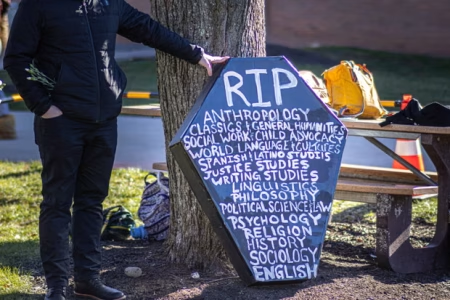
Writers today already have to deal with the dreaded algorithm in the hopes that their work will reach their target audience, and as mentioned earlier, pushing students towards STEM careers isn’t anything new. It’s just far more enforced. As universities continue to cut humanities programs, and policymakers increasingly emphasize technical and quantitative skills, literacy is being viewed as secondary. Despite being fundamental to success in every field.
This attitude creates a difficult environment for writers who may already feel that their work is undervalued and are constantly dealing with jumping through the hoops of traditional employment. As for the even braver writers who bet on themselves and make an attempt towards publishing books, A weaker reading culture can make publishers more cautious, reducing opportunities for new or experimental authors.
Artists reflect the times.
One of the saddest consequences for me is the impact the literacy crisis can have on future writers. That being said, we could have less. Strong writing skills are built through extensive reading. If children read less, fewer may develop the skills and passion to aspire to become creative writers. Nina Simone once said:
Because writing has always been revolutionary and a way for us to time-stamp and record the cultural climate. Now, as a writer, I believe even more so that it’s our duty to encourage present storytellers to reflect the times. Hopefully, the watching youth will be inspired by those of us who put pen to paper (or hands to keys), despite dispute.
