
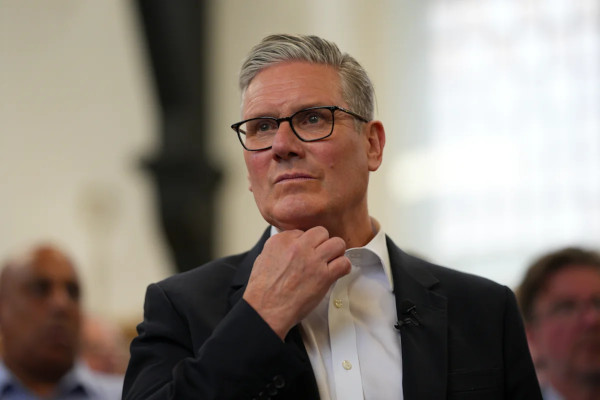
United Kingdom Prime Minister Keir Starmer plunged the government into distress as he announced his resignation on Jun. 22, 2026. In less than two years of his leadership, citizens across the nation saw that he and the Labour Party’s policies had given mostly non-beneficial results.
He inherited and attempted to lower Britain’s debt, restricting internet use for children and teens, and survived the backlash of former Lord Peter Mandelson’s association with late sex offender Jeffrey Epstein. Starmer was seen as the man who would undo the Conservatives’ misdemeanors to improve the government, only to fail at setting a substantial foundation for necessary changes.
Keir Starmer’s Legal Career Made Him Top PM Pick
Before diving into his downfall, it’s important to know why Keir Starmer was Britain’s beacon of change. In the late 1980s, Starmer studied law to understand human rights issues. He graduated with a Bachelor of Civil Law from Oxford University in 1986, then passed the Middle Temple’s bar exam in 1987. He furthered his education by working as a barrister, researching and organizing human rights cases.
Starmer soon cemented his legal career when he became the Doughty Street Chambers’ lead lawyer in 2002. He demonstrated his social justice to major corporations and power players who tried to manipulate British law in their favor.
He offered legal guidance to Greenpeace activists Helen Steele and David Morris in the McLibel case. McDonald’s threatened to sue them and three other colleagues for spreading disinformation about the company. Because of Starmer, the case went from 1990 to 1997. While Steele and Morris did not win the case, their impact addressed the burger chain’s malpractice that they attempted to hide.
The human rights lawyer was even hired as an adviser for international cases on certain occasions. He helped abolish the mandatory death penalty in several Caribbean nations and African countries. News outlet The Sun weaponized Starmer’s achievement by stating he defended murderers in 2024. It was an attempt to stain his 2024 prime minister campaign.
Historians marked Keir Starmer’s shift into politics after retiring from the Northern Ireland Policing Board in 2008. He was appointed the Director of Public Prosecutions (DPP) and Head of the Crown Prosecution Service (CPS). He endured a series of national cases that left people cheering on his pursuit of corrupt politicians and criminals.
He oversaw the Members of Parliament Expense Scandal, exposed by journalist Heather Brooke. She has proven that several MPs abused the system for various purchase reports, mostly resulting in false accounting and mortgage fraud. And he helped reorganize the CPS in the retrial of the Stephen Lawrence murder by allowing forensic evidence in investigations.
But people wanted Keir Starmer as prime minister when he tackled the Partygate scandal. In late 2021, his predecessor, Boris Johnson, was reported to have hosted two Conservative parties in Downing Street during the COVID-19 lockdown. A six-month investigation revealed that 83 officials repeatedly participated in eight events and committed 127 violations.
Starmer told the press that he “set a trap” for Johnson by asking about the now-former Director of Strategic Communications, Allegra Stratton. “I first asked him, ‘Did you apply all the rules?’ I haven’t seen the video of Allegra.” He referred to the mock interview from ITV that questioned the Christmas party in No. 10.
He continued, “But he was told about her laughing in response to being asked, ‘What do we say about the parties?’ So I said to my team, ‘I think there is something here. Let’s get him on record. Because [Johnson’s] first instinct will be to lie. It was a thread that would be pulled over for months. […] It paid dividends in the end. He’d had to leave parliament because he lied.”
How The Labourers Caused Keir Starmer to Fall
According to UK Political, Keir Starmer has been a longtime member of the Labour Party since he was 16. He joined the radical group when they were known as Young Socialists, but later departed to focus on his education at Oxford.
While Starmer pursued his legal career, Labour leaders Tony Blair and Gordon Brown reformed the party, which aided their win in the General Election in 1997. Northern Ireland once loved them for their efforts to end violence from the Troubles era with the Good Friday Agreement in 1998.
They established the National Minimum Wage and the New Deal to raise workers’ pay. They continued to gain support for fighting for equality and social justice until they lost government control in 2010. Labour members blamed the 2007 recession for their downfall.
Starmer soon took the mantle of the Labour Party in April 2020. He became the hope of reconnecting the political group with the British public. He succeeded when he won the 2024 General Election by promising to undo the harm the Conservatives have done to the government.
The former prosecutor did some good by focusing on families in need, securing a national wealth fund of €8.5 billion, and handling immigration measures. Unfortunately, his and his Cabinet’s failures outweigh the positives.
Starmer’s chancellor, Rachel Reeves, stripped the winter fuel allowance for the elderly. Work and Pensions Secretary Liz Kendall suggested cutting disability benefits to save billions of euros. And when he hoped to increase Britain’s national income, Starmer backed down on multiple opportunities to help the citizens, such as the farmers’ inheritance relief.
The Keir Starmer they hoped would guide the nation to glory has taken more of a backseat ride. The Labour Party also alienated the voters as it pushed for more far-right ideology. The UK VPN Ban was one of the earlier signs of government control over the nation. The party also suffered from Peter Mandelson’s involvement in the Epstein Files, lowering Starmer’s approval rating.
Who’s Expected to Fill in Starmer’s Shoes?

Keir Starmer will be keeping the seat warm until Parliament finds its pick for the next prime minister. The top candidate, Andy Burnham, recently won the by-election in Makersfield on Jun. 19. He outpaced Reform UK MP candidate Robert Kenyon by 9,231 votes.
Despite being Starmer’s smoking gun to resignation, Burnham does hold the interests of the Labour Party. According to the BBC, he vowed to follow Chancellor Reeves’ economic policies and not to increase the rate of income tax, VAT, and National Insurance.
With the upcoming NATO strategy meeting for the Defense Investment Plan (IDC) on Jul. 7, Burnham was asked how he would prepare. He wants to reform public investment and procurement to reduce welfare bills and hire more workers, hoping to generate more funds for defense.
