
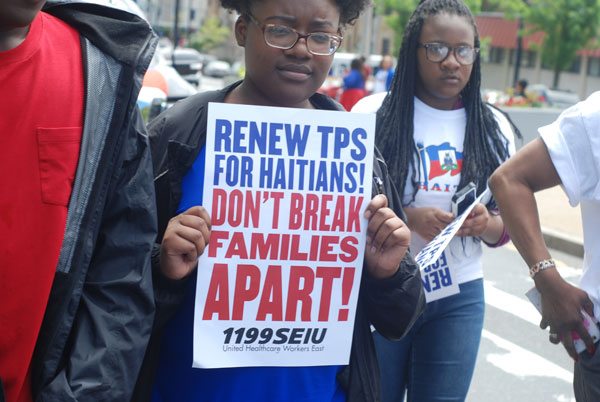
This month, the Supreme Court of the United States sided with the Trump administration and voted to end Temporary Protective Status (TPS) for Haitians in the United States. Individuals currently holding TPS who have no other lawful basis to remain in the U.S. face potential removal, though many have concurrently filed for asylum.
Haitians are not the only group that will be impacted by this order. The 6-3 ruling overturned decisions by federal judges that had blocked the administration from terminating Temporary Protected Status for over 350,000 people from Haiti, but will also erase protective status for around 6,100 from Syria.

What Is Temporary Protective Status (TPS)
TPS has long been used as a humanitarian solution for migrants who are unable to return home safely. President Trump’s efforts to scale back this program and similar programs have further fueled the debate over the immigration policy’s use and scope. Since 1990, TPS has allowed migrants from countries with unsafe conditions to reside and work legally in the United States.
TPS has been granted to Haitian immigrants since the 2010 earthquake that devastated the island. More than 300,000 people were killed by the earthquake, and over 1 million people were displaced. A cholera epidemic, which followed the earthquake, killed another 9,000 people and has only recently been brought under control. In the meantime, in October 2016, Hurricane Matthew brought another major blow, destroying most of the homes in the Southern part of the island.
Despite the immense poverty, lack of infrastructure, and limited healthcare, the Trump administration has concluded that Haiti is prepared to reintegrate tens of thousands of citizens now living and working in the United States.
Why Did the Supreme Court End TPS
This has been a busy month for the Supreme Court, as it has issued controversial decisions throughout June. When the Trump administration terminated TPS for Haiti, Syria, and other countries, lower courts found that the administration failed to follow the procedures Congress established.
Under those procedures, TPS should only be terminated if an interagency review determines that conditions in the country have improved. Documents uncovered during the Haitian TPS case revealed that the Trump administration failed to follow required legal procedures and ignored ongoing dangers in Haiti.
Despite this, the Supreme Court ruled 6-3 that a provision of the TPS statute limiting lawsuits challenging TPS “determinations” prevented courts from hearing any lawsuits challenging the Department of Homeland Security (DHS) secretary’s failure to follow the required legal procedures. In addition, the majority opinion declared that President Trump’s repeated public denigration of Haiti and Haitians did not rise to the level of unconstitutional racial animus that would permit a court to set aside the TPS decision.
One of the Supreme Court judges who voted to end TPS, Justice Amy Coney Barrett, is the mother of two adopted children from Haiti. Some believe this is further evidence that the conservative majority court is more concerned with staying in the president’s back pocket than with upholding the Constitution.
The irony of Barrett voting against TPS while having Haitian children (one of whom was adopted at 3 years old after the 2010 earthquake in Haiti) is a representation of how individualism plagues the courts, the administration, and the country.
How Will This Impact the United States
Haitian communities are spread throughout the United States and are essential to our society. They’re our neighbors, co-workers, and friends, and they have built lives for themselves here that they might not have believed possible in their home country.
Furthermore, thousands of Haitian Temporary Protected Status holders work as essential healthcare workers, nursing assistants, and home health aides in the United States, with many of their patients being the elderly, veterans, and children. The long-term care sector is already under severe strain, and terminating TPS for Haitian’s would further exacerbate those problems.
As The Arc of Massachusetts explained, services that individuals in long-term care rely on, like group homes, day programs, and other community-based supports, were already experiencing severe workforce shortages. The group noted that these workforce shortages will be further exacerbated by immigration challenges.
