
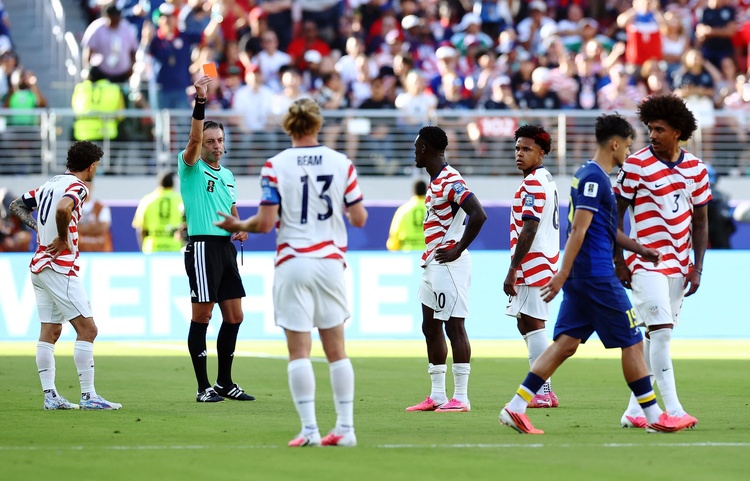
The dream World Cup for the USMNT continued on Wednesday night, but it was not without a premium cost. Folarin Balogun, the brilliant striker who is tied for eighth among all players with three goals so far, was handed a controversial red card early in the second half, with the US clinging to a one-goal lead.
Given Bosnia and Herzegovina’s attacking woes, it didn’t feel inevitable that the decision would cost the United States in that contest, and a late, brilliant free kick from Malik Tillman sealed the victory. But the penalty doesn’t end in the match it’s given.
There is an automatic one-game suspension, and FIFA reserves the right to extend the ban if it sees fit, though that’s incredibly unlikely here. Either way, the USMNT is in big trouble against Belgium without its best goal-scorer, and it’s all because of a red card that truthfully should never have been handed down in the first place.
VAR Steps In to Tarnish USMNT Victory and World Cup Chances

A full-strength USMNT would have a really good shot at beating a Belgium team that has looked pretty mediocre for all but about 35 minutes of play in yesterday’s Round of 32 match with Senegal. But they won’t be at full strength, thanks to a shocking red card handed to Folarin Balogun in the USMNT’s own Round of 32 match.
He is the second-best player on the team, and he’s the best goal-scorer. He was in really good form, and the backups, with all due respect to Ricardo Pepi and Haji Wright, are just not on the same level. Scoring goals will be challenging for the USMNT without Balogun, but he shouldn’t be suspended in the first place.
Usually, when you read a headline saying that VAR ruined something, it’s usually that it robbed a team of a goal because someone’s toe was an inch offside. Here, that’s not the case, though an offside call wiped out two goals for the Americans. It was the right call both times, though.
No, this time, VAR stepped in because of a foul and nearly ruined that contest and certainly ruined the next. After Balogun and Bosnia defender Tarik Muharemovic tussled for a ball in the air, Balogun landed on Muharemovic’s leg. No card was awarded until VAR decided that Balogun’s infraction needed to be examined.
The ultimate decision, after seeing the grisly slo-mo and still-image results, was a red card, which meant the US was down to 10 men for 30 minutes (and 10 stoppage-time minutes) and will be without Balogun for their Round of 16 match with Belgium.
As a side note, it’s a little ridiculous that a non-carded foul was upgraded all the way to a red, and it’s even more ridiculous that that was the first card shown all night. Balogun had some genuine complaints about missed calls against him earlier on, and Christian Pulisic’s jersey was yanked back as he was running past a defender, all without even a normal foul being called.
Two experts agree that this was not right. First, ESPN’s Andy Davies believes that VAR used the wrong protocol here. Second, former Premier League referee Graham Scott noted that he believes the entire system needs refinement.
“With both players challenging for ball, the contact from Balogun on Muharemovic, while it looked bad in slow motion, was purely accidental and an unfortunate result from two players challenging for possession of the ball in a normal football movement,” Davies wrote. “VAR made their recommendation to the referee based on slow-motion and still replays, which is not aligned with VAR protocols, as these should be used for only point-of-contact purposes in a red card tackle situation.”
Graham wrote, “Balogun became a victim of this modern trend against Bosnia. His actions are all part of the normal rough and tumble of football, he is never out of control and the contact is accidental… I would prefer tackles like this to produce cautions at worst. Messi was let off completely, and there is nothing reckless about Balogun’s actions either. In the spirit of the law, Balogun was unlucky.”
Graham also mentioned the controversial non-call on Lionel Messi earlier in the group stage, noting that it was pretty similar to what transpired with Balogun, except that the Argentinian didn’t get a red card. It seems like, based on the rulebook, a red card was inevitable, but the rulebook needs changing, and the protocols need to be applied correctly.
So, what can the USMNT do? There is a valid gripe with all of this, and it seems likely that a governing body would agree if it were pointed out that VAR used the wrong protocols or that Messi was not carded for the same type of foul. Unfortunately, none of that matters.
According to The Athletic, a team cannot appeal a red card decision in the World Cup. What’s done is done. It cannot be undone. And to make matters even worse, Balogun isn’t even allowed to be on the sidelines with his teammates. He can be in the stadium, but that’s about it. Talk about harsh.
So, while it is amazing that the USMNT has advanced to the Round of 16 once more and won its first-ever knockout stage game (and now has three World Cup wins in a single tournament for the first time ever), there’s a huge cloud hanging over the win for a controversial red card that can’t be undone despite its seemingly unfair nature.
