
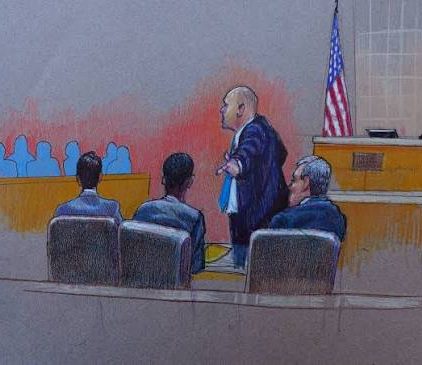
The battle for a new trial in the deadly track meet case is underway as convicted killer Karmelo Anthony, 19, hires a new defense team, which files a motion arguing that his trial defense has a secret agreement with the prosecution. Anthony claims he was coerced into not testifying to avoid disturbing the agreed-upon arrangements.
Motioning For a New Trial
Karmelo Anthony was tried for the murder of 17-year-old Austin Metcalf, who was fatally stabbed in the heart at a track meet in Frisco, Texas, in April 2025. While the defendant never denied the act itself, he justified it as self-defense. Nonetheless, the jury found him guilty, and he was sentenced to 35 years in prison.
Anthony’s new representation filed a motion on Tuesday requesting a new trial. In said motion, they argue that his constitutional right to a fair and open trial was violated when Judge John Roach limited the public’s access. A gag order was issued almost a year before the trial’s start date, and Anthony’s defense argues it was made “sua sponte and on no party’s motion.”
Gag Order Restricting Public Access
The gag order was not violated throughout the trial, but it was taken to an extreme, with the entire pretrial proceedings kept out of public view. All meetings discussing evidentiary issues, trial security, and schedules were held behind closed doors, and no pretrial hearing on access restrictions was held.
“The public docket discloses no motions in limine and none of the substantive pretrial litigation that in fact occurred — filings that were hand-delivered rather than filed in the District Clerk’s public record,” the motion states. “A member of the public who examined the docket before trial would have found no hearing to attend and nothing to read.”
Restrictions on the trial continued to grow as the date edged closer; the courthouse campus was placed under a curfew, and the judge designated restricted zones. All audio, video, and livestreaming were banned; only nine members of the media were allowed in court each day; and only a few dozen seats were reserved for members of the public.
Only eight seats were reserved for Anthony’s family in the courtroom, so his grandfather and aunts were unable to watch the live trial. “The same off-the-record method that hid the pretrial proceedings from the public also produced the understanding on which the entire defense was built,” the defense stated in the motion.
Unwritten Agreement
During pretrial proceedings in May 2026, the lead prosecutor “proposed the parties ‘try the case clean’ — ‘based only on what happened under the tent that day’ — with neither side offering character, reputation, or extraneous-conduct evidence concerning either the Metcalf twins or the Defendant.”
However, the agreement was never written out and does not appear on the public docket. “To avoid media reporting on ‘bad act’ evidence, the understanding was memorialized only as a deliberately generic motion in limine, hand-delivered to the Court on the first day of trial; it does not appear on the public docket,” the motion explained.
Defense was unable to call upon a forensic psychologist to discuss the adolescent’s reaction to a fight-or-flight response or an expert to explain Anthony’s epilepsy because of the unwritten agreement they set in place. The defendant was still allowed to testify, but only “to the altercation like any other tent witness, free of character impeachment, and the defense would present its self-defense case through him.”
Agreement Not Upheld
According to the new defense attorneys, both sides abided by the agreement until the last day of presenting evidence. On June 8, 2026, prosecutors announced: “the agreement had ‘never contemplated a testifying defendant’ and asserted that defense counsel had already ‘opened the door’ by mentioning in opening that the Defendant played chess, a position the Court itself rejected.”
The court found the argument to have no legal mechanism to enforce the agreement “because it had been reached, and presented to the court, off the record — and that if the Defendant testified, the door to character and extraneous-offense evidence would almost certainly open.”
Afterward, Anthony was allotted only 10 minutes to confer with his attorneys and decide whether to testify, and in the end he did not take the stand. “By then, it was too late to conduct a different voir dire, deliver a different opening, or re-cross the State’s witnesses; and as punishment, the defense case was reduced to three pre-approved questions of the Defendant’s mother,” the motion argued.
Motion Arguments Pending Hearing
In the motion, Anthony’s attorneys also request that Prosecutor Roach be recused from the hearing, which has yet to be scheduled for arguments, noting that he appeared on WFAA for an interview discussing the case after the teen had been sentenced to 35 years.
Roach’s statements were described as “problematic” by the defense, and when he was asked if the jury got it right, he responded, “Yeah, they did.” He also said it was an “easy decision” to restrict courtroom access and that “the general public [still] had access to the courtroom.”
“The case remains a ‘pending or impending proceeding’ before the Court at this time, and public statements expressing the judge’s personal views on these matters would suggest to a reasonable person the judge’s probable decision on any motion for a new trial that may be filed,” the motion says.
“Most pointedly, the Court publicly defended the very courtroom-access restrictions that Mr. Anthony challenges as having denied him a public trial — the subject of his contemporaneously filed request for an evidentiary hearing and Motion for New Trial.
“The Court has now publicly characterized the same restrictions as proper and asserted that the public had access to the courtroom. The Court would thus be required to rule on a challenge to its own rulings after publicly committing, in the media, to those rulings’ correctness.”
