
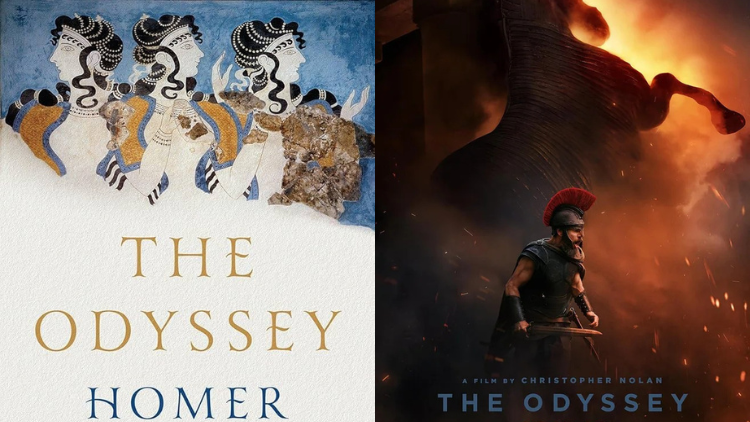
The Odyssey is a difficult story to pin down the details of. Historians aren’t even sure Homer was a real person. He may have been a group of people or a made-up name to put on a story that had largely been passed down orally tons of times before someone decided to write it down. There are well over 60 different translations of the original story, too.
There are also numerous film adaptations. Some are more overt than others. Christopher Nolan’s The Odyssey is a clear adaptation. The SpongeBob SquarePants Movie, Beau is Afraid, and O Brother, Where Art Thou? are a few good examples of the adaptations you may not have realized even count.
The point is that this story has been told and retold an unfathomable number of times, and changes each time are not only necessary but inevitable. The translators of the original poem should know that better than most, but they may have missed the point in analyzing Nolan’s theatrical version.
Emily Wilson, Daniel Mendelsohn React to Christopher Nolan’s The Odyssey

Let me preface this by saying that I do not even pretend to think that I know better than those who’ve translated The Odyssey. They are experts on the subject matter, and I am nowhere close (reading the book twice does not come close to what they’ve done). That said, it appears that they have forgotten the very nature of translating or adapting a story.
Emily Wilson said via the AP, “I want to celebrate the fact that so many more people are aware of ‘The Odyssey’ and were brought back to the poem. But at the same time, I had the sense that Christopher Nolan was trying to pack everything in while missing themes that were essential to the poem.”
Daniel Mendelsohn added, “This tormented, guilt-ridden Odysseus, stripped of humor and wit, seductiveness and cleverness, is a sibling of Memento’s anguished amnesiac, of Batman, of Oppenheimer, men tormented by pasts they wrestle with in different ways. Nolan has merely remade Homer’s hero in his own image.”
The first thing that needs to be pointed out is that even in translating, things get changed and left out. Read Wilson’s translation (which I most recently read and which served as a big basis for Nolan’s adaptation) and then read Robert Fitzgerald’s version. They are the same story but are very different. Almost every translation will give you a different experience, and readers may come away with different revelations.
So, even when taking a story as directly as possible, things change. That is even more true in an adaptation. Book lovers often forget that an adaptation is not meant to be a copy. Nolan is not out to copy Homer’s epic tale. He’s out to adapt, which is literally defined as “to make fit (as for a new use) often by modification.” In other words, to adapt is to change.
Yes, Nolan’s version of Odysseus is different from Homer’s original version. He’s more tortured than in the poem, where he was cunning and arrogant (he is also pretty arrogant in the most recent film). But Wilson’s Odysseus is a little different from Richmond Lattimore’s version, and those two should theoretically be the same.
Per the AP, Wilson wondered why there was an absence of the Greek gods that permeate Homer’s poem. Putting aside the adaptation versus copy debate, there is actually a theory that in Nolan’s version, the gods don’t exist. MAJOR SPOILERS AHEAD: Athena, as portrayed by Zendaya, could actually just be Odysseus’ guilty conscience for heinous acts the Greeks committed in Troy.
Even if that’s the case, Athena appears physically in the movie, while the other gods do not. But that does not mean they’re not there. Zeus’ Law permeates the entire story, and he is seen (or rather, he is heard) during some of the most important scenes. The same is true for Poseidon, who doesn’t appear physically but makes his mark on the Greek soldiers.
To their credit, these translators did appreciate the film and loved the cinematic nature of one of the biggest blockbusters to come out recently. Wilson also notably said, “It was fun to be there with my kids. I didn’t feel it was pulling teeth to engage with it. If you can see it on a big screen, you should absolutely go.”
Often, we lose sight of what it means to adapt a work. This is particularly difficult to keep in mind when a work is so beloved or so close to us. Project Hail Mary was a very faithful adaptation to its source material, but there were still those who adored Andy Weir’s novel who were frustrated by what ultimately did not make it into Phil Lord and Chris Miller’s film version.
The same is true for The Odyssey. Such a seminal and important work of literature has bewitched readers for centuries, and unsurprisingly, those who’ve put in the work to bring it to English-speaking audiences and translate it in a new way love the original book. They may have just lost sight of what it means to adapt something and the inevitable consequence of retelling a story as old as time.
