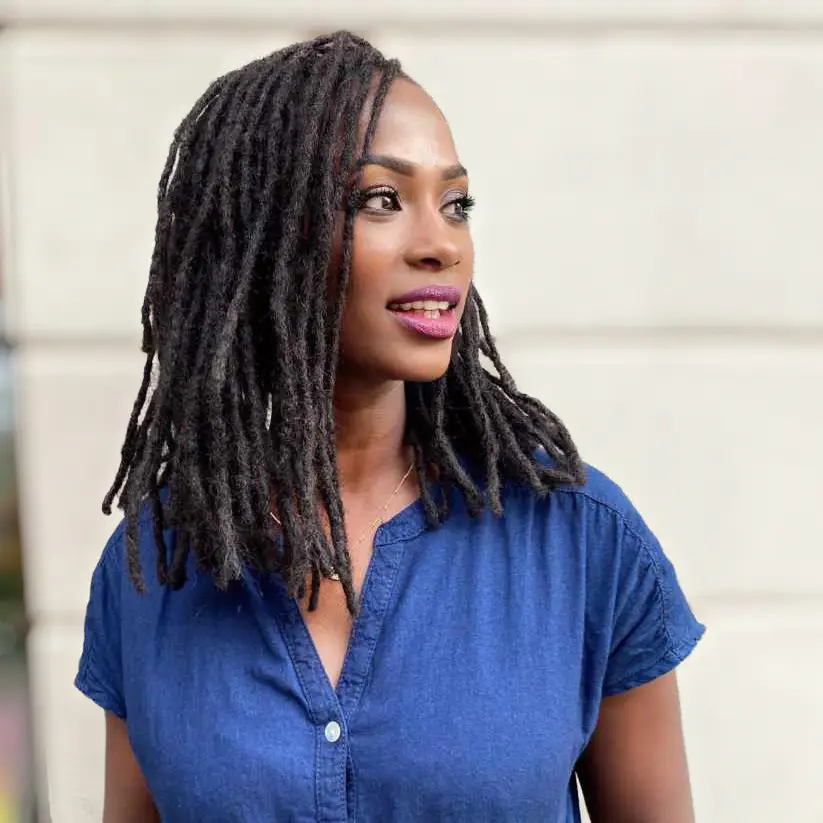
I’m not a professional stylist, so I can’t say everything below is fact. Follicle law. Hair Bible. All I can share is what I have learned, and what seems to be working for me regarding semi-freeform locs and 4c hair. Dreadlocks, also known as “locs”, are a well-known form of hairstyle that is embedded in cultural significance. The history goes back thousands of years and spans different eras. Locs are not just a hairstyle, but also a symbol of spirituality, freedom, cultural identity, and resistance.
Let’s begin!
How It Started
I started from a fade. My last trip to the barbershop was in Dec 2019. I then let my hair grow from there. Below you can see my hair wasn’t long enough to two strand twist. I used a sponge brush on my twa. I washed my hair, put a sort of loc gel on my hair (very little), then placed a durag on my head. I practically lived in a durag. The brush really separated my locs for me. I’m terrible at parting, so I let the brush kind of navigate where my locs would be.
There are many different kinds of locs, and I decided on semi-freeform for two reasons:
The first being, I had been thinking about locking my hair for a while. My thick hair seems to have a mind of its own and does best when there’s very little manipulation. Semi-freeform locs don’t require as much retwisting as traditional or sister locs, and that appealed to me. I didn’t want to twist my hair, and honestly, I didn’t want to pay anyone to do it either. Also, I’m a Lauryn Hill fan, and her iconic semi-freestyle loc look during the 90s was definitely on my inspiration board.
I started my locs in the first half of 2020. The world was totally locked down due to the COVID-19 virus, and there was a deep sense of uncertainty engulfing us all. While facing an unpredictable pandemic and even watching the World Health Organization (WHO) scramble, the last thing I wanted to worry about was what my hair looked like. Locs require patience and have no true timeline.
The pandemic was the perfect time for me to start them. Furthermore, salons and beauty supply stores were locked down. The lockdown forced me (and millions of others) to stay home. This was the time I decided that DIY and being more hands-on with my products would be the safest, healthiest, and most cost-efficient option for my hair.

My DIY Must-Haves
I’ve been making and using my own shampoo and moisturizer since June 2022, and using aloe vera as a hair mask before I rinse it with my shampoo. I have not used any type of conditioner. I also take biotin and daily vitamins (that have biotin in them). I found the recipe below online, but added my own little sauce:
● ¼ cup coconut water
● ¼ cup liquid castile soap (Dr. Bronner’s is an inexpensive favorite)
● 20 drops of your favorite essential oil(s) (I like lavender, peppermint, and lemongrass)
● ½ tsp. olive or almond oil (optional for severely dry hair) (I use castor oil)
● Add aloe vera. Pieces of the aloe and all the ooze.
My moisturizer spray bottle is literally just cold water, aloe vera (leaf pieces and ooze), and a couple drops of my signature scent. Cutting the leaves and scooping out the goo feels ancestral to me. I make a ritual out of it. Then spray on my hair generously every day.


Freedom In Freeform
Hair is a major aspect for not only Black Americans, but for the Black diaspora as a whole. Having semi-freeform locs has given me a sense of pride in my people and culture. Colonization may have taken away coordinates, as in, I might not ever know exactly where my ancestors were located before the Transatlantic Slave Trade. But I find pride in knowing that I look like my bloodline. Pride in knowing that my ancestors see themselves when they look at me and my hair.
