
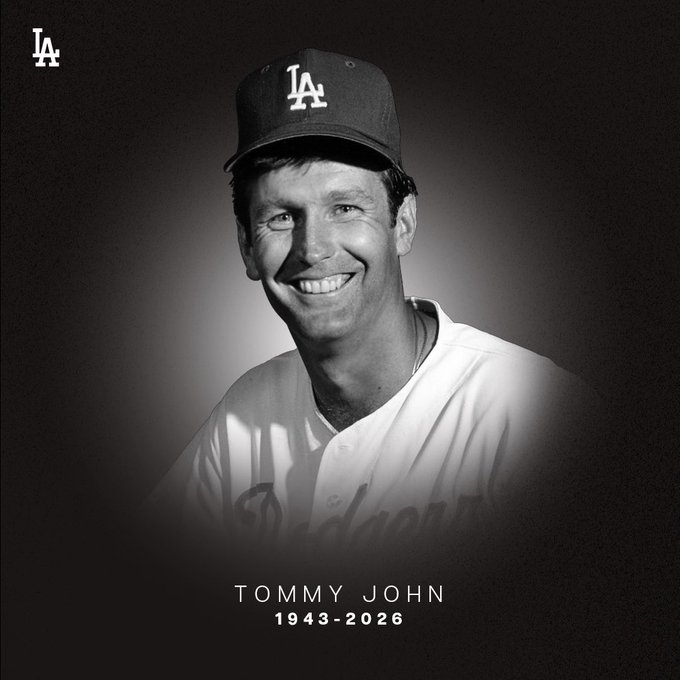
Long-time Major League pitcher Tommy John, whose name will be forever affiliated with groundbreaking elbow surgery, passed away on Sunday at the age of 83. The cause of death was bladder cancer. He passed away peacefully at his home in Lakewood Ranch, Florida, surrounded by his wife, Cheryl, and family. John, who won 288 games in his three-decade, 26-year big league career, was a four-time All-Star with the second-most wins of any pitcher in the Modern Era not elected to the Baseball Hall of Fame,
But it was his Sept. 25, 1974, experimental elbow surgery performed by Los Angeles Dodgers team physician Dr Frank Jobe that will forever be his historical calling card. Not only did the surgery allow John to resume his career, but it has extended the playing days of thousands of ballplayers at every level.
John’s Early Life and Minor League Career
John was born in Terre Haute, Indiana, and grew up playing sandlot ball at several of the fields around the city. A friend of his father’s, Arley Andrews, taught John how to throw a curveball, which would be his main pitch throughout his career. He was an outstanding two-sport athlete at Gerstmeyer High School in Terre Haute, excelling in both baseball and basketball. He had a 28–2 record as a pitcher and graduated as Gerstmeyer’s valedictorian in 1961. Several colleges recruited John as a basketball player.
But he also caught the attention of the Cleveland Indians, who signed him after his graduation. He was initially assigned to the Dubuque Packers of the Class D Midwest League. He went 10-4 with the Packers and was promoted to the Class-A Charleston Indians to start the 1962 season.
After struggling with his control, John was eventually promoted to the Class-AAA Jacksonville Suns toward the end of the season. 1963 saw him splitting time between Jacksonville and Charleston, going 9-2 before a September callup by Cleveland.
Early Career and the Surgery
John had a rough season in 1964, as he bounced between the Indians and the AAA-Portland Beavers. He was traded to the Chicago White Sox in the offseason, where he got his first taste of success in the Show. He won 34 games over his next three seasons and finally made his first All-Star Game in 1968. But injuries and an inability to find the strike zone hampered him over the ensuing three seasons, and in December of 1971, he was traded to the Dodgers for Dick Allen.
His career rejuvenated, he notched 40 wins over the next three campaigns. Including the 1974 season, where in the midst of his best year ever, disaster struck. On July 17, in a game against the Montreal Expos, he threw a pitch to Hal Breeden that, after completing his motion, felt like his arm was detached from his body.
Dr. Jobe performed a groundbreaking surgery where he rebuilt John’s ulnar collateral ligament with a wrist tendon. He endured a long, slow recovery, missing the entire 1975 season. Many questioned whether he would ever return.
Comeback and Banner Seasons
But return he did, ending the 1976 season with a 10-10 record and 3.09 ERA. He was awarded the National League Comeback Player of the Year Award for his performance and perseverance after coming back from that devastating injury.
He would go on to win 37 games for the Dodgers over the next two seasons, finishing second in the NL Cy Young Award voting in 1977 and making his second All-Star Game in 1978. John’s contract was up with the Dodgers at the end of the 1978 season, and he signed a $1.4 million, three-year deal with the New York Yankees.
When he came to the Yankees, he was at the top of his game. John won 21 and 22, respectively, in 1979 and 1980 and was named to the All-Star Game in both seasons. He finished second to the Baltimore Orioles’ Mike Flanagan in the American League Cy Young balloting after the 1979 season, and fourth behind Steve Stone, Mike Norris, and teammate Goose Gossage in 1980.
Career Decline and Life After Baseball
Jhn pitched well in the strike-shortened 1981 season and helped the Yankees reach the World Series, where they lost to the Dodgers 4 games to 2. He started poorly in 1982 and was relegated to the bullpen. As he continued to struggle, he was traded to the California Angels on Aug 31. He pitched well for the Angels in the first half of 1983 and 1984 but faltered in the second half of each campaign.
In 1985, he started poorly and was eventually assigned to the bullpen. He took some time off to be with his mother, who was dying, and the Angels released him on June 19, the same day his mother passed away. He was picked up by the Oakland Athletics the next month, but his performance continued to lag.
He returned to the Yankees for the 1986 season and stayed with them until 1989, when New York finally released him in May of that year. He was the oldest player in the Majors that season at 45 and for a while held the record for most seasons played in the bigs with 26, bested by Nolan Ryan later.
In retirement, John became a broadcaster for the Minnesota Twins and Yankees. He then became a Minor League pitching coach for the Expos and Yankees franchises and later managed the now-defunct Bridgeport Bluefish of the independent Atlantic League.
Memorial
The Los Angeles Dodgers issued this statement on Sunday after Tommy John’s passing. “The Los Angeles Dodgers would like to express our sadness over the passing of Tommy John, who died Saturday at the age of 83. Thanks in no small part to the pioneering surgery that bears his name, Tommy’s extraordinary career encompassed 26 seasons and 288 career victories. We offer our deepest condolences to his family and friends.”
