
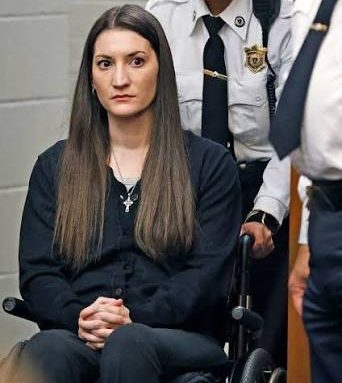
Closing arguments are expected to be heard Thursday morning in the murder trial of a Massachusetts woman accused of killing her three young children in 2023. Throughout the five-week-long trial, Lindsay Clancy’s defense has sought to prove she is not criminally liable because she was suffering from postpartum psychosis at the time.
Content Warning: This article discusses an exceptionally disturbing case involving multiple children’s murders and attempted suicide. The details may be upsetting or triggering for some readers. Reader discretion is advised, and those who may be sensitive to these topics are encouraged to proceed with caution or discontinue reading.
Closing Arguments Expected
Court proceedings will resume around 9 a.m. local time in Plymouth Superior Court on Thursday, August 27, 2026. Jury deliberation will begin after both sides deliver their closing arguments, each allotted an hour.
Defense attorney Kevin Reddington has done a marvelous job thus far in the trial, picking out inconsistencies in the witnesses’ explanations and humanizing Lindsay Clancy, who was once described as a wonderful and loving mother to her children.
Expert Testimony
Although Clancy did not testify on her behalf, the prosecution called more than 70 witnesses, including her ex-husband and father of her children, and the defense called 10 witnesses, including her relatives and former in-laws. However, the most crucial testimony came from the psychologists and psychiatrists who examined Clancy before and after the killings.
Some medical experts deem Clancy criminally responsible for the killings; others were protecting their careers and defending their efforts when pushed by the defense, demanding an explanation as to why the defendant did not receive help when she asked, or was put on several medications without listening to her side effects.
Horrific Killings in Coastal Town
Lindsay Clancy, 36, pleaded not guilty by reason of lack of criminal responsibility in the killings of her three children: Cora, 5, Dawson, 3, and Callan, 8-months. The three were found strangled to death with exercise bands in the basement of the family’s Duxbury, Massachusetts home on January 24, 2023.
Clancy was found by her then-husband, Patrick Clancy, outside with her throat and wrists slashed. She attempted suicide immediately after and jumped out a second-story window, but instead of dying, she paralyzed herself from the waist down. She claims she was suffering from postpartum psychosis, a rare mental illness that follows childbirth, affecting mood, sleep, and other hormones.
Prosecutors argue that Clancy planned the killings and sent her husband out of the house so that she could carry it out. While Patrick was gone for thirty minutes, Clancy managed to strangle three children, which, by testimony from a medical expert, only took 20 seconds before they became unconscious. However, it can take anywhere from 5 to 10 minutes to fully die.
Afterward, Clancy faked a suicide attempt by making superficial cuts to her wrists and throat before lowering herself out a second-story window, according to prosecutors. If the defendant is found guilty, she will face a mandatory life sentence, but if she is found not guilty by reason of insanity, she will be committed to a psychiatric hospital.
Rebuttal Witness Testimony
In the final moments of testimony on Wednesday, Kevin Reddington conducted a cross-examination of a senior psychiatrist for the FBI’s Behavioral Analysis Unit, who believes that Clancy’s was not hearing voices ordering her to kill her children. Dr. Gregory Saathoff said Clancy was in complete control that day and aware of her actions.
Reddington referenced the prosecution’s opening statement by asking Saathoff if he believed Clancy decided to kill her children because she “no longer liked the life she thought she wanted” and was making “a selfish choice” to “manipulate her providers, seek out a quick and easy fix when she was feeling depressed and anxious.”
“I think that statement that you read really minimizes what she was going through,” Saathoff responded.
If you or someone you know is experiencing emotional distress, a mental health crisis, concerns related to substance use, or simply needs someone to talk to, help is available. Call or text 988, or visit 988lifeline.org to chat with a trained crisis counselor 24 hours a day, 7 days a week.
