
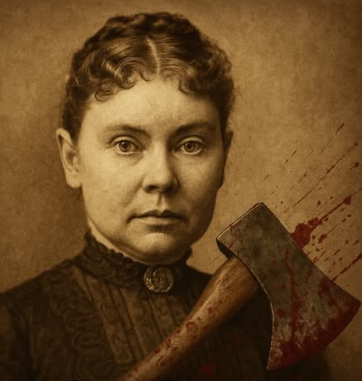
Season 4 of Ryan Murphy’s Netflix series Monster will center on the infamous and controversial Lizzie Borden case from the 1800s. This newest season was released on Thursday and is officially the fourth retelling of the case in this particular narrative.
However, the Lizzie Borden case has gained lasting fame through various forms of media, including nursery rhymes, books, documentaries, television series, and podcasts.
Ax Murders of 1892
Lizzie Borden was born on July 19, 1860, to Andrew Borden and Sarah Anthony. She was the youngest in her family, after her sister Emma Lenora. They lived in the growing city of Fall River, Massachusetts, where there were relatively low crime rates, which is why the community was shocked when Andrew Borden and his second wife, Abby Borden, were found murdered.
On August 4, 1892, the Borden family home was lively in the morning with both parents, the family’s live-in nanny, Lizzie, and her maternal uncle. Andrew and the uncle had left the home and returned at 10:30 a.m., but by then Abby Borden had already been whacked with a hatchet 18 times.
Investigators say that Abby was on the second floor of the home and facing her killer at the time of the attack. A short time after, Andrew appeared to have been whacked 11 times while laying on the couch in the living room. His daughter, Lizzie, discovered him and called for the nanny, saying that someone came in and killed him while he was asleep.
It was not until the doctor from across the street came to check on Andrew that they discovered Abby was upstairs dead as well. He declared both of them dead at the scene around 11 a.m.
The brutality of the killings was beyond comprehension, and many found it bold to occur in a home on a busy street in the middle of the day. The two were bludgeoned to death with an ax, but what was even more shocking was that the police’s prime suspect was their youngest daughter, Lizzie, who was living in their home at 32 years old.
Lizzie Borden Trial
Lizzie Borden went to trial in June 1893. Investigators had plenty of circumstantial evidence to arrest her and pursue the case, including the axes found in the basement and the contradictory stories she told them about where she was, what she was doing, and what she heard.
She was charged with double murder, but was found not guilty in just under an hour of jury deliberations. Unfortunately, the murders of her parents continued to follow her for the rest of her life. A nursery rhyme was formed in early 1894, and children would stand outside of her house, taunting her with the lyrics.
True Crime Theories
Several theories have emerged about what happened that day in the Borden family home. Some writers believed that Lizzie committed the murders, but for different reasons. One suggested that she was physically and sexually abused by her father and was driven to it. Another suggested that she was rendezvousing with the nanny, and her stepmother, Abby, reacted in disgust.
Lizzie allegedly reacted by killing her with a candlestick and went downstairs to confess her secret to her father, who also reacted the same way, and she became angry and killed him with an ax. It is not confirmed that Lizzie was a lesbian or in a relationship of any kind, but nonetheless, some do believe that the nanny was involved somehow.
The other possible suspects were the maternal uncle, Andrew’s then-believed-to-be illegitimate son, and sister Emma. However, the son was disproven to belong to Andrew, and the other two had solid alibis for the time of the murders.
The World Will Never Know
Lizzie died June 1, 1927, of pneumonia at age 66. Her funeral was fairly empty as one could imagine, but she remains talked about to this day. There is no record of her ever confessing to her father’s and stepmother’s murders, so no one will ever know what truly happened that day.
All the world has now is her memory and Ryan Murphy’s interpretation in Monsters season 4.
