
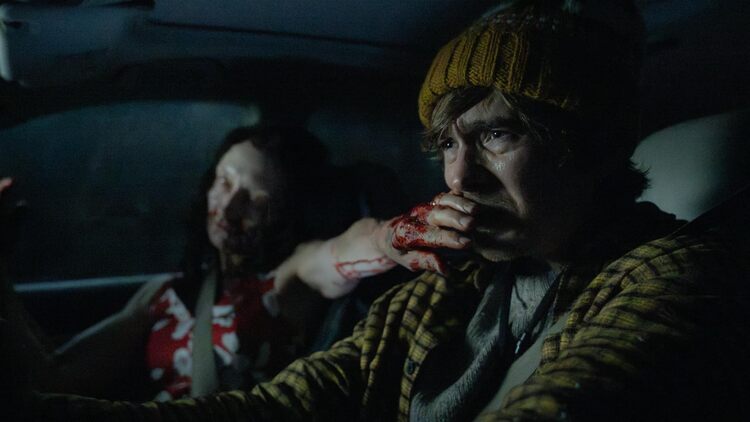
The ending of Resident Evil (2026) has been divisive amongst fans. A movie’s ending can be crucial to how well-received it is. If it’s bad, then fans will be turned off. If it’s good, that can redeem a movie that might have stumbled beforehand (see: Disclosure Day as a shining example of how important it is to nail the ending).
Zach Cregger, writer and director of Resident Evil, admitted after the fact that he changed the original ending with a backup option he shot just in case. As it turns out, it was a brilliant choice that made the movie that much better.
The Existing Resident Evil Ending

SPOILER WARNING. The final scene of Resident Evil has sparked intense debate online. In the movie, Bryan survives his odyssey through the outskirts of Raccoon City to finally make it to the hospital. He delivers the key piece of the antidote to the Umbrella Corporation scientists, hiding the fact that he’s been bitten.
By the time he begins asking for help, Umbrella scientists are mixing the antidote and ignoring him. He begins to morph into a monster straight out of the games, a William Birkin-esque monstrosity complete with tentacles and that big glowing eye they all have.
He begins, against his will, attacking the scientists, all while begging them to just inject him with the antidote and put an end to all this. The scientists don’t care to use the antidote they plan to give to the National Guard on Bryan at all until it’s too late, and a comedy of errors ensues as they all die and Bryan becomes the monster, with the antidote being lost a la Resident Evil 2.
Zach Cregger’s Original Idea
That’s the ending we got in theaters, the one that has divided moviegoers since the movie dropped. It’s not the original plan that Zach Cregger had for Resident Evil, though. He had a very different ending in mind, one that would’ve been a lot less relatable.
“One of the missteps I made early on was not doing that. And so we reorganized the chain of events. Thank God, I shot this as a contingency plan. It was like my plan B,” Cregger said of his original ending. He revealed that the antidote was supposed to shatter when the first scientist dropped it rather than bouncing around from person to person, all of them unwilling and eventually unable to cure Bryan.
“Originally in the script, that scientist pulls the needle out, and as soon as Austin grabs the woman’s face, he drops it, and it shatters,” Cregger explained. “Then the rest of the movie is just Austin killing the scientists, and people were just like, ‘No, like it’s over,’ you know. But I shot that shot of the scientist putting the needle in his pocket just because I had a feeling. I was like, ‘I feel like I’m going to need that.’”
Cregger concluded, “And so then we were able to build a new sequence of the end, and I shot a contingency of him going for the stab in Prague when we were doing our thing, as just like, ‘If I need it, I should just get it.’ Thank God, because that’s what we ended up using. It keeps the stakes all the way until the end. It’s like, ‘save him, save him.’ Whereas before it was just like ‘kill them all.’”
The Beauty of the Actual Ending
For one thing, the ending of Resident Evil keeps Bryan’s humanity all the way up to the bitter end. This allows the audience to continue rooting for him instead of the scientists working for the evil corporation. Bryan is an everyman, a member of the working class, someone we should root for. Turning him into a mindless killing machine would have upended that idea.
Secondly, it represents the game series so well. The thematic through-line in Resident Evil is an anti-corporation stance. The Umbrella Corporation creates the outbreak and then uses and abuses regular people to get an antidote (Leon has to synthesize it in Resident Evil 2) that they want praise for. Part of the comedy of the series is how inept the corporation and its members ultimately are, too.
Therefore, the ending Zach Cregger went with illustrates all of that perfectly. The scientists do not care to help Bryan, the person who just literally risked life and limb to help them, until it’s too late. Then, they’re so bumbling and incompetent that it doesn’t matter. But through all of that, as Cregger mentioned, they’re still trying to figure out a way to keep the antidote and not administer it to Bryan.
That ending and the comedy of errors that precedes it showcase that corporations are laughably corrupt and incompetent, one of the most important factors in Cregger’s adaptation.
