
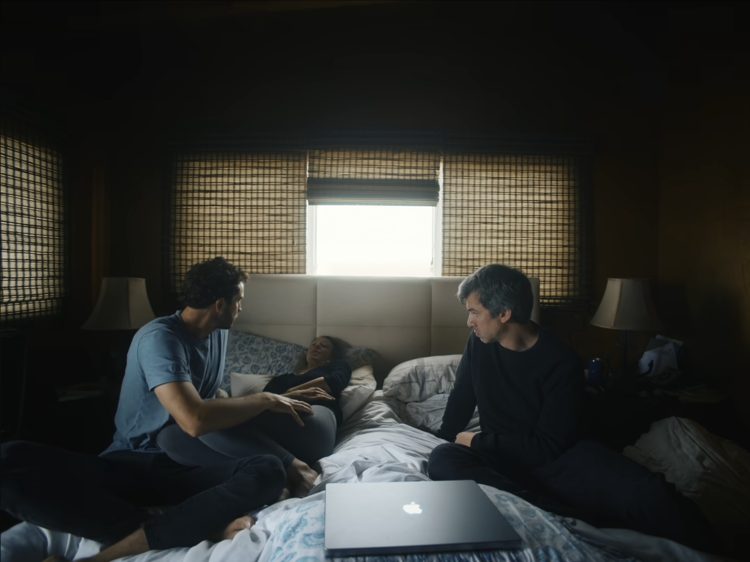
You Can See Everything promises to give viewers an intimate look at enigmatic and infamous felon Elizabeth Holmes. Nathan Fielder, known for his social experiment sketch comedy, if there’s a good term to really describe what he does, directs with Lance Oppenheim, but Fielder is the boots-on-the-ground on-screen documentarian, living with Holmes and her partner, Billy Evans.
That alone is enough to convince audiences to go see the documentary, which is having a level of success at the box office that is somewhat uncommon for documentaries. What transpires has to be seen to be believed, as the film takes such wild turns to end up in a place that you can’t predict. If someone had told me flat-out what happens beforehand, I don’t think I would have believed them.
In the end, by following the story and the bizarre turn of events, Fielder and Oppenheim stumble into one of the most impactful documentaries ever, one that raises questions about the very practice of making documentaries, among many other things. It’s a melting pot, a concoction of factors that simply cannot and will never be replicated.
You Can See Everything Review

It is impossible to discuss You Can See Everything, a highly ironic title by the end of the three-hour journey, without spoiling. In that way, and in its metatextual conversation, it is very much like Digger. So, this is your spoiler warning, and it is absolutely much better to go into this as blind as possible. That includes not doing a crash course on Nathan Fielder or Elizabeth Holmes beforehand.
The first half of this movie moves at a slow pace, and the hype that this is the best and most mind-bending documentary of all time actively works against it. You Can See Everything lays out the dynamic between Nathan Fielder, Elizabeth Holmes, and Billy Evans pretty quickly, and then it spends much of the rest of the time before she goes to prison just living in it, bringing nothing new to the table. The interactions are fascinating, but they don’t exactly add much to the story.
Once Holmes does go to prison, though, is when You Can See Everything hits a stride that so few movies, documentary or otherwise, have even dreamt of. It pulls you as an audience member into the abyss with the characters on-screen thanks to a wild and unpredicted twist. It turns out that Billy Evans wanted to be paid for their involvement in the documentary, which is highly uncommon and raises immense ethical questions about everything we’ve seen so far.
That kind of thing could totally derail a documentary, but it ends up working brilliantly to aid the film’s thesis by the end. Instead of skirting past the ethical dilemma this poses, Fielder and Lance Oppenheim, of Primetime fame a few weeks ago, shift the perspective to focus on those ethical issues. The central question of A24’s You Can See Everything shifts to that, rather than the initial “who is Elizabeth Holmes” question from the first half.
It is this paradigm shift that turns a documentary into something more. It’s a documentary and a biopic and a criticism of all of it wrapped up into one astonishing piece of art. Amanda Seyfried, who portrayed Holmes in the Hulu series The Dropout, comes along for the ride, and her presence is a godsend.
On one hand, it forces her to reckon with the potentially somewhat falsified portrayal she put on, asking the audience where the line is with that sort of thing. Seyfried initially says it doesn’t matter if a specific, key line was actually ever uttered by Holmes, because it’s the sentiment behind the line that both matters and is accurate. Fielder, Oppenheim, and eventually Seyfried decide to ask if that’s actually the case.
By the end, everything is called into question, including Fielder’s role in it all. He and Oppenheim have curated what they want you to see out of hundreds of hours of footage, but a late conversation between Fielder and Seyfried suggests that this is less a documentary than a controlled narrative.
It’s eventually revealed that Fielder probably did get too close and became too attached to Holmes, developing an empathy for her that clouds his judgment and prevents, something that the closing few scenes of the movie do a good job illustrating.
So, it brings up valid questions about all of it, demanding the audience reckon with everyone. Who’s the real manipulator, Billy Evans or Elizabeth Holmes? What role does portrayal play in the perception or truth of a situation? How accurate is anything? Are documentarians, previously considered more unbiased, playing a part, too?
It’s not quite a perfect film, as the first half drags on way too long before it really kicks into high gear. But throughout, the filmmaking, from the camerawork and framing to the excellent score, shines. This is extremely well-made, and it brings up endlessly fascinating questions about our world and us.
And ultimately, it subverts the very premise in unpredictable, unprecedented, and unrepeatable ways. You can see everything, but in actuality, you can’t. You can only see what everyone involved, from the characters to the filmmakers and beyond, want you to be able to see.
Score: 4.75/5
