
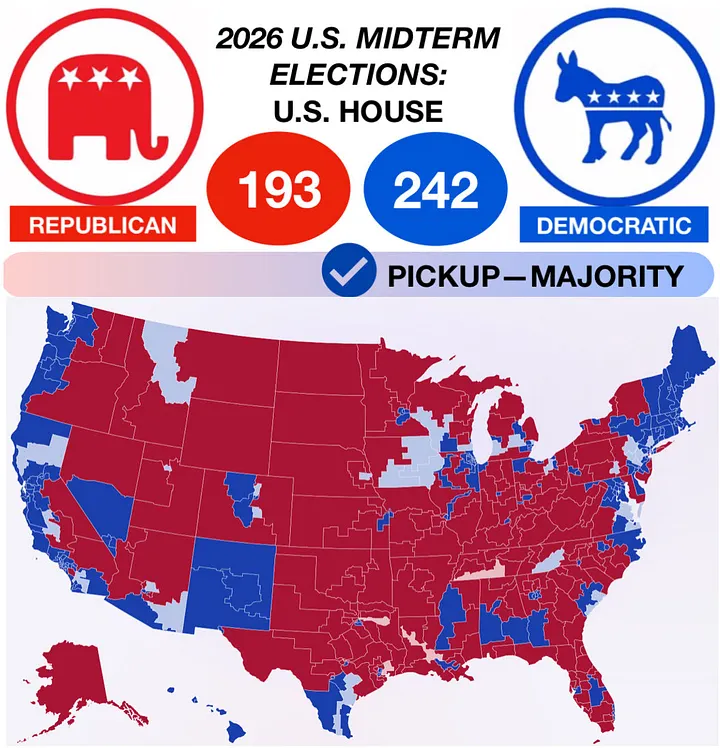
Greg Simbeck makes his picks for which party will control the United States House and Senate.
The time has almost arrived. We are on the eve of the historic 2026 Midterm elections that will decide who controls the U.S. House and Senate during the last two years of the Donald Trump presidency. Much discussion and ample polling projections point to a “Blue Tsunami.” Republicans counter that polls have historically undercounted probable GOP voter participation.
But with the president’s approval ratings at all-time lows due to inflation, the rising costs of gas, housing, and food, and a war with Iran that shows no end in sight, the overall consensus is that the Democrats will regain control of the House of Representatives. The Senate, by many measures, is too close to call. So it’s time to attach some real numbers to these predictions.
Summary Prediction of House Midterm Elections
Base for Predictions
As a starting point for my House predictions, I used the Cook Report’s House Races Ratings Chart. Then, after reviewing other polling data, recent trends, historical outcomes, and using some individual savvy, I arrived at my conclusions as to who would control this body. The current party breakdown in the House is 218 Republicans, 214 Democrats, 1 Independent, and 2 Vacant.
The Cook Report’s current rankings chart lists this information.
Number of Seats in each Category
- Solid Democratic 186
- Likely Democratic 18
- Lean Democratic 18
- Toss Up 18
- Lean Republican 18
- Likely Republican 17
- Solid Republican 160
How I Calculated My Totals
Taking all the factors I mentioned above, I first examined the 18 toss-up Midterm races. Of these, 14 are currently held by Republican representatives, and four are held by Democrats. After factoring in all of my information sources, I determined that the Democrats would take home 12 of these seats on election night.
Some of the more interesting Midterm races where the seat changed hands include Kentucky-6, Ohio-7, and Pennsylvania-1. On the lean Democratic column, I determined that the Democrats would be victorious in all 18 races. On the lean Republican seats, however, I predicted that Democrats would prevail in two of the 18 races.
My prediction is that they would flip Arizona-2, currently held by Eli Crane, and Wisconsin-1, which is currently represented by Bryan Stell. I predicted that no seats would flip in the solid and likely races for both parties.
Conclusions
After totaling up all of the columns for each party, my final prediction is that the balance in the U.S. House of Representatives after all of the votes are counted would be:
Democrats 238
Republicans 197
This would represent an epic night for the Democrats and a nightmare two years for Mr. Trump, a lame-duck president.
Summary Prediction of Senate Midterm Elections
The U.S. Senate is currently controlled by the Republicans by a margin of 53-45, with two Independents who caucus with the Democrats. Remember, if the parties each have 50 seats when the smoke clears, the Republicans would still control the body by virtue of Vice President JD Vance representing the tie-breaking vote. Since many of the Midterm Senate races are not hotly contested, I examined the closest races to determine who will reign over the upper body for at least the next two years.
Breakdown of Hotly Contested Midterm Senate Races
Georgia: Who would have thought a year ago that this would be an easy Midterm win for the Democrats? Incumbent John Ossoff is an articulate, media-savvy politician who is garnering some attention as a possible 2028 presidential candidate. Representative Mike Collins, riddled with rumors of a House ethics probe and ties to white supremacists, was never in this race. Republicans have already ceased outside funding to this race.
North Carolina: Senate Majority Leader Chuck Schumer’s recruitment of former Democratic Governor Roy Cooper was a masterful stroke. The popular ex-Governor has maintained a comfortable lead throughout this Midterm race. Republican candidate Michael Whatley’s close ties to President Trump proved to be his undoing.
New Hampshire: Unlike some of the other Midterm Senate races, national Republicans thought that they had chosen the perfect candidate in former Sen. John E. Sununu. But Representative Chris Pappas has successfully tied Sununu to the president’s unpopular policies, and the Democrats’ lead has significantly increased over the past month.
Texas: Nowhere is the contrast in Midterm candidates more stark than in the State of Texas. The Republican candidate, state Attorney General Ken Paxton, has a scandal-ridden career along with much-publicized extramarital affairs. This one is on President Trump for his campaign against popular incumbent Senator John Cornyn.
The only thing Paxton has going for him is the $170 million Elon Musk has contributed to his campaign. However, Democrat James Talarico has run a flawless campaign and has actually outraised Paxton in the second quarter of this year. The race is still close, but Talarico has the momentum.
Ohio: Popular ex-Democratic Senator Sherrod Brown has run a strong Midterm campaign against incumbent John Hustad. Another expensive race that has seen a turn in the Democrats’ favor due to lackluster campaigning by Hustad and Brown’s success in tying his opponent to the spread of unpopular data centers. Brown has held a narrow lead for the past few months, that seems to be expanding in the past week.
Michigan: This one has gotten ugly. Democratic Socialist Abdul El-Sayed won a hotly contested primary against Representative Haley Stevens, and the repercussions from that race are still being felt. He is facing off against Mike Rogers in a Midterm race that has been heated from the get-go. El-Sayed has been focusing on tying Rogers to the president’s unpopular policies, while Rogers is stirring the flames, saying his opponent is a radical socialist.
And just over the weekend, Stevens threw her support behind Rogers after vehemently opposing his campaign since she started running for the seat. This is a head-scratcher that has left folks wondering why she would commit political suicide over her differences with El-Sayeed. Another tight one, but the polls indicate that the Democrats should take this one home.
Maine: Another strange one. Incumbent Republican Senator Susan Collins in the fight of her political life against state Senate President Troy Graham. Although Collins has always tried to keep her distance from President Trump, Jackson has made a point of highlighting Collin’s inability to hold the line on the president’s policies on tariffs and the war with Iran. Skyrocketing fuel oil costs, which are used by many residents of Maine to heat their homes, is also a major issue in the race.
Jackson, of course, became the candidate after nominated Democrat Graham Planter left the race amid accusations of sexual harassment. Jackson started out slowly but has been gaining momentum in the past couple of weeks.
Alaska: Last week the New York Times reported that Democratic former Representative Mary Peltola’s campaign and the Democratic Senatorial Campaign Committee recruited a Dan J. Sullivan to enter this Midterm race to confuse voters. Incumbent Dan S. Sullivan, national Republicans and President Trump all cried foul. But a federal judge on Sunday dismissed a Justice Department lawsuit seeking to block certification of the election.
Ms. Peltola has disavowed knowledge of the plot, and today a new poll had her leading by six points. Dissatisfaction with President Trump and an organized campaign by Peltola and her supporters should be enough to produce a victory in this ranked-choice state.
Kansas: In a place that has not elected a statewide Democratic Senate candidate since 1932, Pastor Adam Hamilton might just pull off the upsets of all upsets. An uninspired campaign by Incumbent Republican Richard Marshall, rising fuel and fertilizer prices, and reports that he unmercifully went after patients for unpaid bills as a doctor have cast his candidacy in an unpopular light.
Hamilton, for his part, has played the populist moderate candidate who was leading the race by six points in the latest New York Times/Siena University poll. This is a state that President Trump won by 16 percentage points in 2024.
Iowa: Democratic Representative Josh Turek is running a strong Midterm campaign against determined Representative Ashley Hinson. Turek is playing the moderate card, and there is plenty of backlash in Iowa over the president’s tariffs and Iran War. Turek is also aided by the runaway gubernatorial candidacy of State Auditor Rob Sand.
Iowa: Democratic Representative Josh Turek is running a strong campaign against determined Representative Ashley Hinson. Turek is playing the moderate card, and there is plenty of backlash in Iowa over the president’s tariffs and Iran War. Turek is also aided by the runaway gubernatorial candidacy of State Auditor Rob Sand.
Turek leads by one point in the latest New York Times/Siena University poll, and this one will go down to the wire
South Carolina and Mississippi: Darlene Graham and Cindy Hyde-Smith have both run extremely weak Midterm races in these solid red states, but due to the heavy composition of registered Republican voters in each state, they most likely will prevail in close races.
New Senate Balance of Power
My prediction is that the Democrats prevail in Georgia, North Carolina, New Hampshire, Texas, Ohio, Michigan, Maine, and Alaska. This would leave them with a 53-47 Vance-proof majority.
