
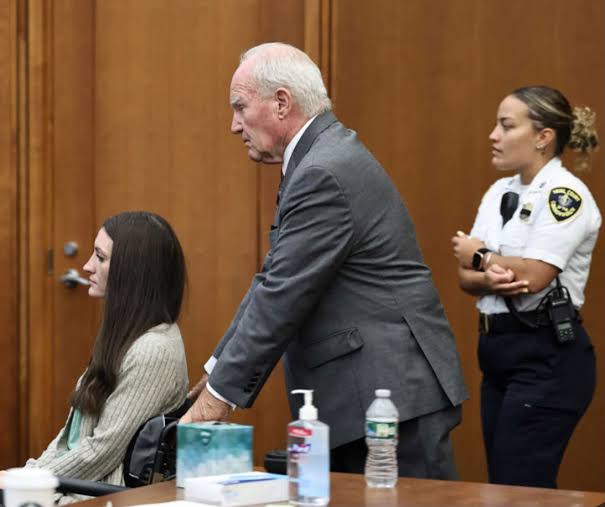
The judge handling the case against the Massachusetts mother accused of strangling her three young children in 2023 denied the defense’s motion arguing double jeopardy, paving the way for prosecutors to bring Lindsay Clancy back for a second trial.
A Second Trial is Possible
On Monday, November 9, 2026, Judge William Sullivan’s 17-page order and memorandum explaining his decision to deny the defense’s motion to dismiss in the Lindsay Clancy case were released to the public.
“Because the Court concludes that there was a manifest necessity for a mistrial based on the jury’s deadlock, a retrial on the murder indictments does not violate Clancy’s right not to be placed in double jeopardy,” Sullivan wrote.
“The Court understands the frustration of the defendant and the jurors that despite the utmost diligence, the jury ultimately was unable to reach a verdict in this emotionally grueling and complicated case. While a party may desire a procedure that increases the odds of receiving a favorable outcome to the case, the Court’s primary concern must be protecting the fairness of the proceedings and avoiding the possibility of a coerced verdict,” he wrote.
Clancy’s first trial concluded without a verdict after six weeks of testimony and three rounds of jury deliberations. The former labor and delivery nurse was charged with three counts of first-degree murder in the deaths of Cora, 5, Dawson, 3, and Callan, 8 months. Members of the jury returned after nearly 40 hours of deliberations deadlocked on September 4.
After Sullivan declared a mistrial, jurors went to the media and explained that 11 of them were in favor of finding Clancy not guilty by lack of criminal responsibility, but the lone holdout juror was set on convicting her of murder. Michael Desronvil later identified himself as the one holding the trial up and claimed he never had any doubts about Clancy’s guilt.
Experts Weigh In
Experts believe that if a second trial were to occur, Clancy would more than likely be found guilty. If the defense’s motion had been granted, then there would be no chance for a second trial. Trial attorney and former prosecutor Randolph Rice said prosecutors must now address what went wrong in the first trial before bringing her back.
“I think there’s real possibility that DA [Tim] Cruz says, ‘We’re going back to trial … and we have learned from our mistakes,‘” Rice said, suggesting that the Plymouth County prosecutors did not express enough empathy when arguing their case.
Prosecutors have not publicly stated whether they intend to retry Clancy or not, and if they do, it is unclear if they would charge her with first-degree murder or attempt to convict her of a lesser charge.
Double Jeopardy Motion Denied
Clancy’s defense attorney, Kevin Reddington, filed a motion to dismiss, arguing double jeopardy if a second trial were to be brought. He argued that there was no “manifest necessity” for a mistrial and that a new trial would violate the defendant’s Fifth Amendment rights.
“Clancy contends that there was no manifest necessity for a mistrial because the Court failed to consider the alternative of inquiring into the meaning of the foreperson’s notes and questioning Juror Doe to determine whether there was good cause to discharge Juror Doe,” Sullivan wrote in his ruling denying the defense’s motion.
Sullivan also ruled that Clancy’s defense team is not entitled to materials pertaining to the holdout juror, including cell phone records and his jury selection questionnaire, stating that it is not relevant to the possibility of a retrial. He also found no reason to examine the juror under oath, despite the defense’s argument that he failed to follow court orders.
“Given that the jury unquestionably had reached an impasse, the Court did not and does not view the foreperson’s notes as reliable evidence of Juror Doe’s inability or refusal to deliberate or follow the law,” Sullivan wrote.
