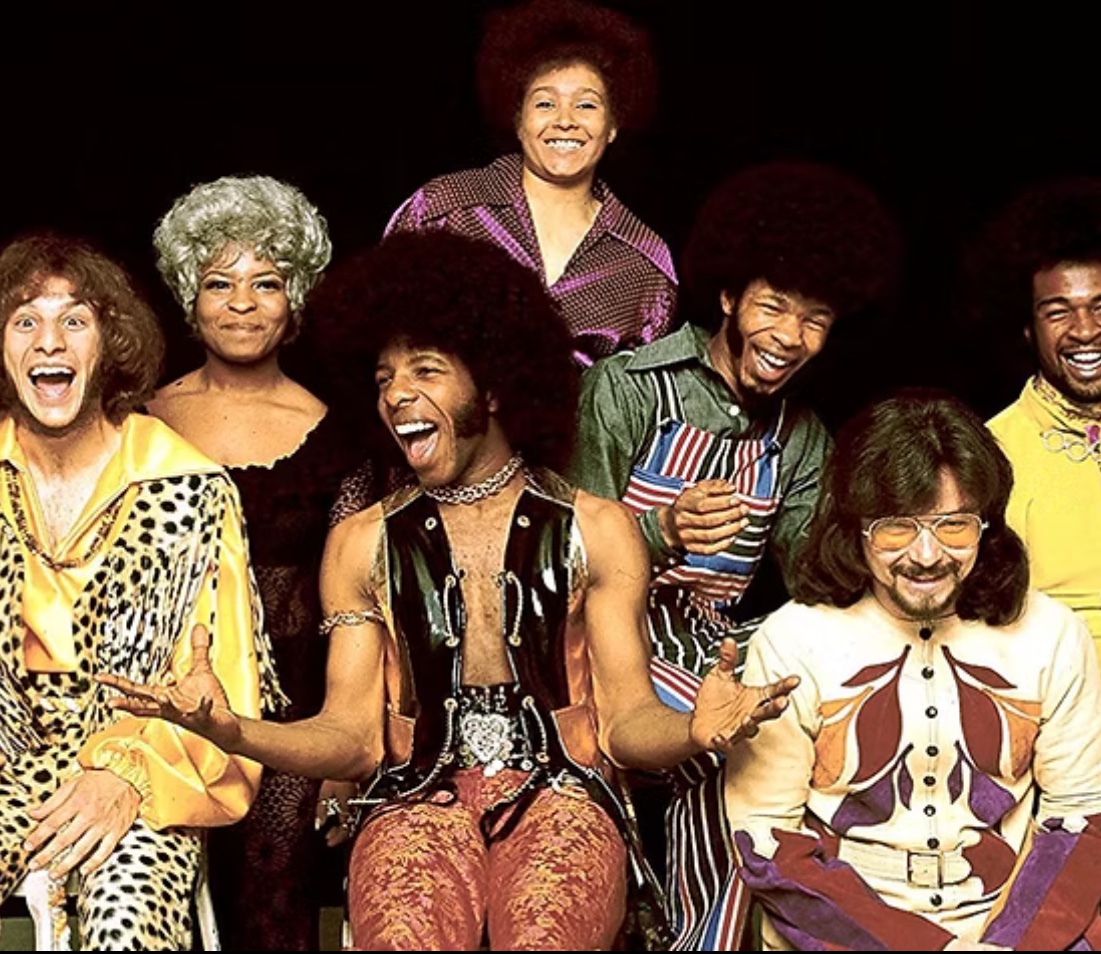
Sly Stone, the purveyor of everything soulful and funky and a groundbreaking bandleader who broke color barriers and integrated family into his sound, died on Monday at home in the Granada Hills neighborhood of Los Angeles. He was 82. His cause of death was “a prolonged battle with C.O.P.D.,” or chronic obstructive pulmonary disease, “and other assorted health issues,” according to his representatives.
Stone, an unpredictable yet talented singer, songwriter, multi-instrumentalist, and musical maestro, led his multiracial and gender-mixed band, which combined soul, R&B, gospel, and rock ‘n’ roll, ushering in a new era of funk music and influencing generations of musicians that followed. They produced a string of still famous hits in the late 1960s and early 1970s but unfortunately lost steam due to drug addictions and dissension.
Early Beginnings and Gateway to Stardom
Sylvester Stewart was born in Denton, Texas, on March 15, 1943, the second of Alpha and K.C. Stewart’s five children. The family soon moved to Vallejo, Calif., where Sly’s father worked as a cleaner and maintenance man at a department store. The children were raised in the Pentecostal Church, where they learned their love of music.
Sylvester and three of his siblings formed a vocal group, the Stewart Family Four. They released a gospel single, “On the Battlefield,” with “Walking in Jesus’s Name” on the flip side. Singing together, they formed the harmonies that would characterize their later work.
Stone, who picked up the nickname Sly thanks to a friend’s misspelling of his first name, was always the center of attention. His aptitude for learning instruments was off the charts, and he incorporated his newfound skills into his music. Sly played doo-wop guitar for several groups and played with a variety of other Bay Area bands. He produced Bobby Freeman’s “C’mon and Swim,” which became a Top 10 hit in 1964, and it started a new dance craze. He also worked as an area radio D.J. who played a format-shattering mix of white and black artists.
Stone Forms the Band and Success Follows
In 1966, Stone formed a group called Sly and the Stoners, while his brother, Freddie, fronted a group called Freddie and the Stone Souls. They merged their talents in 1967 and started playing under the name of Sly and the Family Stone,
It was a racially mixed, eclectic band that consisted of Freddie on guitar, Sly on the organ, Larry Graham on bass, Gregg Errico on drums, and Vaetta Stewart, Sly’s younger sister, singing backup. Later additions to the band included trumpeter Cynthia Robinson, saxophonist Jerry Martini, and Stone’s sister Rose on keyboards and background vocals.
The band’s debut album, “A Whole New Thing,” released in 1967 by Epic Records, did not sell well. But the follow-up, “Dance to the Music,” and its Top 10 title track catapulted the band to stardom. And the hits would follow, including “Everyday People,” “I Want to Take You Higher,” “Family Affair,” “Hot Fun in the Summertime,” and “Thank You (Falettinme Be Mice Elf Agin).”
Stone’s music centered on unity and acceptance while also challenging racial stereotypes and raising social consciousness. The Family Stone played Ed Sullivan at the Newport Jazz Festival and Sunday morning at Woodstock.
As featured in PBS’ excellent documentary “We Want the Funk,” the music’s primary focus was to bring people together and joyously get up and dance. And Graham would change the way soul and funk bassists played from then on. His thumb plucking of the bass was often copied and became the standard sound for those genres of music.
Tough Times and Later Life
But the hits stopped coming, mainly due to drug use, which caused divisions in the band. Sly started missing concerts and producing uneven albums. As a gimmick, Stone married the mother of his first child, Sylvester Jr.’s Kathy Silva, an actress, onstage before a concert at Madison Square Garden in June 1974 in front of 20,000 people. The divorce followed shortly after that. He never married again.
The original Family Stone disbanded in 1975, and there were sparse recordings and even fewer appearances by Stone in the years that followed. His later appearances included the induction of Sly and the Family Stone into the Rock & Roll Hall of Fame in 1993, the 2006 Grammy Awards, and a 2010 performance at Coachella.
Stone started living in an RV, and he was rumored to be penniless. He decried these rumors, saying he liked moving around and the RV had everything he needed. He sued his former managers, claiming that they had defrauded him of many millions. A jury eventually awarded him $5 million, but the judgment was soon reversed.
In 2019, he did reach a deal with Michael Jackson’s publishing company, Mijac, which allowed him to finally collect payment from his minority interest in his music catalog. He eventually moved into the home in Granada Hills, where he spent the time watching television, visiting with family, and listening to music.
Legacy and Tributes
Among the many artists influenced by Stone’s music were George Clinton, Stevie Wonder, Prince, Michael Jackson, Questlove, the Red Hot Chili Peppers, and Bootsy Collins, as well as jazz musicians like Miles Davis and Herbie Hancock.
Questlove, who directed an Academy Award-winning 2021 documentary that included a performance by the Family Stone (“Summer of Soul”), said in a tribute.
“He had a way of talking, moving from playful to earnest at will. “He had a look, belts and hats and jewelry. Everybody was a star, as he said (and sang), but he was a special case, cooler than everything around him by a factor of infinity.”
Bootsy Collins’ simple tribute to Stone was. “There will never be another you to do what you do,”
Sly Stone is survived by his son, Sylvester Jr., two daughters, Sylvette Robinson and Novena Carmel, and six grandchildren.
