
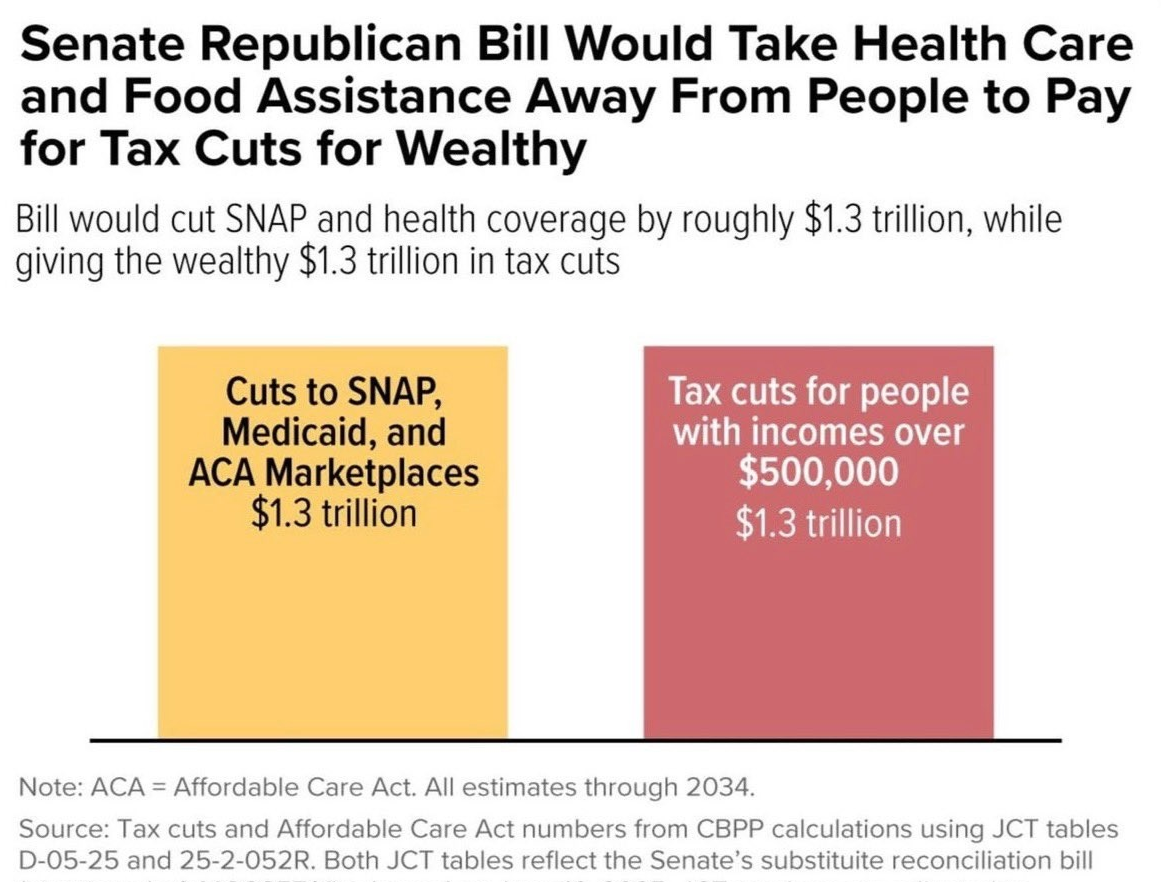
The Senate is done with its Vote-a-Rama session, and once again, the rich and powerful win out. With the chance to put the skids on some of the worst provisions in Trump’s “Big Ugly Bill,” They instead appeased the president once again and, in the process, lined their pockets. I will not go over every aspect of this bill, which amounted to a complete capitulation to an aging, vengeful, and heartless leader who, every day, makes a mockery of the office he holds.
There is no longer any doubt that Republican Senators and Congress members fear the wrath of Trump. If anyone doubted it. Sen. Lisa Murkowski spelled it out publicly last month when she said.
“We are all afraid. It’s quite a statement. But we are in a time and a place where I certainly have not been here before. I’ll tell you, I’m oftentimes very anxious myself about using my voice, because retaliation is real. And that’s not right.”
More on Ms. Murkowski later, but the following are some of the major components of the bill that demonstrate how little the Senate and MAGA nation as a whole care about 90% of the citizens of this country.
Senate Medicaid Cuts Run Deep
The Senate’s version of the reconciliation would cut $930 billion in the next decade from Medicaid, Medicare, and the Affordable Care Act. That would increase the number of uninsured people in the U.S. by 12 million in the next decade. The House version cuts $800 billion over that period, resulting in 11 million people becoming uninsured.
Both bills establish work requirements for the Medicaid program that provides health insurance for low-income and disabled Americans. They both require adults to work, volunteer, or study for at least 80 hours a month to qualify for the benefits without an exception. The House version of the bill includes work requirements for Medicaid enrollees without disabilities between the ages of 19 and 64, beginning no later than next year.
Both versions prohibit Medicaid funding that would cover gender transition services for children and adults, including surgeries and therapy. The Hyde Amendment already bans the use of federal funds for abortions, but both versions of the bill would halt payments to Planned Parenthood for other services, the House for 10 years, and the Senate for one. And finally, states must cover an individual’s Medicaid benefits three months before they sign up. Both bills reduce this to one month.
Draconian SNAP Cuts
The Supplemental Nutrition Assistance Program (SNAP) provides monthly payments to around 42 million Americans. Both bills would drastically cut federal spending on the program by forcing states to pay more of the costs for providing these benefits. They would also require more SNAP recipients to work before receiving their benefits. The non-partisan Congressional Budget Office (CBO) has determined that the work requirement alone could result in 3.2 million people losing access to food stamps.
And the number could go much higher depending on how much state governments reduce or eliminate benefits due to their own perilous financial situations. The Senate did reduce some of the requirements as they scurried for votes (Ms. Murkowski) this morning. Over the next decade, more than $68 billion will be cut from the SNAP program. Dottie Rosenbaum, a senior fellow from the Center on Budget and Policy Priorities, a left-leaning group, said this about the proposed cuts.
“These provisions are things that will cause some households to have smaller SNAP benefits in the future. It’s not a small number of households.”
The Deficit and Winners and Losers
Two days ago, the CBO estimated that the Senate reconciliation package would add nearly $3.3 trillion to U.S. budget deficits over the next 10 years. The House version would add an estimated $2.8 trillion during that period. Next time you hear from someone that Democrats are the tax-and-spend party. Don’t believe it.
And if this passes, here are the winners and losers according to NBC and Al-Jazeera.
Winners Include
- Corporations
- High-income households
- Border security advocates
- Fossil fuel companies
Losers Include
- Younger generations
- Healthcare workers
- Clean energy sector
- Lower-income Americans
Oh, and the biggest winner of all, Donald Trump and his continued iron-grip on the Republican Party.
