
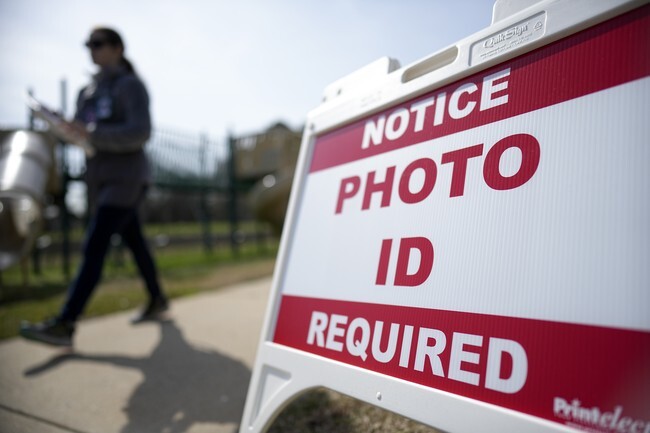
The U.S. Senate is debating President Trump’s Safeguard American Voter Eligibility Act (SAVE). It’s likely to fail due to strong Democratic opposition. Trump is pulling out all stops to get this bill over the top. This includes asking Senate Majority Leader John Thune (R-SD) to pull the plug on the Senate’s precious filibuster process. Thune is not in favor of setting this precedent, as I am sure the Senate Parliamentarian is not. Trump has threatened not to sign any other legislation till this arrives on his desk.
The SAVE Act is Trump’s latest gambit to hold off the blue wave expected in this year’s Midterm Elections. After his failed attempt to redistrict the GOP to victory, as well as his insane idea to nationalize local elections, this might be his last hope of stemming the Democratic tsunami that will result in the tying of his hands policy-wise and lead to impeachment threats. Let’s take a closer look at the SAVE Act, which, if enacted, could disenfranchise over 21 million voters.
When is an ID not an ID Under the SAVE Act?
MAGA Nation will attempt to convince you that everyone should be supportive of the SAVE Act because all voters should possess some kind of identification to avoid cases of fraudulent voting. The misnomers contained in that logic are many and varied. The first question to ask about the presumption is. What’s an acceptable form of identification, and what is not? “A driver’s license should work, correct?” Not if you have moved since the last election.
Instead, you would need a passport or a birth certificate. And in five states (Michigan, Minnesota, New York, Vermont, and Washington), even an up-to-date driver’s license won’t suffice. Under the SAVE Act, residents of all states would be required to possess a REAL ID that verifies their citizenship. “A military ID will be sufficient, correct?” Not by itself. Again, under the SAVE Act, you must also bring along your military “record of service,” which indicates that your birthplace was in the U.S.
Military discharge papers would also be invalid because they do not indicate the country of birth. “I think I have my birth certificate somewhere.” Not so fast. It must be a birth certificate issued by a local, state, or tribal government. Under the SAVE Act, you would not be able to use the certificate your doctor gave to your parents at your birth, because it hasn’t been certified.
Not to mention it takes time to acquire a new passport, birth certificate, or REAL ID license. And for most provisions of the SAVE Act, the government has not given voters a grace period to obtain these documents.
Other Outrageous Nuggets
Under the Act, a person could still register to vote online or by mail. Unfortunately, you would also have to go to an election office to prove your citizenship. This provision would cause a sharp reduction in voter registration drives. In a blow to recruiting younger voters, you could not use a school or college identification card as an acceptable photo ID.
The SAVE Act would also require states to take additional steps to remove illegal voters from the rolls for federal elections. To verify voters’ legal status, states are being encouraged to adopt a federal citizenship-verification procedure retooled last year by the White House, as well as other databases. However, some states have already conducted citizen checks that have falsely flagged votes as those of suspected noncitizens.
That means that currently registered voters whose citizenship status was called into question by a voter list review would have to prove their citizenship to remain on the rolls. The Act also levies severe penalties on election officials who, for instance, register a voter who does not present acceptable proof of citizenship.
In addition, individuals and groups under a provision of the SAVE Act could file civil lawsuits against election officials who register people without proper identification. And with the level of harassment that election workers face, this could exacerbate the already pronounced shortage of election officials.
Trump’s Additions to the SAVE Act
As is always the case, the president has complicated the process of approving the SAVE Act by adding three additional provisions to the legislation. The first one is the virtual elimination of most mail-in voting. Under his plan, people would only be able to vote absentee if they’re disabled, ill, serving in the military, or traveling.
This despite the fact that mail-in voting has proven to be one of the safest and most convenient ways to cast a ballot. In fact, Trump just submitted a mail-in ballot for yesterday’s Florida congressional primary.
Next, he wants to add verbiage that would forbid transgender athletes from participating on sports teams associated with their gender identity. And finally, he wants to add language that would add criminal provisions for doctors who provide gender-affirming care, including prescribing puberty blockers or hormones, to transgender youth. He calls it “transgender mutilation of our children.” These added provisions have made it even more unlikely that Thune can assemble the votes needed to pass the SAVE Act.
A Solution Looking for a Problem
Are U.S. elections full of rampant fraud? The answer is an emphatic NO! A Brennan Center for Justice study examined 23.5 million votes cast during the 2016 presidential election and found only 30 suspected incidents of potential noncitizen voting. After the 2020 election, the Associated Press contacted local election officials in six swing states. They found a total of 475 potential voter fraud cases, which is an extraordinarily small percentage of the more than 25 million ballots that were cast in those states
Even the right-wing Heritage Foundation found that fewer than 100 examples of noncitizens voting occurred between 2000 and 2025. The SAVE Act is just another example of Mr. Trump’s plan to disenfranchise as many voters as possible in the midterms in an attempt to retain his diminishing power base.
