
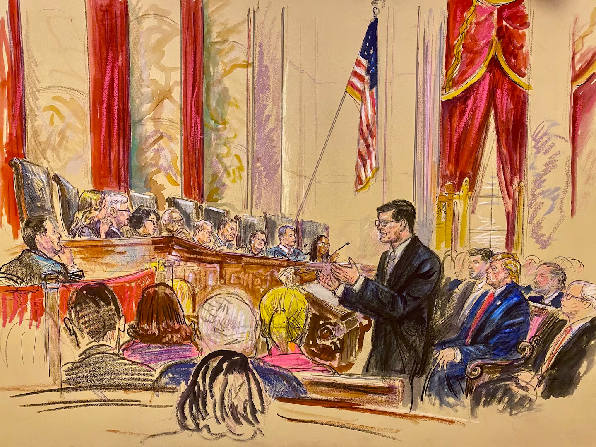
On Apr. 1, Supreme Court Justice Amy Coney Barrett addressed the issue of Donald Trump’s Birthright Citizenship order. The executive order raised a major red flag when the president endorsed it upon his return to the White House. From then on, he empowered and staffed up Immigration and Customs Enforcement (ICE) and reformed the Customs and Border Patrol (CBP).
Justice Barrett questioned Trump Solicitor General John Sauer’s justification, citing its confusing legal terms. She exclaimed, “How would it work? How would you adjudicate these cases? You’re not gonna know at the time of birth, for some people, whether they have an intent to stay or not, including US citizens.
What if you have someone who is living in Norway with their husband and family, but is still a US citizen, comes home and has her child here, and goes back? How do we know whether the child is a US citizen because the parent didn’t have the intent to stay?” Sources indicate that the hearing made President Trump the April Fool.
How the Trump Administration Defines American Citizenship
The Birthright Citizenship order, also known as “Protecting the Meaning and Value of American Citizenship”, was submitted on Jan. 20, 2025. According to the document, being an American is a privilege rather than a right. President Trump refers to the 14th Amendment, saying that the decision of Dred Scott v. Sandford is “The United States’ shameful decision.”
His administration believes that birthright citizenship never extended to foreigners and excluded that anyone born in the country should not immediately be given the privilege. The order gives conflicting circumstances of a parent or both who are not a permanent or legal US citizen can’t claim that their child was born legally. The exceptions are to provide a visa or their permanent residence, or to be present at the time of birth.
How Does Birthright Relate to the 14th Amendment?

Justice Barrett and the other judges drew Sauer’s attention to the 14th Amendment. It previously prevented Confederate-born African American slaves from receiving naturalized birthright citizenship in Union territories. Because Dred Scott was born in Virginia and was still a legally owned slave when moving to Missouri and Illinois during the 1830s, the Supreme Court ruled that he would not be granted freedom.
The 14th Amendment, ratified in 1898, included birthright citizenship. Chinese immigrant Wong Kim Ark argued that he should be granted citizenship because of his birthplace, San Francisco, California. The state joined the Union in the 1850s, and Kim Ark was born around 1870. The Justices ruled that he should be given his constitutional right because his parents were domiciled US residents.
The Supreme Court Resist to Further Probe into Anti-Immigration
Sauer tries to justify Trump’s anti-immigration order to go against what the Constitution states: “All persons born or naturalized in the United States, and subject to jurisdiction thereof, are citizens of the United States and of the State from where they reside.”
Despite having a policy stating that it requires documented proof, Section 2, Part A of the “Values of American Citizenship” does not match that policy. It requests that government departments and agencies refrain from searching for US documentation on the parents within and outside the country’s borders. Then Section 2 Part C says that a baby born in the United States will not be granted birthright citizenship after 30 days.
Trump also damaged his case when he used his assertive xenophobia in a Truth Social post: “Birthright Citizenship is not about the rich people from China, and the rest of the world, who want their children, and hundreds of thousands more, FOR PAY, to ridiculously become citizens of the United States. It’s about the BABIES OF SLAVES!”

Justice Barrett even shut down Sauer’s explanation as he tried to convince the Supreme Court to consider national allegiance as a factor. She argues that children should not be subjected to their parents’ social beliefs, for they cannot form ideals in infancy. Her peers, Justice John Roberts and Justice Ketanji Brown Jackson, also displayed their skepticism.
Justice Roberts responded, “The examples you give to support that strike me as very quirky. And then you expand it to a whole case to a whole case of illegal aliens, I’m not quite sure how you can get to that big group from such tiny, and sort of, idiosyncratic examples.”
Justice Brown Jackson further questioned Trump’s and Sauer’s logic on the determination process. He exclaimed, “How does this work? Are you suggesting that when a baby is born, people have to have documents, present documents? Is this happening in the delivery room? How are we determining when or whether a newborn child is a citizen of the US under your rule?”
Birthright Citizenship Case Shows An Orwellian Desire
Based on the hearing, it’s clear that the Trump administration wants to double down on immigration by enacting mass surveillance. The nation has watched ICE and the CBP crackdowns drive itself into a catastrophic state. That includes the president issuing illegal orders to illegally use the National Guard in the targeted Democratic states.
US citizens have been informed for the past year of how the government wants to implement surveillance, which has already cost US citizens their safety and privacy. And it appears this plan is already underway through the power of AI.
Last week, Massachusetts Senator Elizabeth Warren and the US Senate were actively investigating OpenAI after the Department of Defense agreed to use it. The Trump administration wants to justify it as a way to detect terrorists. For now, the fight to preserve birthright citizenship continues as protesters wait for the verdict in the summer.
