
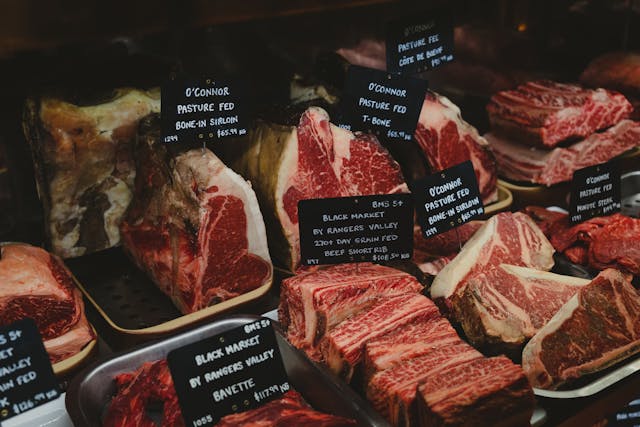
Many Americans have traditionally shared their love for what they consider their pride and joy: their devotion to beef. A few years later, their prized meat is becoming less affordable due to rapidly rising prices. The United States has recognized that its grocery expenses correlate with the ongoing conflict with Iran, driving the US’s soaring oil prices.
American farmers have found other factors contributing to the nation’s beef supply before the US-Israel alliance. The reasons behind the US’s shrinking cattle herds revolve around three issues: the rising cost of farmland development, the mass export of livestock feed, and the lack of awareness of climate change.
The Budget Cuts for US Agriculture
In 2024, 78% of American farmers who voted for Donald Trump’s second presidential term expected the US agriculture sector to receive more government funding. Instead, the 47th president focused on the AI industry, tariffs, boosting military power, dismantling DEI programs, and aggressive immigration policies.
His administration further betrayed the farmers’ trust when the Department of Agriculture cut Biden-supported food programs, including the Emergency Food Assistance Program. As of Feb. 2026, the American Farm Bureau Federation (FB) reported that the USDA has cut roughly about $25 billion USD from the workers’ net income. Economists Dr. Faith Parum and Daniel Munch projected that the loss would double, predicting $48 billion USD in 2026.
Ranching Operations for US Beef Have Grown Pricey
The farmers’ vote immediately took a turn for the worse when operational expenses rose. Cattle ranchers are struggling to maintain domestic beef distribution in the US due to the lack of funding. Louisiana State University Ag Center has gathered data over the past year to see what’s taking up a chunk of their pay grade.
While farm vehicles are the most expensive, land acres are the real drawback. Ranchers are offered $5,000 USD per 2 acres. They can purchase up to 100 acres, which is worth half a million US dollars. That’s enough to herd 100 cows and 4 bulls, but additional equipment and livestock feed are enough to push them towards bankruptcy. Operating a cattle ranch at that scale costs about $1.15 million USD.
Fencing and barns follow second on the list. Depending on the amount of land you would purchase for raising cattle, five strands of perimeter fencing cost $7,814 USD per one-third of a mile (1,689.6 feet). One barn can house up to 20 cows and one bull for $10,200 USD. Ranchers can choose to raise the cattle without one if they purchase 1 or 10 cows and a bull.

LSU’s research also highlights the volatility of cow investments. According to Town & Country Bank, fluctuating market prices can influence lenders and affect the farmer’s income. The best option for them to earn the most money is the 30-cow ranch, which costs $14,138.71 USD per cow.
The 10 and 100-cow ranches are the least profitable for two different reasons. The 100-herd takes a large spending cut for the fencing and land expenses, about $750,000 USD of the $1.15 million USD budget. The 10-herd has the same issue, costing $75,000 USD out of $111,637.00. Yet its investments are $326 less than the 100 herd.
The scaling of the operation affects how much the lenders will invest in the ranch’s profitability. Higher numbers offer lower investments per cow due to the spending risk. The smallest numbers suggest the ranch may not generate enough returns in a couple of months.
Trading Cattle Grains for Profit Instead of Feeding Them
While the US has the right to be frustrated by oil prices affecting the cost of beef, there is one factor they have not considered. Utah cattle breeder Brady Brackett explained that the government has not prioritized cattle reproduction, including sustaining livestock feeding grains.
Two of the main foods that are fed to most cows are corn and soybeans. They are affordable, provide necessary nutrients, can be easily maintained in various farming environments, and are renewable food sources. So, if the US has no problem producing these grains, why aren’t they going towards sustaining the beef supply?

The answer lies in the US’s trading history. For soybeans, China and Brazil are the leading buyers. Farm Doc Daily published their findings in the article called The United States, Brazil, and China Soybean Triangle: A 20-Year Analysis on Feb. 20, 2024.
Brazil previously used the grain as a food source, then took the opportunity to grow its own rather than solely relying on US exports. They soon surpassed their distributor in 2013 and shipped 3.74 million bushels in 2023. China saw the South American nation thriving with its production and invested 73% of its soybean purchases in its exports. The US still exports soybeans to China, even after President Trump imposed a 100% tariff on their goods.
Corn, on the other hand, is a leading US export to Mexico, South Korea, and Japan. Between 2024 and 2025, the US has supplied Mexico with 37.4 million of its product, including coarse grains. The country’s ranchers relied on US corn to sustain their livestock for meat consumption and dairy production during the drought season. South Korea and Japan have similar needs for their livestock. On April 17, 55.1 million bushels have been shipped to these three countries.
Climate Change Ignorance Resulted in Lack of Livestock Care
Since the 1970s, climate change activists have warned not just the US, but the whole world about the dangers of their demand for meat consumption. One of those activists is Frances Moore Lappé, a food researcher and author who predicted that the desire for profitability could harm the planet.
Due to social pressure, the National Cattlemen’s Beef Association sought to disprove that her vegetarian recipes were inedible. Over the past three and a half months, her book, Diet for a Small Planet, has captured the attention of millions of Americans.
Her daughter, Anne Lappé, followed in her mother’s footsteps and issued the same warning in 2020. The United States demand for beef and other meats was drawing attention to countries, such as Brazil, committing arson to the forests for farmland development. According to her Retro Report interview, she advised people to eat less meat, as 80% of agricultural land is used for livestock production.

She explained, “There are so many ways that industrial beef impacts our planet, from water use to the soil’s health to the loss of biodiversity. When we’re using so much land for just a couple of crops to feed livestock, you’re talking about the energy being used, the animal welfare implications. All this land, both for grazing and crops, to produce an animal that is giving us an inefficient return on our investments.”
The signs became more apparent when the Environmental Protection Agency (EPA) Administrator Lee Zeldin stated that we should not worry about climate change. The decision came sometime after the US removed itself from the Green New Deal. Unfortunately for him and the Trump administration, they themselves have contributed to the problem by building AI data centers.
Since their introduction in late 2022, more than 228 billion gallons of water have been absorbed by large-scale facilities, with 211 gallons used to generate electricity. The World Resources Institute has reported that the demand from hyperscalers has caused droughts in communities, especially those who work on farms.
The abnormal heatwaves also contribute to the droughts, forcing farmers to purchase livestock feed instead of growing their own. Global warming has become an increasing concern since 2025, when multiple natural disasters occurred. Wildfires broke out across the US, Europe, and Canada, destroying everything in their path. Until the Agriculture Department takes action, cattle ranchers are fighting to keep the beef alive.
