
Christopher Nolan has an almost immaculate track record. Everyone loves his movies, and everyone can make a convincing argument that their favorite of his is his best. He has a deep, rich filmography with incredible movies that connect to so many. He’s ridiculously popular and successful for a reason.
However, he is not perfect. No artist is. Everyone’s art has weak spots, and that includes Nolan’s. The biggest criticism over the years has been a perceived inability to write women. This is not exclusive to Nolan, as it’s something a lot of male artists struggle with, but it is something he’s been criticized for. Mileage with his movies may vary based on how much stock you put into the women in his films.
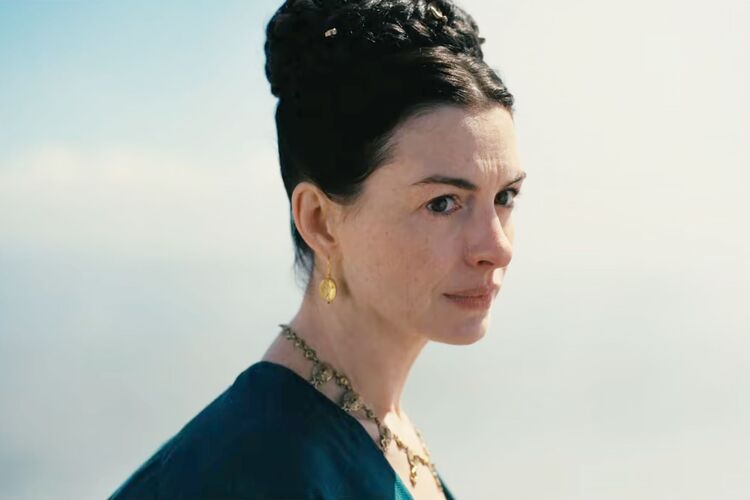
But if you ask Anne Hathaway (and if you read my review of The Odyssey), Nolan might actually deserve some credit for how he wrote the leading lady, Penelope, of Ithaca.
Anne Hathaway Says Christopher Nolan Improved Penelope in The Odyssey

For years, people have lamented the way female characters are written in Christopher Nolan movies. Criticisms center around the dead wife trope (present in Inception), a lack of real agency as strictly supporting roles (like in Oppenheimer and quite a few others), and characteristics that are strictly tied to the plot.
There are some choices that audiences have not appreciated. Mal in Inception is literally a projection of Dom Cobb’s guilt. Leonard’s wife in Memento dies brutally as a plot device to spur on the story (a movie version of the comic book trend, fridged). Kitty Oppenheimer is reduced to the frustrated but loyal wife on the sidelines.
Art is ultimately up for interpretation, and while not everyone shares these criticisms, they are present. And they’re not likely to die off with The Odyssey, even if Penelope has received praise for how she was written. In the book, Odysseus’ wife is quite one-note (as several characters are), and her only defining trait is that she misses her husband. Most of her actions involve simply crying over Odysseus.
This is true even in Emily Wilson’s translation. It’s something a friend of Anne Hathaway thought about the book until seeing how Nolan and Hathaway came together to help add character depth and layers to someone who didn’t have much of that in the source material.
“I always accepted the narrative about Penelope that focused on her likability, her goodness, her morality,” Hathaway said via Variety. “Chris created a character that’s not a denial of those things, but who is dealing with a constraining and challenging set of circumstances. This paragon of patience is staring at an uncertain future and wearing thin. The costs of playing the game are becoming clear.”
She continued, noting the story about her concerned friend, “She always felt like it was a war tale that blamed women for everything bad in the world. And she came out sobbing. She told me it was the first time she felt welcomed by the story. This version of ‘The Odyssey’ reached out its hand to her.”
Hathaway’s Penelope was much more layered, even if she was still largely reduced to a character who was waiting for her husband to return. Nolan changed a fair amount from the original poem, but veering off the beaten path too often could’ve backfired. Instead, he took what Homer had written and tweaked it to give Penelope more to do within that role and a much better characterization.
Not everyone will agree, but the actress who portrayed Penelope (and I) believe that Nolan might’ve finally shored up one of his biggest weak spots and improved on Homer’s original tale in a meaningful way here. He improved on a lot of other things in the original poem, too, but that was one thing that stood out.
