Elmer Lucille Allen is an example of why I am always impressed by my friends and close relatives who are in STEM or medicine-related careers. In our undergrad years at the University of Kentucky, I would shake my head at their heavy textbooks filled with equations I was sure nothing but a computer could solve.
As I watched my colleagues who are now engineers, scientists, and chemists breeze through their homework, I worked on editing their papers for their various literary arts classes (most of them required, not personally selected). The same sentiments I had towards their homework, their soon-to-be passions, they had towards mine. How I could be working on a 27-page paper was somewhat ridiculous, and to be even more accurate, “extra” to them.
“What do you even write for 27 pages?!”
Was the usual question posed by their analytical minds. Followed by laughter and the utmost respect for one another for our different talents. So, it’s even more amazing to me to have a person from my hometown who has the ability to combine the two talents. She has a legacy in the city of Louisville, the state of Kentucky, and her contributions to both.
Who is Elmer Lucille Allen
Elmer Lucille Allen will already be remembered as a groundbreaker in Louisville’s Black history. Today’s Spalding University was once Nazareth College, Kentucky’s first four-year Catholic College for women. It was there that Allen received her Bachelor of Science degree in Chemistry in 1953.
In 1966, she was hired as a chemist at the Brown Forman Worldwide Beverage Company. This made her the first Black chemist and 1 of only 3 women working in the lab at the company. After working there for 31 years, she retired as the Senior Analytical Chemist.

Elmer Lucille Allen’s interest in art started as a Girl Scout with the various art projects assigned within the program. She took her first art class in the 7th grade. Since then, Ms. Allen has received awards such as the 1986 Governor’s Award in the Arts (Kentucky), the 2011 Caritas Medal from Spalding University, and the 2015 Kentucky Museum of Art and Craft’s Art Advocacy Award.
In 2011, Allen’s work was included in the show Powering Creativity: Air, Fuel, Heat at the Carnegie Center for Art and History in New Albany. In 2016, she was part of the 2016 Women’s Artist Exhibition: The African Heritage Experience at the Kentucky Center for African American Heritage.
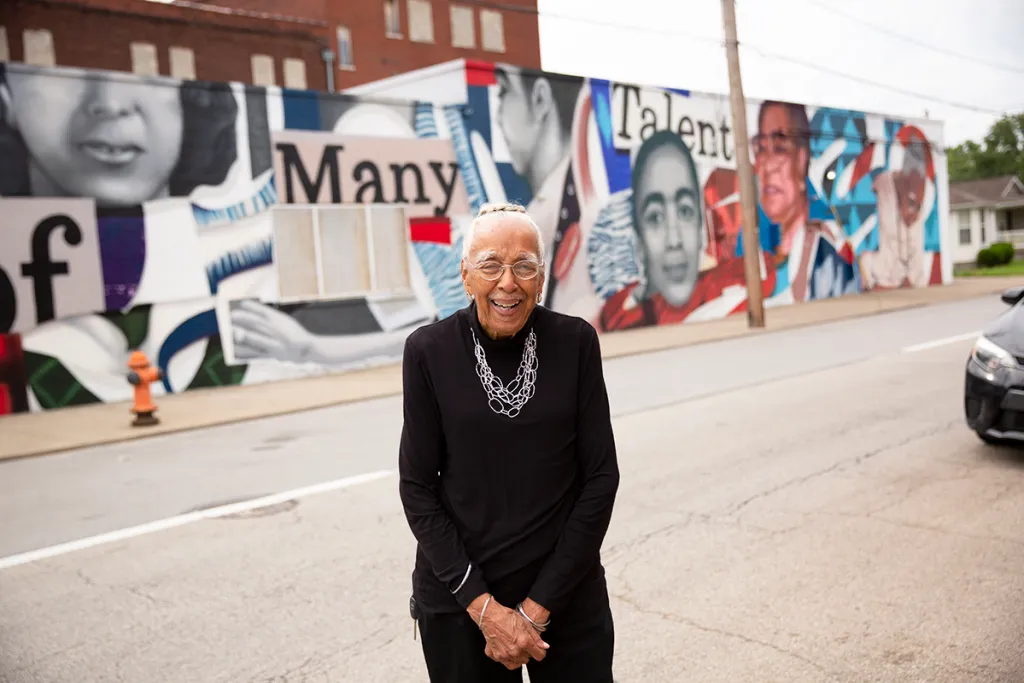
Through the Revitalization of Beecher Terrace project, Elmer Lucille Allen’s story will be a part of the Russell Community, her neighborhood, forever. An original mural featuring Ms. Allen has been painted on a wall in the heart of the West End of Louisville.
Highlighting the Greats of the Derby City
It’s important to me that my hometown is known for more than chicken, horses, and bourbon (though I do love all three of those things with every fiber of my being). Louisville is often left out of the conversation when it comes to incredible people and the incredible feats they’ve taken on and succeeded in. All while never forgetting the small/big town of Louisville that they come from.
Ms. Allen has generously offered her donations and ideas in the development of the Louisville Central Community Centers, Inc., a Black-owned non-profit in the West End of Louisville. In 2017, she was honored with the Lyman T. Johnson Award.
Named after another prominent figure in Black Louisville history, it is the non-profit’s highest honor. Elmer Lucille Allen is proof that history is born in the Russell neighborhood of Louisville, and that the southern city (and birthplace of Muhammad Ali) houses nothing but champions.
