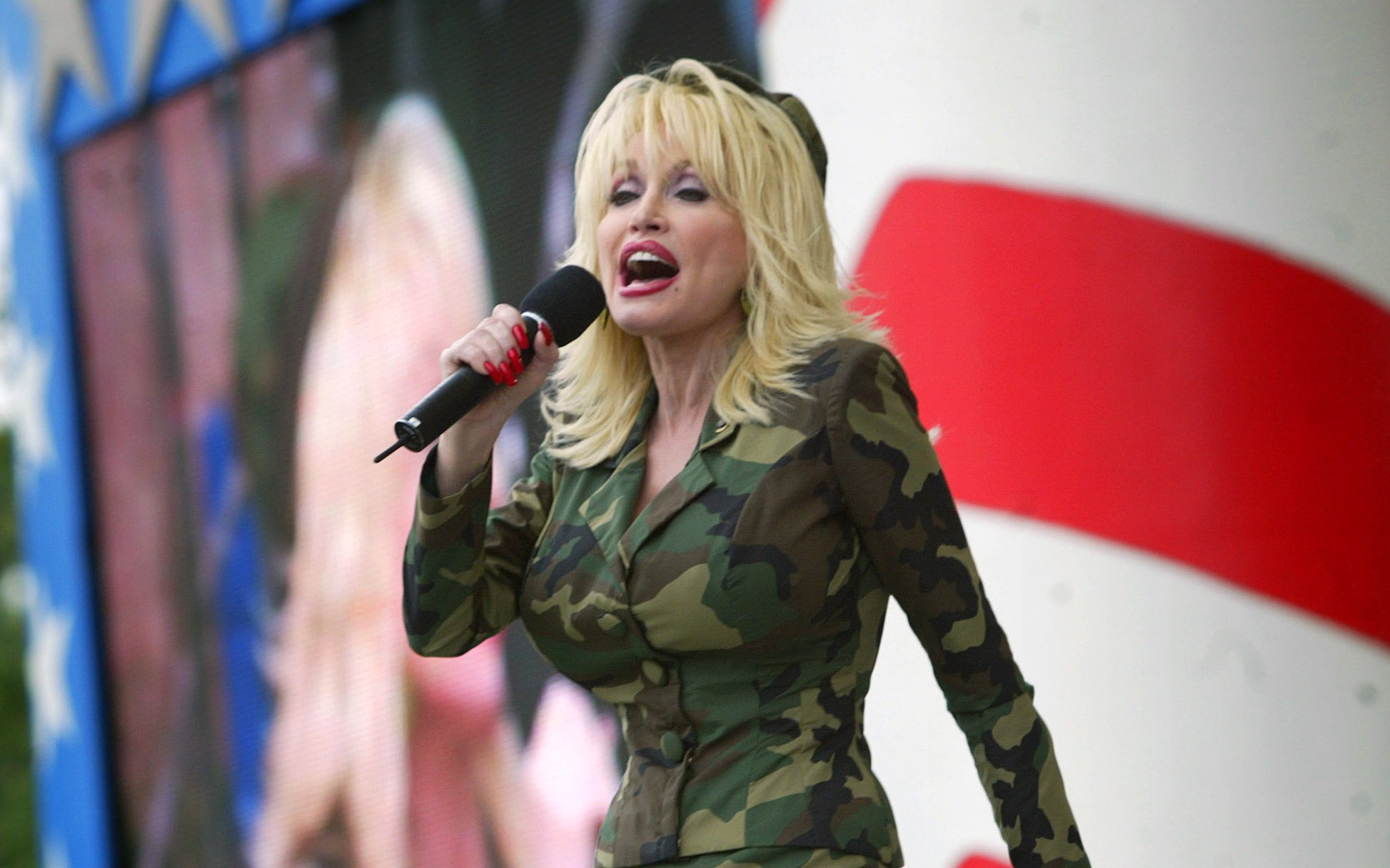
Dolly Parton, who rose from an impoverished Tennessee childhood to become a music icon, a celebrated actor, a savvy businesswoman, and a benevolent philanthropist, has passed away at the age of 80. Parton canceled a Las Vegas show in May due to kidney stones and was admitted to Vanderbilt University Medical Center with kidney and autoimmune issues four days ago. Her cause of death has not been announced.
During her 60+-year career, Dolly sold more than 100 million records and won numerous Grammy Awards, becoming one of the best-selling musicians of all time. And she took up acting, using her downhome personality to wow audiences in movies such as “9 to 5, and “Steel Magnolias.” She became a world-famous benefactor to several charitable causes. Parton also amassed a fortune estimated at $650 million built around her famous persona.
Dolly Parton’s Humble Beginning
Dolly Rebecca Parton was born on Jan. 19, 1946, the fourth of 12 children of Robert Lee and Avie Lee Parton in a one-room cabin on the banks of the Little Pigeon River in Sevier County, Tenn. Her father was a farmer and construction worker. Her mother was a homemaker who sang traditional Appalachian ballads and old Anglo-Celtic ballads around the house. Dolly learned to love music by listening to her mother. She started singing at church, wrote her first song at age 6, and debuted at the Grand Ole Opry at age 13.
After high school, Dolly moved to Nashville in 1964 and was hired first as a songwriter. A year later, she was signed as a performer, and three years after high school, Parton released her first record, “Hello, I’m Dolly.” Her career started to take off after she teamed with country singer Porter Wagoner, and in 1971, she had her first No 1 country song, “Joshua.”
Stardom
In 1974, Dolly released the song “Jolene,” her ode to a rival woman trying to steal her man. It became her first UK success, reaching No 7. Later that year, she recorded “I Will Always Love You,” which was written as a farewell to Wagoner and was a country No 1 in 1974 and again in a re-recorded version in 1982.
In 1977, Parton released her first self-produced album “New Harvest…First Harvest,” which was her first foray into the pop album charts. That same year, she released “Here You Come Again,” which was a Top 20 hit and her first million-selling LP. And the title track earned Dolly the first of her 11 Grammy awards.
Hollywood came calling in 1980 when Dolly made her film debut in “9 to 5.” This venture earned her two Golden Globe nominations for her acting and an Oscar nomination for the title song. Other movies would follow, such as “The Best Little Whorehouse in Texas” (1982), with Burt Reynolds; “Rhinestone“ (1984), with Sylvester Stallone; “Steel Magnolias” (1989), with Julia Roberts and Shirley MacLaine; and “Straight Talk” (1992), with James Woods.
But Dolly always returned to music, and in 1983 she recorded “Islands in the Stream,” a duet with Kenny Rogers, which topped the US pop charts. She would go on to have successful musical collaborations with Emmylou Harris and Linda Ronstad, (“Trio I & II”), and Tammy Wynette and Loretta Lynn (“Honky Talk Angels”). She also formed singing partnerships with a younger generation of artists such as Brad Paisley, Kesha, Nora Jones, Taylor Swift, and her goddaughter Miley Cyrus.
Business, Philanthropy, and Personal
Dolly was also a successful businesswoman. She founded Sandollar, the film and TV production company with former manager Sandy Gallin, which would produce hits such as Buffy the Vampire Slayer and the Father of the Bride film series. In 1986, she bought into the Silver Dollar City theme park in Tennessee and renamed it Dollywood. She doubled its size, adding a Dollywood-branded spa, a cabin complex, a theatre-restaurant, and a waterpark.
And in 1988, she created the Dollywood Foundation, which in 1995 initiated the Imagination Library project, which sends age-appropriate books to children around the world every month until they are five. She also set up a reserve to help preserve the bald eagle; coordinated relief efforts for those affected by the Smoky Mountain wildfires of 2016; and contributed to an HIV/Aids charity album.
She supported Black Lives Matter; opposed a North Carolina “bathroom bill” that restricted transgender people’s access to toilets; donated generously to the Vanderbilt University Medical Center in Nashville, Tennessee, where her niece was treated for leukaemia. As part of this set of contributions, in 2020, she donated $1 million for research into COVID-19, which formed the basis for the eventual Moderna vaccine.
In 1966, Dolly married Carl Dean, an asphalt contractor who stayed out of the spotlight. They lived a happy life together until Mr. Dean passed away in 2025 at the age of 82. They had no children.
Dolly is survived by six of her siblings: Willadeene Parton, Robert Lee Parton Jr., Stella Parton, Cassie Parton, Freida Parton, and Rachel Ann Parton George.
RIP Dolly!
