
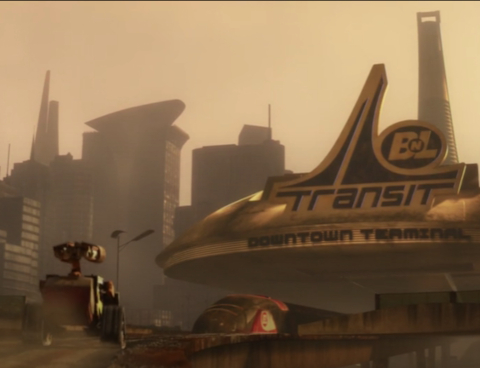
“You’ll own nothing and be happy.” These are the words of Danish politician and Folketing member, Ida Auken. Her hypothesis startled the 2016 World Economic Forum, when she predicted that businesses would seek to strip consumers of ownership rights by 2030. Within a decade, Auken’s phrase is used around social media as the world witnessed the disturbing growth of capitalism’s reliance on price gouging, cloud services, artificial intelligence, and rapid production.
But what if I told you that Pixar foresaw this future eight years before her? In 2008, the film Wall-E depicted how capitalism can negatively affect government decisions on a global scale. The Oscar-winning animated feature presented the idea through the fictional corporate monopoly Buy-N-Large.
Buy-N-Large’s Timeline in Wall-E
Wall-E director Andrew Stanton gave the audience an official timeline of how Buy-N-Large became an international corporate entity in the film’s DVD commentary. He stated that it was once two separate companies: Buy Yogurt, a small frozen yogurt shop, and Large Industries, a men’s suit retailer. Large Industries purchased Buy Yogurt during the 1960s and later adopted early AI.
According to Stanton, Buy-N-Large cooperated with The Incredibles’ supervillain, Buddy Pine, an engineering prodigy who later grew up to become Syndrome. The superhero film’s intro took place during World War II (1939-1945), and director Brad Bird confirmed that the majority of the plot takes place in the fictional futuristic 1960s. The corporation manufactured multiple machines and led numerous industries up to 2057. Not even Buzz’s batteries and the Cars timeline can escape BnL’s grasp.
Eventually, Buy-N-Large became a global conglomerate with 2 million subsidiaries, including government bodies. In 2105. CEO Shelby Forthright became President of the United States and later Earth’s corporate leader when consumer products filled landfills with mountains of waste. To them, the trash was unrecyclable.
He and his BnL board of directors initiated Operation Cleanup for 2110, assembling the Waste Allocation Load Lifter-Earth Class (WALL-E) bots. They also prepared the luxury space cruiser, the Axiom, designed to hold 200 billion humans.
Before launching, Forthright prepared two separate videos: one for the Axiom captains and the other for A113, the autopilot AI. The captains received their video if there is physical proof that plant life becomes sustainable again.
Originally, Operation Cleanup was supposed to finish by 2115, and Captain McBrea states this in a late-morning announcement in Wall-E. “Oh, would you look at that!” he exclaimed live. “It’s been 700 years since the Axiom launched for its five-year cruise.” They are left with an operation manual to activate the Axiom’s warp drive and return to Earth.
Unfortunately for the humans, the Buy-N-Large CEO and the corporation saw that it was not worth the hassle. Instead, they sent an emergency confidential video to A113, canceling Operation Recolonize, and granted it all-access permission to keep the Axiom in space. Forthright explained to A113 that the air is so polluted that it’s impossible to breathe. And for 705 years, Wall-E and the rest of the units compacted unrecyclable trash. The majority of the film takes place in 2805.
The Axiom is a Consumer Trap
Rewatching Wall-E is very mind-blowing, given what it predicted about the far future. Its most evil scheme does not come from A113 itself, but rather what the Axiom represented. Back in 2025, I discussed Knights of Guinevere’s Park Planet being an allegory for Disney’s failed utopia, EPCOT. Buy-N-Large’s luxury space cruiser shares the same characteristics as a consumer trap.
The audience witnessed the mega corporation heavily advertising its products in the abandoned city and in the Axiom’s interior. Like Walt Disney, Forthright saw an opportunity to build loyal customers for life rather than address greenhouse gases and climate change. Wall-E does not hide this fact either, as A113 showed Captain McBrea the classified video.
The disheveled CEO commanded the AI, “Rather than fixing the problem, it’ll be easier for everyone to stay in space.” Thanks to the captain’s quick thinking, the ship’s log traced the message back to 2110, the same year the Axiom departed from Earth.

Earth’s population over-relied on Buy-N-Large products to survive during the space cruiser’s 705-year journey. This included the single-use robots that kept it operating. The hover lounge chairs evolved into human’s mobility and communication vehicles. It affected their ability to be active and have proper face-to-face interactions. There were rarely any social gatherings because people quickly grew bored with the provided extracurricular activities.
What’s disturbing about Wall-E’s fictional capitalistic dystopia is that Earth’s future generations got brainwashed while living life in the Axiom. There’s a scene where Wall-E boards a transit terminal towards the Captain’s Quarters. Our favorite trash compactor saw the All-Day Daycare, where the Nanny bots are educating the toddlers.
They teach them the alphabet using Buy-N-Large’s products and their signature logo. “B is for Buy-N-Large. You’re very best friend.” All of the Axiom’s robots are not evil; it’s how their AI is programmed to market the corporation as trustworthy.
How Wall-E Predicted Ida Auken’s Famous Phrase
The 2008 Pixar film has been the most consistent at predicting the ever-evolving strategies of the business industry. Currently, the United States’ economy is in crisis due to Donald Trump’s second presidential term. He, his administration, and US business leaders throughout 2025 made reckless decisions to increase revenue at the expense of personal interests.
He halted DEI programs, threatened other nations with tariffs, sought to regulate cryptocurrency in US legislation, advocated for the US to be the world’s leading AI power, and wants to acquire more land for prized resources.
Wall-E’s Axiom accurately depicts Ida Auken’s unsettling phrase, “You’ll own nothing and be happy.” You may have heard those words from tech influencers recently. This is because industry leaders are actively relying on selling digital goods, such as streaming subscriptions, AI programs, and cloud gaming, at the expense of people’s privacy and by inducing higher spending.
The latest fervor came from Amazon founder Jeff Bezos, who predicted that advances in artificial intelligence would force people to give up owning a computer by 2024. With the ongoing Memory Crisis that skyrocketed RAM and GPUs, he suggested that people rent cloud data. Bezos received brutal backlash in the past week for the method, which would only sink buyers into debt over time.
And it’s not just the tech industry, it’s everywhere. Housing and vehicle ownership are expected to take the hardest hits in 2026. Gen Zer’s reported back in March that their incomes don’t meet the demands of housing and mortgage prices. The National Mortgage Professional found that only 26.1% of Gen Zer’s could afford a house in 2024, compared with 54.9% of Millennials. As for cars, it’s the insurance premiums that buyers are most worried about. Bankrate saw an average annual cost rise to $2,697 during 2025.
Buy-N-Large Envisions the US Losing Its Superpower
Buy-N-Large’s history also reflected what is happening now with the United States, as it follows Trump’s One Big Beautiful Bill Act (OBBBA). Wall-E presented the corporate monopoly as American, designing the press room after the White House and an instrumental jingle that resembles “Hail to the Chief.”
Their signature logo is always in red, white, and blue, just like the nation’s flag. Based on Stanton’s commentary, BnL sought to conquer and control global supply chains. Their business strategy resulted in meeting demands with mass production while collecting subsidies to stay in operation.
The US is committing similar actions by threatening military action, imposing tariffs, and negotiating questionable deals. The Trump administration believed that OBBBA would increase spending to reduce the national debt. Instead, it added to costs, causing inflation to rise nationwide. Former US President Joe Biden raised it to $36 trillion, intending to allocate half of the $4.7 trillion to the American Rescue Plan in 2024. Under OBBBA, that ceiling has risen to over $38 trillion.

Wall-E portrayed the downfall of global capitalism with Buy-N-Large’s name scattered on their products that were left to decay. Buy-N-Large came to an end when the Axiom returned to Earth in 2805, but what about the US? Capitalism won’t be going away, but the film did predict another possibility for the nation’s status as a superpower four years earlier.
In 2012, the National Intelligence Council collected responses for Global Trends 2030. The most popular prediction was that the US would no longer be seen as the world’s leading nation. Many believed that China would surpass them based on its population, military spending, and technological investments.
China is expected to have the largest economy by then. That may soon become a reality as the nation becomes more self-sufficient in technology by analyzing and working with cheaper computer parts. And with the US in deeper debt, their Wall-E future may come faster than expected,
