
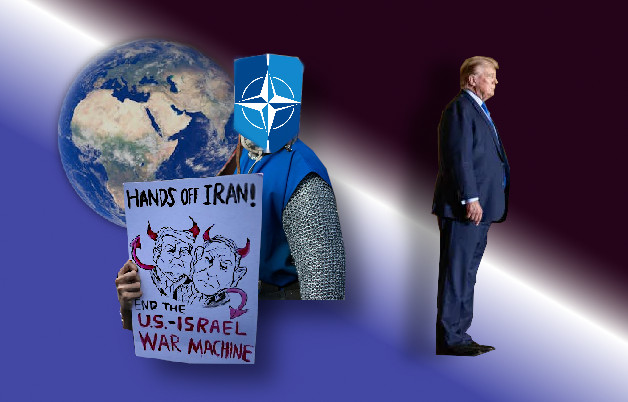
The Middle East is revolting against Donald Trump and Benjamin Netanyahu’s unnecessary war against Iran as it continues into the week of Easter. When his allies refused to help him seize the Strait of Hormuz, the US president threatened to withdraw from NATO. Then, he prods Iran to open the valuable oil trade route in 48 hours or “all Hell will reign down upon them.” And he ends his declaration with, “Glory be to God!”
Al Jazeera discussed with political scientist John Mearsheimer about the US and Israel’s strategy to make a “safer, more stable Middle East.” He responded, “The greatest threat to stability in the Middle East is the United States working closely together with Israel. […] We are going to crash the international economy as a result of this war.“
Why Did NATO Decline to Enter the US-Iran War?
The North Atlantic Treaty Organization (NATO) was formed to help allied nations collectively face world-level threats involving a threat to one of its members. The US-Iran War is an exception because Trump chose not to consult with the organization’s members.
He coordinated a missile strike at Israel in conjunction with Israeli Prime Minister Benjamin Netanyahu. When the attack occurred on Feb. 28, observers noted that it occurred 8 days after the Supreme Court deemed Trump’s tariffs illegal for violating IEEPA’s terms.
The United States saw it as an act of retaliation against anyone who refused to accept his authority. February 2026 also brought pivotal discoveries in the Epstein Files investigation. When the third batch of documents was released, numerous powerful figures were identified, including LA’28 Olympic Chief Casey Wasserman, SpaceX and xAI CEO Elon Musk, and former Prince Andrew Mountbatten-Windsor.
NATO and the rest of the world could not be fooled by Trump’s declaration of war against Iran, as it is a distraction by the United States president to take the spotlight off his connections to Jeffrey Epstein. Officials in his administration, including ex-attorney general Pam Bondi and FBI director Kash Patel, have repeatedly protected him under oath. The documents released had his name redacted over 38,000 times.
NATO and Non-Members Are Halting Support to Weaken Israel
While NATO and the rest of the world watch the US president desperately crying for the Strait of Hormuz for oil, what’s in it for Netanyahu? The Israeli prime minister seeks to neutralize Iran’s energy supply to prevent Iran from attacking its shipments and weakening its army. So far, the Israeli military has struck one of Iran’s largest natural gas fields, South Pars, and may start bombing Iran’s power plants with the US.
European NATO allies and non-members have carefully observed the Iran-Israel Conflict, aware that all the participating parties are using fuel to strengthen their firepower. A few countries later restricted access to US-associated bases and supply demands when Trump provided the US Air Force and the Navy to Netanyahu.
On Mar. 31, Al Jazeera reported that Spain has restricted the United States use of Naval Station Rota and Moron Air Base. Non-NATO member Switzerland, which has previously provided US military supplies, suspended its operations. The European nation stated that they won’t contribute their weapons until the war ceases. France followed their resistance strategies.
The Middle East Wants the War to End, Including Israelis

The world continues to protest against the US-Iran War, and surprisingly, some Israelis are joining the cause. According to MeidasTouch, millions of protestors in Baghdad are pleading with the ruling Shiite clerics, urging Iraq to support Iran. Ben Meiselas also presented that Syria, Yemen, and even Israel’s capital, Tel Aviv, courageously oppose the US-Israel alliance.
While Trump and Netanyahu believed their deeds were heroic, the protestors’ voices rang their message loud and clear. Disgusted by the demonstrators, Israeli law enforcement was given an arrest order. The video showed officers using buses in hopes of mass detainment and aggressively shoving the captured to breakup parts of the opposing crowd.
Iran’s Executions May Entail Future Conflict

Due to the Feb. 28 attack, Iran’s Supreme Court has been undergoing executions. Recently, two men who were discovered as part of the People’s Mojahedin Organization of Iran (PMOI/MEK), a banned opposition group. They were once Islamic supporters in 1979, then were labeled as “terrorists” after Tehran changed leadership in the 1980s.
The Iranian judiciary said, “Azbollah Montazer and Vahid Baniamerian were hanged after the trial, and their sentences were upheld by the Supreme Court.” The two men received the death sentence for multiple armed terrorist acts on Apr. 4. Four other members convicted back in 2024 were also executed for similar reasons on Mar. 31.
Despite national support during the US-Iran War, the country does not have universal approval for suppressing opposition. Human rights groups have described Iran’s executions as “cruel”. A prisoner will experience psychological torture, mock hangings, starvation, and interrogations. The process may take months before the prisoner is forced to confess.
The Guardian has confirmed 145 executions have been committed in Iran. Included in the list of victims in the past three months was 19-year-old wrestler Saleh Mohammdei. One dual national, Swedish-Iranian Kourosh Keyvani, was identified as an Israeli spy and was hanged. Iran’s internet shutdown makes it more difficult for journalists to find accurate information. Non-NATO countries in the Middle East may need to investigate the Iranian Supreme Court in the future.
