
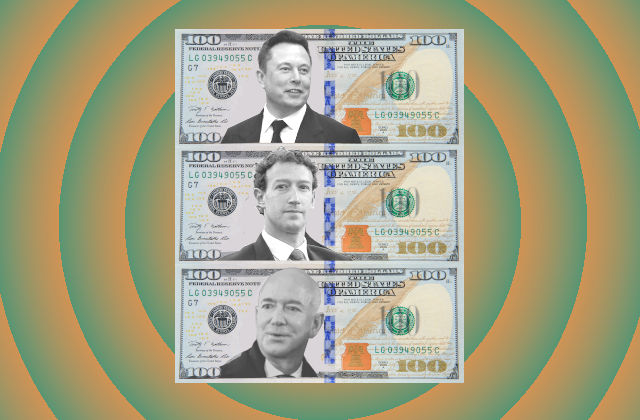
Vermont Senator Bernie Sanders has warned that the United States has been on the brink of becoming an oligarchy over the past year and a half. He and his supporting House members learned that US President Donald Trump assembled tech billionaires to prioritize AI industrialization.
Out of the thirteen lobbyists, SpaceX’s Elon Musk, Meta’s Mark Zuckerberg, and Amazon’s Jeffrey Bezos were named the richest. Their wealth has contributed to LLM development, AI automation and integration, and hyperscaling data centers. Despite exceeding their investors’ 2025 expectations, their actions to support the administration have stirred the US economy and politics.
What Made the US an Oligarchy?
The World Population Review describes oligarchy as a government controlled by a small group of people with similar interests. Many of them involve wealthy individuals who use their finances to control the government body.
In his December 2024 public address, Bernie Sanders highlighted the signs, weeks before Donald Trump’s 2025 inauguration. “In 2024, just 150 billionaires spent nearly $2 billion to purchase candidates,” Rolling Stone journalist Peter Wade transcribed. “Now Trump is rewarding those who gave to his campaign with top roles in the federal government. Those chosen by him to serve in his administration have a combined wealth of at least $383 billion – a number higher than the GDP of 172 nations.“
Connecticut Senator Chris Murphy added, “What it means is that a handful of really rich people run the government, and they steal from ordinary people using their access to the government in order to make themselves and their families richer.”
The nation has watched the 47th president and his supporting billionaires disrupt the US economy with funding bailouts, government spending cuts, and advertising, or whatever they believed would fill the American pocket. Musk, Zuckerberg, and Bezos are considered the most powerful people among the rich elites. They each possess high-value assets that drastically shifted US democracy to oligarchy.
Jeff Bezos: The Amazon Jungle

Bezos revolutionized online shopping with Amazon after giving up a highly paid position on Wall Street. Before the dot-com boom began in the mid-1990s, books became his magnum opus for webstore formatting. Along with the convenience, shoppers could read reviews before purchasing and could buy items regardless of location. The marketplace grew into a global marketplace that sells almost anything a consumer is looking for.
Amazon soon offered its subscription service, Prime, for faster delivery, while Prime Student offers discounted textbooks and dorm necessities. Bezos also invested in the entertainment industry by introducing Prime Video (formerly Amazon Unbox) as an online movie rental that later evolved into a streaming service in 2014.
But Bezos’ leadership influenced the American oligarchy, beginning with the acquisition of The Washington Post. In 2013, the Amazon founder purchased the reputable watchdog from the Graham family for $250 million. Many of its readers feared that a tech billionaire would compromise journalistic integrity. According to sources, his leadership broadened the Post’s digital reading content and preserved the unbiased opinions. The move prevented the news outlet from declining further.
That was until Donald Trump won the 2024 Presidential Election. Bezos’ attitude changed significantly when he joined the billionaire league. On Oct. 10, 2025, Washington Post columnist and Fox News contributor Marc Thiessen expressed and confirmed that the once-protected freedom of the press became conservative. His Trump Nobel Peace Prize report indicated MAGA behavior, congratulating the “Prince of Peace” publicly. The president responded on social media, “Thank you, Washington Post. Wow!!!”
New York Times journalists Johnathan Swan and Maggie Haberman wrote about the transformation of US journalism under the second Trump administration. Their latest book, Regime Change: Inside the Imperial Presidency of Donald Trump, highlighted a December 2024 dinner conversation between the president and Jeff Bezos.
Readers and Washington Post journalists were disgusted by the Amazon founder’s regret about his purchase of the newspaper. He complained, “The people there are terrible. They don’t listen. My other companies, they listen.” Bezo’s commentary addressed the Washington Post layoffs from Feb. 4, 2026. He laid off 300 workers from chosen departments, including the foreign bureaus.
Another unfortunate contribution Bezos made was producing Melania Trump’s docuseries. The film’s production company was MGM Studios, which Amazon acquired for $8.5 billion in 2021. After her husband prepared for his second term, Bezos was reported to have donated $1 million to Trump’s inaugural fund. Melania was purchased by MGM Studios for $40 million, and $35 million was spent on its marketing.
Democratic lawmakers were questioning whether Bezos was offering bribes to please the president. A letter was later sent to Amazon CEO Andy Jassy on Mar. 15, 2026. It reads, “The fact that Amazon is seeking favorable treatment from the Trump administration while paying a far-above-market sum to produce and promote the Trump family’s film raises questions about Amazon’s exposure under federal anti–bribery laws.
When corporate giants…transfer tens of millions of dollars to the family of the sitting President, that not only raises questions about corporate governance, but also risks eroding public trust in the fairness of our economic and political system.”
And the letter’s statement has remained true for Bezos’ recent endeavors. Now managing his space venture, Blue Point, and his AI startup, Prometheus, his narrative aimed at helping the American people is on shaky ground. He’s currently on a mission to propose zero income tax. This would help lower-income workers avoid paying higher federal dues and provide immediate relief to cover necessities.
Bezos does acknowledge that the problem is the Trump administration’s overspending, but not many consumers are convinced that he has changed since joining the tech oligarchy. He is still devoted to integrating AI for Amazon and has supported the rental ideology rather than the consumer’s right to goods ownership. He denied that he loves the idea in a May 2026 interview when he predicted that computers would have subscription services and gamers would play on a shared cloud in 2024.
Mark Zuckerberg: The Facebook Meta-morphosis

Zuckerberg dominated the internet in 2004 with his college experiment, Facebook. What was originally a social hub for college students evolved into a worldwide social network for everyone. But Zuckerberg struck gold when he discovered that a majority of the platform’s success came from business marketing.
When he introduced Social Ads in 2007, Facebook gradually attracted 100,000 users. Within 4 years, 1 million users utilized the platform for marketing alone. Businesses, both corporations and small sellers, generated a total of $3.15 billion in ad revenue.
Companies immediately researched and developed the landing page strategy to earn pay-per-click due to its success rate. Zuckerberg would smash records again when he added news feed adverts. From 2012 to 2020, Facebook earned $86 billion. Today, the platform is in an identity crisis with Meta.
Meta was once Facebook’s VR platform. Zuckerberg integrated it into the gaming sector in 2021 to encourage users to socialize and interact in fictional environments, or metaverses. The incentive was to lure customers to purchase The Quest headset so they would visit them. He reused the name for AI development after OpenAI achieved exponential gains with its text-generating AI software, ChatGPT.
Zuckerberg hired former ChatGPT programmer Shengjia Zhao, OpenAI of Zurich Xiaohua Zhai, and his chief AI officer Alexandr Wang for Meta’s next venture, Superintelligence Labs, in February 2025. He exchanged $14.3 billion for Scala AI’s cooperation as he chased after Sam Altman’s success. Altman described Zuckerberg’s team assembly as “crazy.”
Despite being the second richest man on Earth, Zuckerberg is considered the weakest link in the AI oligarchy. He was once a Trump critic during his first presidential run, as he was known to spread misinformation to smear his opponents. Zuckerberg went through a series of apologies, saying, “The bottom line is: we take misinformation seriously.”
The Facebook Meta CEO’s tone towards the returning president shifted after being invited to meet him in 2019. The meeting involved lawmakers discussing how to improve US internet regulation. According to Business Insider, Trump and Zuckerberg’s friendship blossomed over time.
Socialists believed that the president’s threat to ban Facebook and halt its operations became the pivotal point. “Perhaps I should have done it while I was President,” he commented on Truth Social in 2021, “but Zuckerberg kept calling and coming to the White House for dinner, telling me how great I was.” Facebook and its TikTok cousin, Instagram, were terrified by the founder’s decision to unrevoke his accounts in 2023.
Elon Musk: The Dogefather of SpaceX

The now-trillionaire Musk is the most valued in the oligarchy but has the messiest relationship with Trump. Because he donated an estimated $300 million to Mr. Trump’s 2024 presidential campaign, Musk was appointed special head of the Department of Government Efficiency (DOGE). He aided the president in either ceasing federal funding for certain programs or retiring selected sectors of the US government.
He soon became very displeased with his position after DOGE employees accessed and stole sensitive information from the US Treasury database. Many of the secured documents came from the Health and Human Services Department.
Another reason concerns the One Big Beautiful Bill Act (OBBBA) drafts, opposing the elimination of the green energy tax credit. Housing that relies on solar and wind energy and electric vehicle owners were gravely impacted. Considering Musk owns Tesla, it’s no wonder he called it a “pork-filled, disgusting abomination.”
Facilities that run on fossil fuels and AI data centers that consume water are exceptions, as both benefit the Trump administration. Musk delivered one final punch by alerting the world to the redactions the administration made on the Epstein Files in March 2025. DOGE continued to operate and boasted of having eliminated 30,000 federal awards and lease programs.
The political breakup would slowly recover during Musk’s preparation for the xAI merger with SpaceX. Both he and Trump met again at the memorial service for Turning Point USA founder Charlie Kirk in September 2025. The president cemented the end of their feud by awarding Musk a $4.16 billion contract with the US Space Force to support SpaceX’s satellite mission. He promised and expects the company’s IPO will reach a market value of $1.75 trillion.
The Oligarchy May Crumble Soon
SpaceX, Facebook Meta, and Amazon are showing signs that the tech oligarchy is going to collapse soon. For almost two months, these companies have experienced employee exits and layoffs.
Back in May, SpaceX lost over 50 engineers and researchers, including all 11 xAI co-founders. Reports say that employees were transferring to other AI firms for work. Some who transferred to Meta later experienced job cuts in June. Around 8,000 employees were dismissed, with 4,665 people from their main headquarters in California and Washington.
And Amazon laid off 30,000 workers in April in an attempt to suppress any rebellion against data center construction. It struggles to shut down the voices of three employees from the Amazon Employees for Climate Justice (AECJ). They have filed a civil rights case against the company for violating Seattle’s discrimination laws. The move is a reflection of OpenAI’s journalist subpoenas.
Professional platform Blind reported that tech workers are ranting about the end of meritocracy. More people are less motivated to search for jobs since Big Tech began bidding on AI following the mass tech exodus of 2022. One user posted, “What’s the point of getting a good performance review if you can still be laid off anyway?”
Blind founder Sunguk Moon eerily commented, “The whole mood changed. It went from personal career planning to mass anxiety.”
